
Weekend Sale Limited Time 70% Discount Offer - Ends in 0d 00h 00m 00s - Coupon code: merry71

Free OMG-Certified UML Professional Advanced Exam Practice Questions

Exams4sure Dumps

Exam style questions across every OMG-OCUP-300 domain

Last Update 3 days ago
Total Questions : 10

Start with our free OMG-OCUP-300 practice questions, carefully crafted to mirror the domains, phrasing, and difficulty of the real OMG Certification exam. Each OMG-OCUP-300 exam question comes with a detailed rationale that explains not just which answer is correct but why the others fall short. That's how concepts stick. Use the free set to benchmark yourself: identify your OMG weak domains, see where you're losing marks, and build a focused study plan in minutes.

OMG-OCUP-300 PDF

OMG-OCUP-300 PDF (Printable)
$46.5
$154.99

OMG-OCUP-300 Testing Engine

OMG-OCUP-300 PDF (Printable)
$51
$169.99

OMG-OCUP-300 PDF + Testing Engine

OMG-OCUP-300 PDF (Printable)
$63.9
$212.99
Question # 1

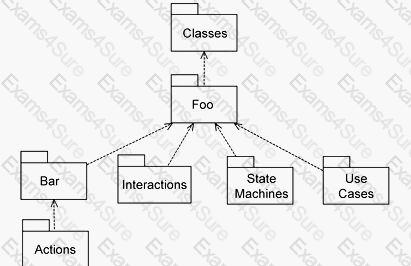
The exhibit depicts the UML superstructure packages for behavioral models. What is the correct identity for packages Foo and Bar?
Question # 1

Options:

A.  

Foo = CoreBehavior; Bar = Communications

B.  

Foo = Activities; Bar = Collaborations

C.  

Foo = Collaborations; Bar = Sequences

D.  

Foo = CommonBehaviors; Bar = Activities

E.  

Foo = Collaborations; Bar = Activities

Discussion 0
Question # 2

What are the underlying semantics of the association between Port and ProtocolStateMachine?

Options:

A.  

The port must have a provided interface whose protocol is specified by the protocol state machine.

B.  

The protocol state machine defines the sequencing constraints on the communications across a port.

C.  

The port must have a required interface whose protocol is specified by the protocol state machine.

D.  

The class of the object that has the port has to have a behavior that is defined by the protocol state machine.

Discussion 0
Question # 3

How can UML be extended? (Choose two)

Options:

A.  

using Interface Definition Library (IDL)

B.  

using the Object Constraint Language (OCL)

C.  

using XML Metadata Interchange (XMI)

D.  

using profiles

E.  

reusing part of the UML infrastructure library and augmenting it with metaclasses and relationships

Discussion 0

Free Exams Sample Questions

