Weekend Sale Limited Time 65% Discount Offer - Ends in 0d 00h 00m 00s - Coupon code: 65pass65

200-301 Implementing and Administering Cisco Solutions (200-301 CCNA) v1.1 is now Stable and With Pass Result | Test Your Knowledge for Free

Exams4sure Dumps

200-301 Practice Questions

Implementing and Administering Cisco Solutions (200-301 CCNA) v1.1

Last Update 3 days ago
Total Questions : 1242

Dive into our fully updated and stable 200-301 practice test platform, featuring all the latest CCNA exam questions added this week. Our preparation tool is more than just a Cisco study aid; it's a strategic advantage.

Our free CCNA practice questions crafted to reflect the domains and difficulty of the actual exam. The detailed rationales explain the 'why' behind each answer, reinforcing key concepts about 200-301. Use this test to pinpoint which areas you need to focus your study on.

200-301 PDF

200-301 PDF (Printable)
$54.25
$154.99

200-301 Testing Engine

200-301 PDF (Printable)
$59.5
$169.99

200-301 PDF + Testing Engine

200-301 PDF (Printable)
$74.55
$212.99
Question # 1

When configuring IPv6 on an interface, which two IPv6 multicast groups are joined? (Choose two)

Options:

A.  

2000::/3

B.  

2002::5

C.  

FC00::/7

D.  

FF02::1

E.  

FF02::2

Discussion 0
Question # 2

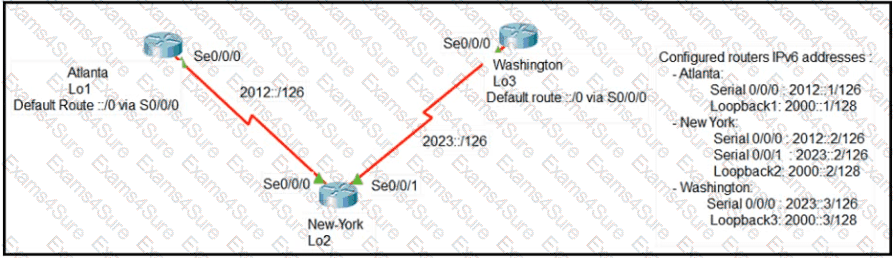
Refer to Exhibit.

Question # 2

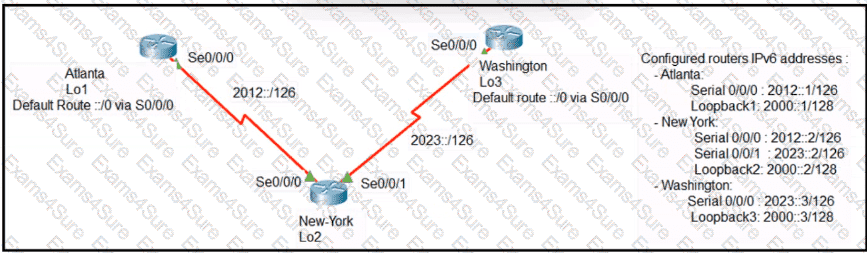
The loopback1 interface of the Atlanta router must reach the loopback3 interface of the Washington router. Which two static host routes must be configured on the New York router? (Choose two)

Options:

A.  

ipv6 route 2000::1/128 2012::1

B.  

ipv6 route 2000::3/128 2023::3

C.  

ipv6 route 2000::3/128 s0/0/0

D.  

ipv6 route 2000::1/128 2012::2

E.  

ipv6 route 2000::1/128 s0/0/1

Discussion 0
Question # 3

How does a network administrator securely manage an AP in lightweight mode?
Options:

A.  

using the CLI via an out-of-band connection

B.  

using the WLC GUI via HTTPS

C.  

using the AP GUI via an in-band SSH connection

D.  

using the CLI via a virtual interface with SSH

Discussion 0
Question # 4

Question # 4

Question # 4

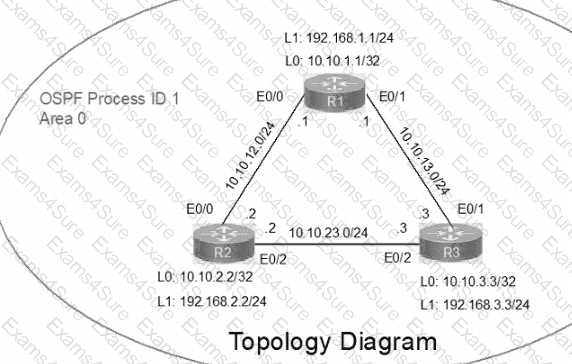
IP connectivity between the three routers is configured. OSPF adjacencies must be established.

1. Configure R1 and R2 Router IDs using the interface IP addresses from the link that is shared between them.

2. Configure the R2 links with a max value facing R1 and R3. R2 must become the DR. R1 and R3 links facing R2 must remain with the default OSPF configuration for DR election. Verify the configuration after clearing the OSPF process.

3. Using a host wildcard mask, configure all three routers to advertise their respective Loopback1 networks.

4. Configure the link between R1 and R3 to disable their ability to add other OSPF routers.

Options:

Discussion 0
Question # 5

How do servers connect to the network in a virtual environment?

Options:

A.  

wireless to an access point that is physically connected to the network

B.  

a cable connected to a physical switch on the network

C.  

a virtual switch that links to an access point that is physically connected to the network

D.  

a software switch on a hypervisor that is physically connected to the network

Discussion 0
Question # 6

In which way does a spine-and-leaf architecture allow for scalability in a network when additional access ports are required?

Options:

A.  

A spine switch and a leaf switch can be added with redundant connections between them

B.  

A spine switch can be added with at least 40 GB uplinks

C.  

A leaf switch can be added with a single connection to a core spine switch.

D.  

A leaf switch can be added with connections to every spine switch

Discussion 0
Question # 7

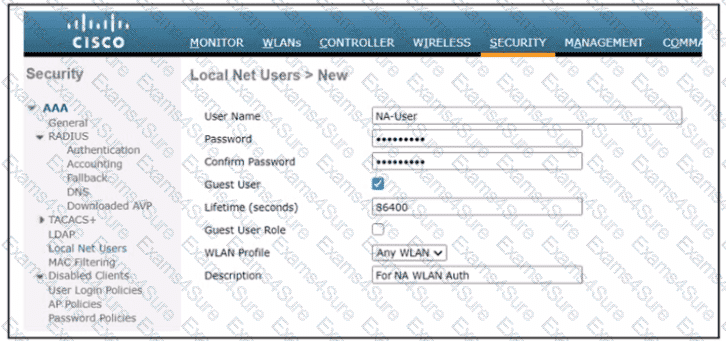
Refer to the exhibit.

Question # 7

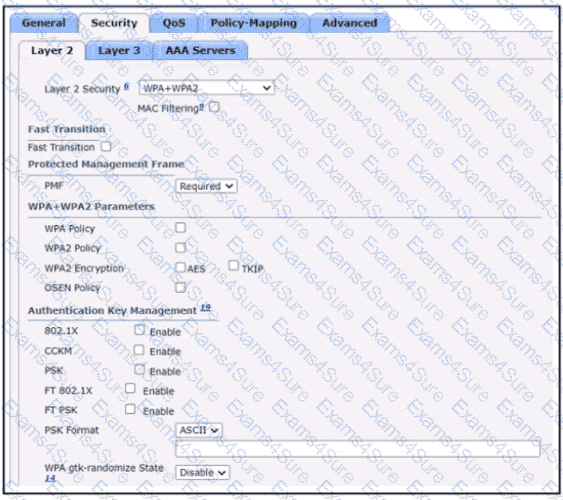
Wireless LAN access must be set up to force all clients from the NA WLAN to authenticate against the local database. The WLAN is configured for local EAP authentication. The time that users access the network must not be limited. Which action completes this configuration?

Options:

A.  

Uncheck the Guest User check box

B.  

Check the Guest User Role check box

C.  

Set the Lifetime (seconds) value to 0

D.  

Clear the Lifetime (seconds) value

Discussion 0
Question # 8

What are two differences between WPA2 and WPA3 wireless security? (Choose two.)

Options:

A.  

WPA3 uses AES for stronger protection than WPA2 which uses SAE

B.  

WPA2 uses 128-bit key encryption and WPA3 requires 256-bit key encryption

C.  

WPA3 uses AES for stronger protection than WPA2 which uses TKIP WPA3 uses

D.  

SAE for stronger protection than WPA2 which uses AES

E.  

WPA2 uses 128-bit key encryption and WPA3 supports 128 bit and 192 bit key encryption

Discussion 0
Question # 9

Which technology is appropriate for communication between an SDN controller and applications running over the network?
Options:

A.  

REST API

B.  

OpenFlow

C.  

Southbound API

D.  

NETCONF

Discussion 0
Question # 10

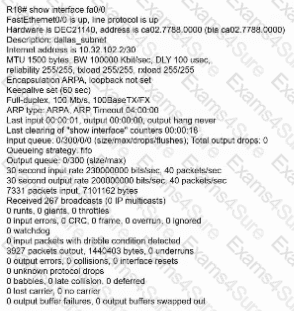
Which interface condition is occurring in this output?

Question # 10

Options:

A.  

duplex mismatch

B.  

bad NIC

C.  

high throughput

D.  

broadcast storm

Discussion 0
Question # 11

Question # 11

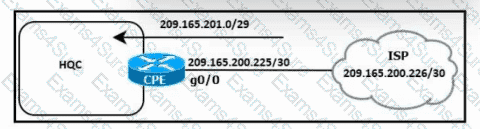
Refer to the exhibit. HQC needs to use a configuration that:

Handles up to 150,000 concurrent connections

Minimizes consumption of public IP addresssses

Which configuration meets the requirements?

Options:

A.  

ip nat pool NATPOOL 209.165.201.1 209.165.201.5 netmask 255.255.255.248ip nat inside source list HQC interface gigabitEthernet0/0 overload

B.  

ip nat pool NATPOOL 209.165.200.225 209.165.200.226 netmask 255.255.255.252ip nat outside source list HQC pool NATPOOL overload

C.  

ip nat pool NATPOOL 209.165.201.1 209.165.201.3 netmask 255.255.255.248ip nat inside source list HQC pool NATPOOL overload

D.  

ip nat pool NATPOOL 209.165.201.1 209.165.201.248 netmask 255.255.255.248ip nat outside source list HQC pool NATPOOL overload

Discussion 0
Question # 12

An organization developed new security policies and decided to print the policies and distribute them to all personnel so that employees review and apply the policies. Which element of a security program is the organization implementing?

Options:

A.  

Asset identification

B.  

User training

C.  

Physical access control

D.  

Vulnerability control

Discussion 0
Question # 13

How do traditional campus device management and Cisco DNA Center device management differ in regards to deployment?

Options:

A.  

Traditional campus device management schemes typically deploy patches and updates quicker than Cisco DNA Center device management.

B.  

Cisco DNA Center device management is implemented at a lower cost than most traditional campus device management options.

C.  

Traditional campus device management allows a network to scale quicker than using Cisco DNA Center device management.

D.  

Cisco DNA Center device management deploys a network faster than traditional campus device management.

Discussion 0
Question # 14

What is a function of Layer 3 switches?

Options:

A.  

They route traffic between devices in different VLANs.

B.  

They forward Ethernet frames between VLANs using only MAC addressses.

C.  

They move frames between endpoints limited to IP addresssses.

D.  

They transmit broadcast traffic when operating in Layer 3 mode exclusively.

Discussion 0
Question # 15

Refer to the exhibit.

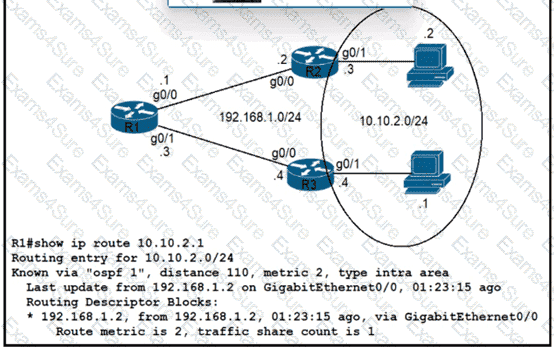
Traffic from R1 to the 10.10.2.0/24 subnet uses 192.168.1.2 as its next hop. An network engineer wants to update the R1 configuration so that traffic with destination 10.10.2.1 passes through router R3, and all other traffic to the 10.10.20/24 subnet passes through r2. Which command must be used?
Question # 15

Options:

A.  

ip route 10.10.2.1 255.255.255.255 192.168.1.4 115

B.  

ip route 10.10.2.0 255.255.255.0 192.168.1.4 100

C.  

ip route 10.10.2.0 255.255.255.0 192.168.1.4 115

D.  

ip route 10.10.2.1 255.255.255.255 192.168.1.4 100

Discussion 0
Question # 16

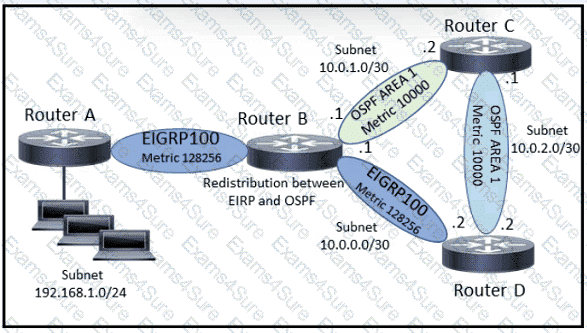
Refer to the exhibit.

Question # 16

A network engineer executes the show ip route command on router

D.  

What is the next hop to network 192.168.1.0/24 and why?

Options:

A.  

The next hop is 10.0.2.1 because it uses distance vector routing

B.  

The next hop is 10.0.2.1 because it is a link-state routing protocol

C.  

The next hop is 10.0.0.1 because it has a better administrative distance

D.  

The next hop is 10.0.0.1 because it has a higher metric.

Discussion 0
Question # 17

Refer to the exhibit.

Question # 17

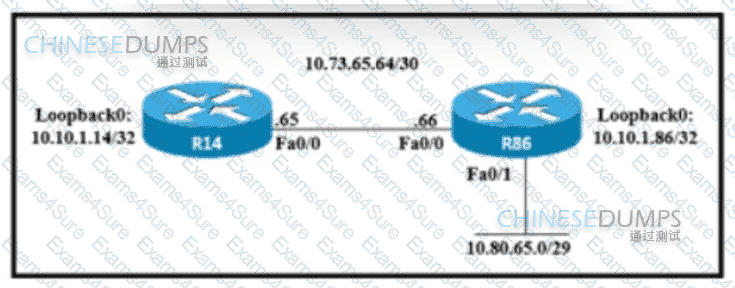
An engineer must configure a floating static route on an external EIGRP network. The destination subnet is the /29 on the LAN Interface of R86. Which command must be executed on R14?

Options:

A.  

ip route 10.80.65.0.255.255.248.0.10.73.65.66.1

B.  

ip route 10.80.65.0.255.255.255..240 fa0/1 89

C.  

ip route 10.80.65.0.255.255.248.0.10.73.65.66.171

D.  

ip route 10.80.65.0.0.0.224.10.80.65.0. 255

Discussion 0
Question # 18

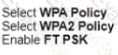
A Cisco engineer at a new branch office is configuring a wireless network with access points that connect to a controller that is based at corporate headquarters Wireless client traffic must terminate at the branch office and access-point survivability is required in the event of a WAN outage Which access point mode must be selected?
Options:

A.  

Lightweight with local switching disabled

B.  

Local with AP fallback enabled

C.  

OfficeExtend with high availability disabled

D.  

FlexConnect with local switching enabled

Discussion 0
Question # 19

Refer to the exhibit.

Question # 19

A)

Question # 19

B)

Question # 19

C)

Question # 19

D)

Question # 19

Options:

A.  

Option A

B.  

Option B

C.  

Option C

D.  

Option D

Discussion 0
Question # 20

Refer to the exhibit.

Question # 20

The loopback1 interface of the Atlanta router must reach the loopback3 interface of the Washington router.

Options:

A.  

ipv6 route 2000::1/128 2012::2

B.  

ipv6 route 2000::1/128 2012::1

C.  

ipv6 route 2000:3 123 s0/0/0

D.  

ipv6 route 2000::3/128 2023::3

E.  

ipv6 route 2000::1/128 s0/0/1

Discussion 0
Get 200-301 dumps and pass your exam in 24 hours!

Free Exams Sample Questions