
Pre-Summer Sale Limited Time 65% Discount Offer - Ends in 0d 00h 00m 00s - Coupon code: 65pass65

300-420 Designing Cisco Enterprise Networks (ENSLD) v1.1 is now Stable and With Pass Result | Test Your Knowledge for Free

Exams4sure Dumps

300-420 Practice Questions

Designing Cisco Enterprise Networks (ENSLD) v1.1

Last Update 19 hours ago
Total Questions : 379

Dive into our fully updated and stable 300-420 practice test platform, featuring all the latest CCNP Enterprise exam questions added this week. Our preparation tool is more than just a Cisco study aid; it's a strategic advantage.

Our free CCNP Enterprise practice questions crafted to reflect the domains and difficulty of the actual exam. The detailed rationales explain the 'why' behind each answer, reinforcing key concepts about 300-420. Use this test to pinpoint which areas you need to focus your study on.

300-420 PDF

300-420 PDF (Printable)
$54.25
$154.99

300-420 Testing Engine

300-420 PDF (Printable)
$59.5
$169.99

300-420 PDF + Testing Engine

300-420 PDF (Printable)
$74.55
$212.99
Question # 61

A global organization with several branches hired a network architect to design an overlay VPN solution. The branches communicate with each other frequently. The customer expects to add more branches in the future. To meet the customer ' s security requirements, the architect plans to provide traffic protection using dynamic IPsec tunnels. Which solution should the architect choose?

Options:

A.  

DMVPN

B.  

EasyVPN

C.  

GETVPN

D.  

L2TP

Discussion 0
Question # 62

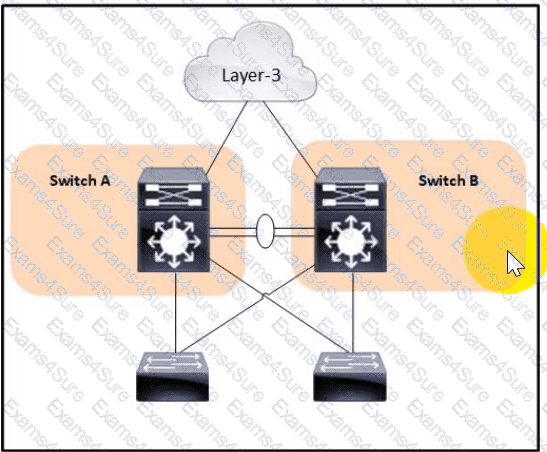
An engineer is designing a network for a customer running a wireless network with a common VLAN for all APs. The customer is experiencing unicast flooding in the Layer 2 network between the aggregation and access layers. The customer wants to reduce the flooding and improve convergence time. Which solution meets these requirements?
Options:

A.  

Migrate all APs to a common Layer 2 access layer switch and run Layer 3 from the aggregation layer to all remaining access layer switches.

B.  

Align HSRP primary and STP root bridges and reduce ARP timers to match CAM timers on the aggregation layer switches.

C.  

Migrate to a Layer 3 access campus design if the APs can run on separate VLANs.

D.  

Align HSRP primary and STP root bridges if the APs cannot run on separate VLANs.

Discussion 0
Question # 63

What is the main purpose of the Cisco SD-Access overlay design?

Options:

A.  

To simplify network management and troubleshooting for support teams

B.  

To ensure high availability and fault tolerance for user services

C.  

To enable seamless integration with SD-Access overlay services

D.  

To enhance network visibility and monitoring for infrastructure

Discussion 0
Question # 64

What is the purpose of an edge node in an SD-Access network fabric?

Options:

A.  

Edge nodes identify and authenticate endpoints and register endpoint information with control plane nodes.

B.  

Edge nodes track endpoint IDs to location mappings, along with IPv4, IPv6, or MAC addresses.

C.  

Edge nodes are the gateway between the fabric domain and network outside of the fabric.

D.  

Edge nodes resolve lookup requests from edge and border nodes to locate destination endpoint IDs.

Discussion 0
Question # 65

Question # 65

Refer to the exhibit A customer requires a Layer 2 network designed to support:

    500 active logical ports

    trunking of 30 VLANs

    convergence of less than 1 second

Which Spanning Tree Protocol must be selected?

Options:

A.  

RPVST+

B.  

MSTP

C.  

CST

D.  

PVST+

Discussion 0
Question # 66

Which type of rendezvous point deployment is standards-based and support dynamic RP discovery?

Options:

A.  

Auto-RP

B.  

Anycast-RP

C.  

bootstrap router

D.  

static RP

Discussion 0
Question # 67

Since installing a cisco TelePresence system, the company is experiencing other application having response issues when the system in use. As a result, the company asked an architect to recommend a QoS solution. The customer is currently using a CBWFQ policy to manage traffic on an internet connection with a speed of 100 Mbps. Which link-capacity limit must the architect choose for strict-priority for the real-time traffic?
Options:

A.  

25 Mbps

B.  

50 Mbps

C.  

33 Mbps

D.  

75 Mbps

Discussion 0
Question # 68

Question # 68

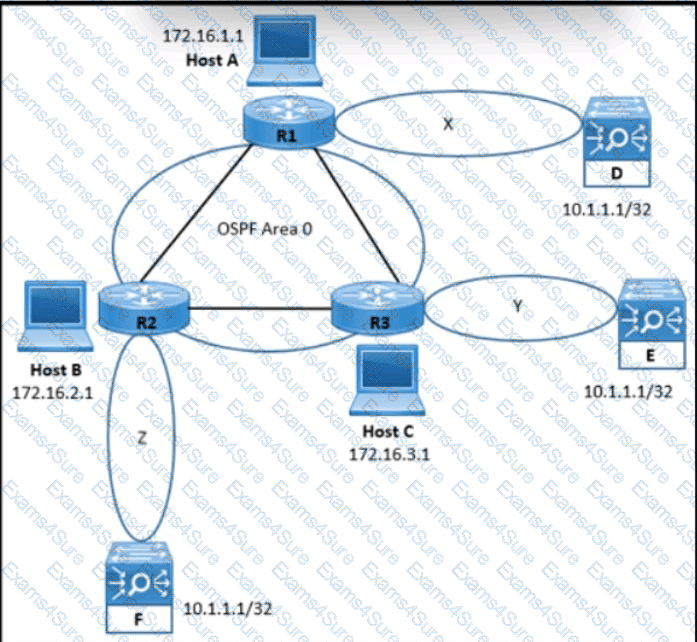
Refer to the exhibit. An engineer is designing an OSPF solution for a customer. The design must take into consideration:

    Application load balancers

    D.  

    E.  

    and F are in different geographical locations and are OSPF-enabled.

    Hosts A,

    B.  

    and C connect to an application through the load balancers using IP address 10.1.1.1/32.

    In the event of a failure of one of the load balancers, hosts must still have access to the application.

Which solution must the engineer choose?

Options:

A.  

All load balancers to be co-located in area 0.

B.  

X, Y, and Z to be configured as different areas

C.  

At least one load balancer to be in area 0.

D.  

X, Y and Z to be configured as the same area

Discussion 0
Question # 69

A network engineer must connect two sites across a public network using a secure tunneling technology that

supports multicast traffic. Which technology must be chosen?

Options:

A.  

IPsec

B.  

GRE

C.  

PPTP

D.  

GRE over IPsec

Discussion 0
Question # 70

An engineer working for a service provider with an employee ID: 4863:43:939 must design a solution to provide remote connectivity over the public internet. The design must:

    securely connect multiple remote sites to the central site

    provide redundant paths to the central site

    allow auto path selection based on failure and connection quality

    support IP multicast

    minimal configuration at remote sites

Which solution must the engineer choose?

Options:

A.  

MPLS provided service with BGP

B.  

dual DMVPN with EIGRP routing

C.  

full mesh OSPF with IPsec tunnels

D.  

full mesh ISIS with GRE tunnels and IPsec

Discussion 0
Get 300-420 dumps and pass your exam in 24 hours!

Free Exams Sample Questions


