
3V0-23.25 Practice Questions
Advanced VMware Cloud Foundation 9.0 Storage
Last Update 4 days ago
Total Questions : 77
Start with our free 3V0-23.25 practice questions, carefully crafted to mirror the domains, phrasing, and difficulty of the real VCAP-Storage exam. Each [EXAMNAME] exam question comes with a detailed rationale that explains not just which answer is correct but why the others fall short. That's how concepts stick. Use the free set to benchmark yourself: identify your VMware weak domains, see where you're losing marks, and build a focused study plan in minutes.

An administrator is tasked with deploying a VMware Cloud Foundation (VCF) Workload Domain that meets the following requirements:
• vSAN ESA as principal storage
• RAID-6 with FTT=2
• Support for Storage Traffic Separation
The administrator is provided the following hardware to perform the task:
• Four ESX hosts, each host contains:
24 CPU cores
96 GB memory
Two 25GbE network NICs
12 NVMe devices 4 TB each, connected to a single SATA/SAS/NVMe Tri-mode controller What four changes must the administrator make to the hardware before deploying the new Workload Domain? (Choose four.)
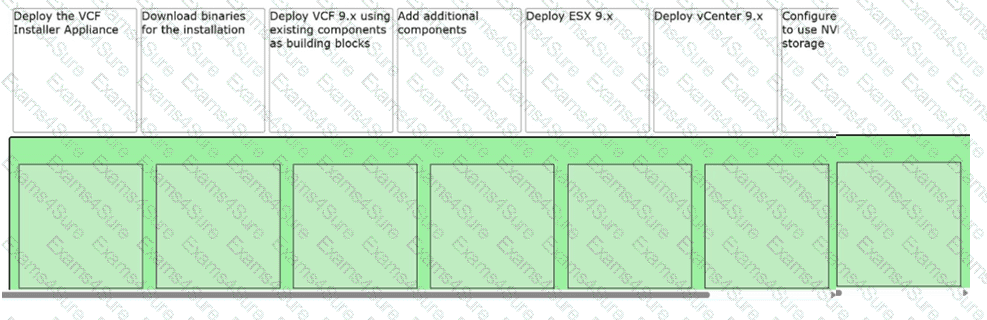
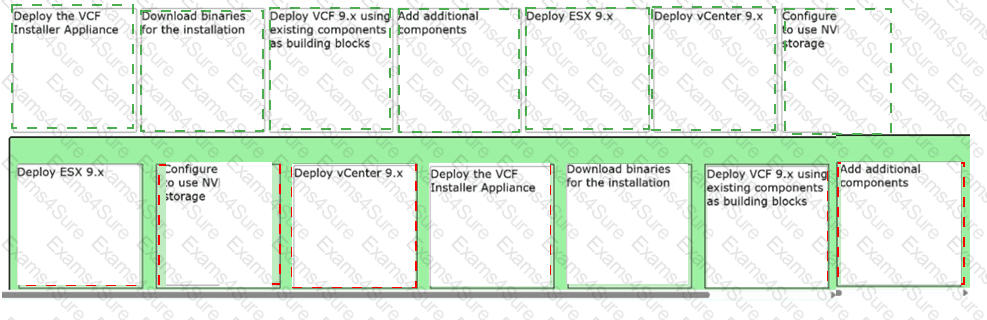
A VMware Cloud Foundation (VCF) Management Domain is requested to be deployed with the following information:
. 6 blade style hosts with no local storage beyond the operating system.
. 4 25 Gb networking cards installed in each host.
. A 30 TB external array configured to support NVMe/TCP only.
. 2 dVS switches, one configured for storage isolation and one for all other traffic.
. Aria Operations is not currently deployed in the environment.
Place the general steps in sequence for converging VCF on to this configuration.
An administrator has been tasked with deploying a new VMware Cloud Foundation (VCF) environment that includes a Management Domain and two workload domains. Compliance regulations require that production and non-production workloads reside in separate failure domains, with the production workload environment using low-latency block storage and the non-production environment relying on high-capacity file-based storage.
Which combination of supported non-vSAN storage solutions should the administrator recommend to meet these requirements?