Spring Sale Limited Time 65% Discount Offer - Ends in 0d 00h 00m 00s - Coupon code: 65pass65

4A0-107 Nokia Quality of Service is now Stable and With Pass Result | Test Your Knowledge for Free

4A0-107 Practice Questions

Nokia Quality of Service

Last Update 14 hours ago
Total Questions : 231

Dive into our fully updated and stable 4A0-107 practice test platform, featuring all the latest SRC Certification exam questions added this week. Our preparation tool is more than just a Nokia study aid; it's a strategic advantage.

Our free SRC Certification practice questions crafted to reflect the domains and difficulty of the actual exam. The detailed rationales explain the 'why' behind each answer, reinforcing key concepts about 4A0-107. Use this test to pinpoint which areas you need to focus your study on.

4A0-107 PDF

4A0-107 PDF (Printable)
$43.75
$124.99

4A0-107 Testing Engine

4A0-107 PDF (Printable)
$50.75
$144.99

4A0-107 PDF + Testing Engine

4A0-107 PDF (Printable)
$63.7
$181.99
Question # 11

On a Nokia IOM 3, how is buffer memory allocated per forwarding complex?

Options:

A.  

512 MB ingress, 512 MB egress

B.  

256 MB ingress, 256 MB egress

C.  

1 GB dynamically allocated between ingress and egress.

D.  

768 MB dynamically allocated between ingress and egress.

E.  

768 MB, with a minimum of 256 MB ingress and egress, and an additional 256 MB dynamically allocated.

Discussion 0
Question # 12

Which of the following statements regarding buffer pool allocation are FALSE? (Choose two)

Options:

A.  

Each network egress port receives its own buffer pool.

B.  

Each SAP-egress port receives its own buffer pool.

C.  

All SAP-ingress ports on the same MDA share a buffer pool.

D.  

All the network ingress ports on the same MDA share a buffer pool.

E.  

Each network ingress port on the same MDA receives its own buffer pool.

Discussion 0
Question # 13

Which of the following is an example of something that CAN be done with hierarchical policing (CFHP) but CANNOT be done with standalone policers?

Options:

A.  

Limiting the maximum forwarding rate of each individual policer and, at the same time, marking, packets as in-profile or out-of-profile.

B.  

Putting packets in a buffer as they are received, and marking packets as in-profile or out-of-profile as they are removed from the buffer.

C.  

Rate-limiting the collective output of several policers, and to reallocate bandwidth that is not utilized by some policers to other policers that need to use it.

D.  

Rate-limiting the collective output of several policers towards each egress FFPC, while maintaining control of the maximum overall forwarding rate.

Discussion 0
Question # 14

Which of the following statements describe the operation of WRED on the Nokia 7750 SR? (Choose three)

Options:

A.  

WRED monitors the shared buffer space utilization over a period of time.

B.  

WRED disables the TCP slow-start congestion control mechanism.

C.  

WRED uses two configurable slopes for each buffer pool: a high slope and a low slope.

D.  

WRED uses the shared buffer utilization, instead of the individual queue depth, to get a better picture of the average resource utilization of the shared buffer space.

E.  

WRED polices the shared buffer pool and marks all packets above a certain rate as "discard eligible."

Discussion 0
Question # 15

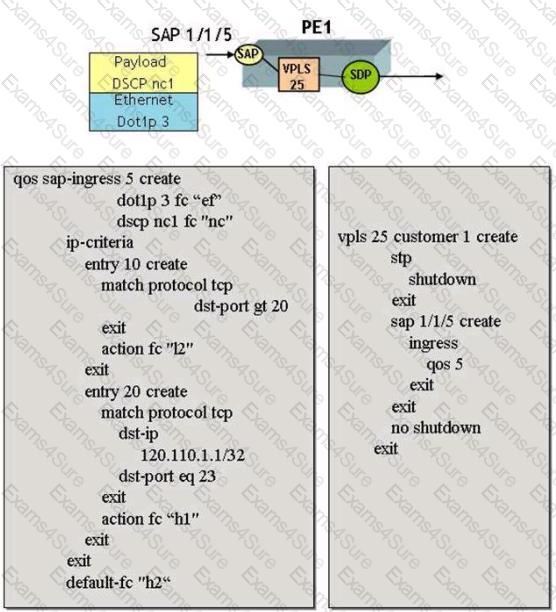
Click the exhibit button below.

Question # 15

Based on the configuration shown below, name the forwarding class to be associated with a TCP packet encapsulated inside an Ethernet frame that arrives on SAP 1/1/5 with the following characteristics:

Destination IP address = 120.110.1.1

TCP port number = 23

DSCP value = nc1

Dot1pvalue = 3

Options:

A.  

H2

B.  

NC

C.  

L2

D.  

EF

E.  

H1

F.  

BE

Discussion 0
Question # 16

Based on queue usage, which of the following QoS-policies when combined will allow queue rates to be dynamically allocated? (Choose two)

Options:

A.  

The slope-policy

B.  

The SAP-ingress policy

C.  

The network-queue policy

D.  

The scheduler-policy

E.  

The network-policy

F.  

The WRED-policy

G.  

The arbitrator-policy

Discussion 0
Question # 17

Which of the following is an advantage of using queue-groups on a service SAP?

Options:

A.  

It enables CFHP.

B.  

It more scalable than using policers.

C.  

It allows a separate set of queues/policers for each VLAN on a port.

D.  

It allows a set of queues to be shared among multiple SAPs.

Discussion 0
Question # 18

On the Nokia 7750 SR, where can network-queue policies be applied? (Choose two)

Options:

A.  

On the network egress port.

B.  

On the SDP.

C.  

On the access ingress port.

D.  

On the egress MD

A.  

E.  

On the SAP.

F.  

On the ingress MD

A.  

Discussion 0
Question # 19

Which of the following statements about configuring queues to use shared or reserved buffer space is FALSE?


Options:

A.  

When queues use shared buffer space, buffers are more efficiently utilized.

B.  

Queues that use reserved buffer space will have memory available for their reserved portion.

C.  

When a queue is not using its reserved portion, other queues can use it.

D.  

Using reserved buffer space prevents a queue from being starved of buffer resources by other queues.

Discussion 0
Question # 20

How many bits in the IP ToS field define the packet’s precedence?

Options:

A.  

3

B.  

4

C.  

6

D.  

8

Discussion 0
Get 4A0-107 dumps and pass your exam in 24 hours!

Free Exams Sample Questions