
Exam style questions across every 500-420 domain
Last Update 3 days ago
Total Questions : 124
Start with our free 500-420 practice questions, carefully crafted to mirror the domains, phrasing, and difficulty of the real AppDynamics Certified Associate exam. Each 500-420 exam question comes with a detailed rationale that explains not just which answer is correct but why the others fall short. That's how concepts stick. Use the free set to benchmark yourself: identify your Cisco weak domains, see where you're losing marks, and build a focused study plan in minutes.

Refer to the exhibit.
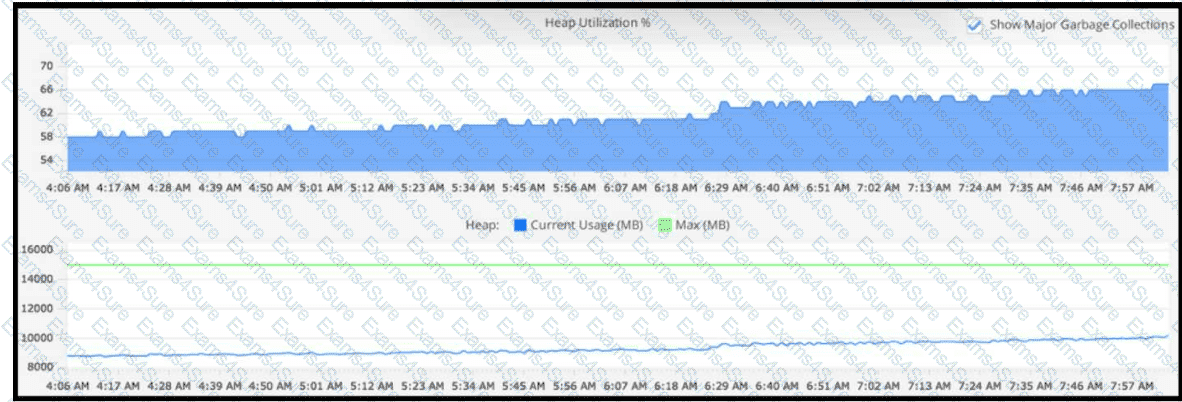
Using this heap-utilization graph, which method is used to confirm whether a memory leak is occurring during a specific timeframe?
What are two differences between creating a Transaction Group using the ' Create Group ' action and defining a Transaction Detection rule? (Choose two.)
A Performance Analyst needs to define a set of Key Performance Indicators (KPIs) from a group of select metrics. The required performance information resides within the Transaction Analytics data set. Which method will accomplish this task?
On a snapshot flow map, which three metrics indicate why the snapshot might have been taken? (Choose three.)
A Performance Analyst has decided to replace a Servlet Business Transaction with a Service Endpoint. There were no Business Transaction Custom Match Rules, and the analyst created a Business Transaction Custom Exclude Rule matching the transaction URI. The analyst also created a Service Endpoint Custom Match Rule matching the URI. Which statement is true?
After reviewing a problem that caused an outage, a Performance Analyst wants to create a single health rule that evaluates multiple conditions. Which two options are valid condition-matching values? (Choose two.)
An online order portal for a restaurant has a “menu” transaction with different request types that must be monitored as separate transactions, such as “menu.salads” and “menu.entree.” A Performance Analyst wants to create one rule that separates the transactions instead of creating an individual rule for each request type. Which option should be enabled on a Custom Match rule?