
Exam style questions across every AI-200 domain
Last Update 2 days ago
Total Questions : 142
Start with our free AI-200 practice questions, carefully crafted to mirror the domains, phrasing, and difficulty of the real Microsoft Certified: Azure AI Cloud Developer Associate exam. Each AI-200 exam question comes with a detailed rationale that explains not just which answer is correct but why the others fall short. That's how concepts stick. Use the free set to benchmark yourself: identify your Microsoft weak domains, see where you're losing marks, and build a focused study plan in minutes.

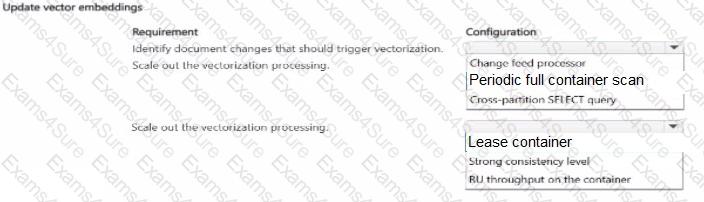
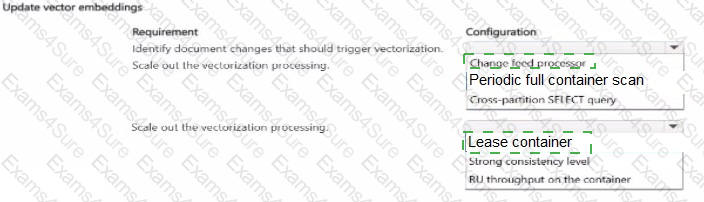
You need to configure vector embedding updates according to the business and technical requirements.
Which information should you use? To answer, select the appropriate option in the answer area.
NOTE: Each correct selection is worth one point.

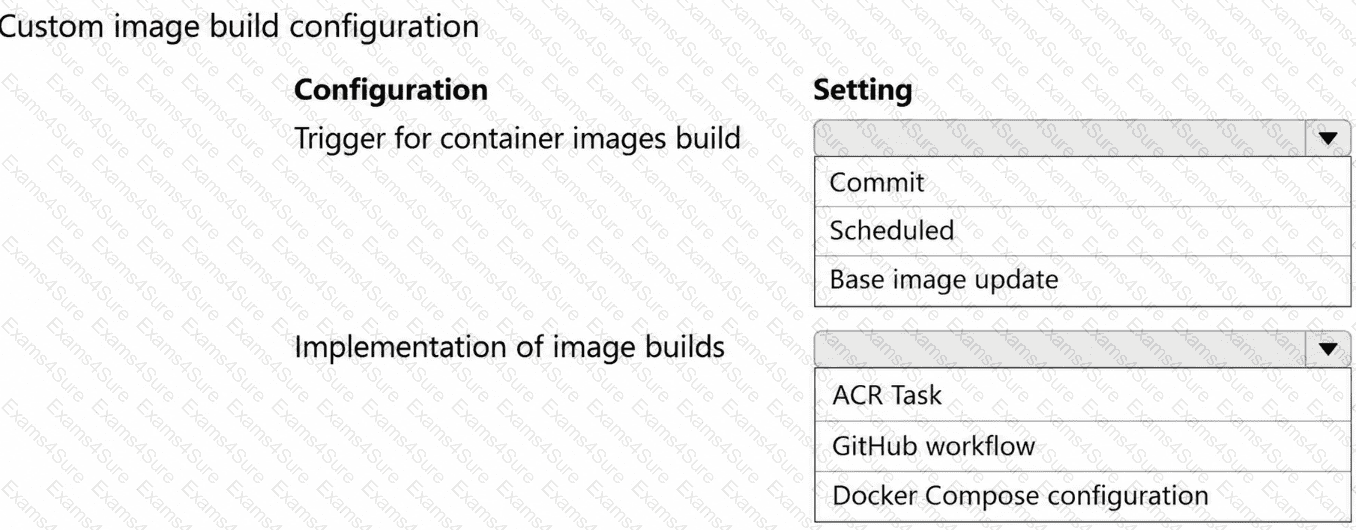
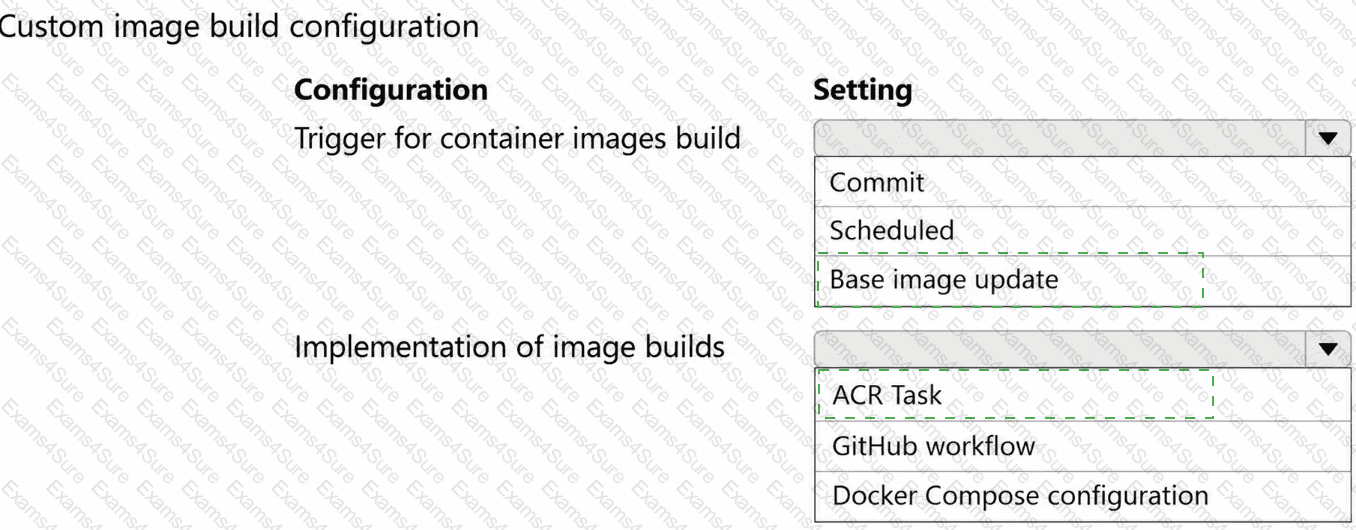
You need to configure image build automation based on the technical requirements.
Which settings should you configure? To answer, select the appropriate options in the answer area.
NOTE: Each correct selection is worth one point.
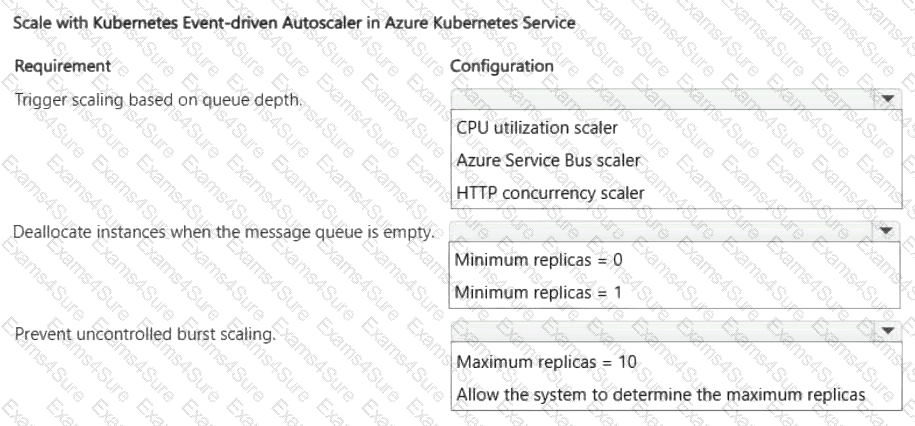
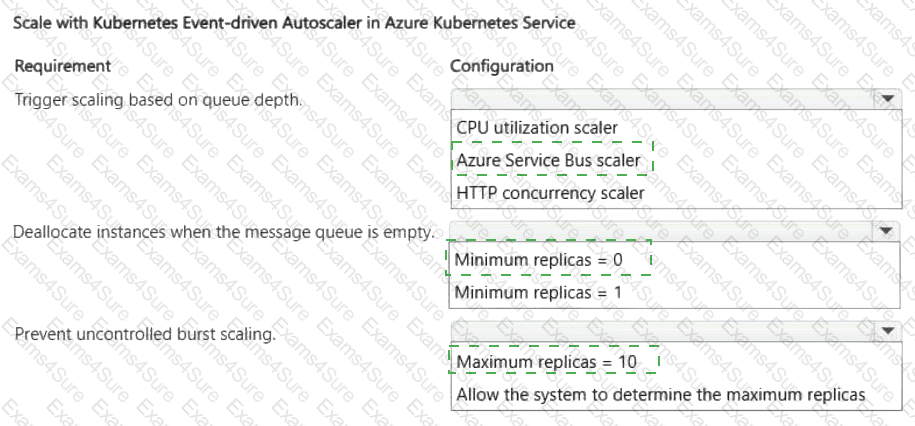
You need to deploy a batch retraining workload.
How should you complete the scaling configuration? To answer, select the appropriate options in the answer area.
NOTE: Each correct selection is worth one point.
You need to improve throughput for concurrent application requests to PostgreSQL.
What should you implement?
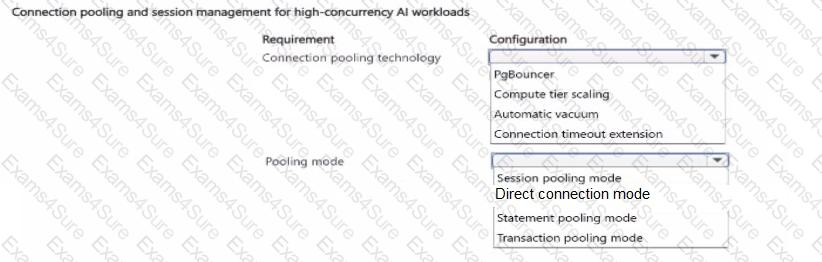
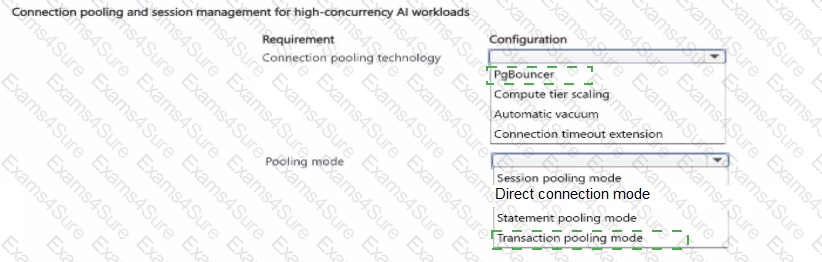
You are developing an application that uses a Python API to perform similarity queries against Azure Database for PostgreSQL. The application creates a new database connection for every request.
During peak traffic, the application intermittently fails to open new database sessions, logs indicate that the maximum number of connections have been reached.
You need to configure the connection pooling strategy to reduce connection setup overhead and maximize reuse for the high-concurrency workload.
What should you configure? To answer. select the appropriate options in the answer area
NOTE: Each correct selection is worth one point.

An application performs similarity search across 5 million embeddings stored in Azure Database for PostgreSQL with pgvector. Queries often filter by department before ranking by cosine distance.
P95 latency for vector similarity queries exceeds the SLA target. Monitoring shows sustained high CPU use during query execution.
You need to reduce P95 latency for filtered vector similarity queries.
What should you do?
Note: This question is part of a series of questions that present the same scenario. Each question in the series contains a unique solution that might meet the stated goals.
You are using Azure Monitor Application Insights to investigate a production API. You open the Logs blade and set the time range to Last 24 hours.
An engineer recommends the following query to count requests by result code and sort the results from most frequent to least frequent:
requests
| summarize request_count = count() by resultCode
| order by request_count desc
You need to determine whether the query returns the number of requests grouped by result code and sorted from most to least frequent.
Solution: The query lists every individual request along with its result code.
Does the solution meet the goal?
Note: This question is part of a series of questions that present the same scenario. Each question in the series contains a unique solution that might meet the stated goals.
You are using Azure Monitor Application Insights to investigate a production API. You open the Logs blade and set the time range to Last 24 hours.
An engineer recommends the following query to count requests by result code and sort the results from most frequent to least frequent:
requests
| summarize request_count = count() by resultCode
| order by request_count desc
You need to determine whether the query returns the number of requests grouped by result code and sorted from most to least frequent.
Solution: The result codes are sorted alphabetically.
Does the solution meet the goal?
You are developing an application that must extract structured field data (invoice number, total, vendor name) from scanned invoices in multiple layouts.
You need a solution that requires no custom model training.
What should you use?
You have container source code stored in a Git repository.
The container registry must automatically build and store a new container image whenever a developer commits code to the Git repository.
You must minimize the use of an external build infrastructure.
You need to configure Azure Container Registry (ACR) to manage the build process natively and automatically.
Which two ACR components should you use? Each correct answer presents part of the solution.
NOTE: Each correct selection is worth one point.



