Pre-Summer Sale Limited Time 65% Discount Offer - Ends in 0d 00h 00m 00s - Coupon code: 65pass65

FCSS_SDW_AR-7.6 FCSS - SD-WAN 7.6 Architect is now Stable and With Pass Result | Test Your Knowledge for Free

Exams4sure Dumps

FCSS_SDW_AR-7.6 Practice Questions

FCSS - SD-WAN 7.6 Architect

Last Update 3 days ago
Total Questions : 94

Dive into our fully updated and stable FCSS_SDW_AR-7.6 practice test platform, featuring all the latest Fortinet Certified Solution Specialist exam questions added this week. Our preparation tool is more than just a Fortinet study aid; it's a strategic advantage.

Our free Fortinet Certified Solution Specialist practice questions crafted to reflect the domains and difficulty of the actual exam. The detailed rationales explain the 'why' behind each answer, reinforcing key concepts about FCSS_SDW_AR-7.6. Use this test to pinpoint which areas you need to focus your study on.

FCSS_SDW_AR-7.6 PDF

FCSS_SDW_AR-7.6 PDF (Printable)
$43.75
$124.99

FCSS_SDW_AR-7.6 Testing Engine

FCSS_SDW_AR-7.6 PDF (Printable)
$50.75
$144.99

FCSS_SDW_AR-7.6 PDF + Testing Engine

FCSS_SDW_AR-7.6 PDF (Printable)
$63.7
$181.99
Question # 11

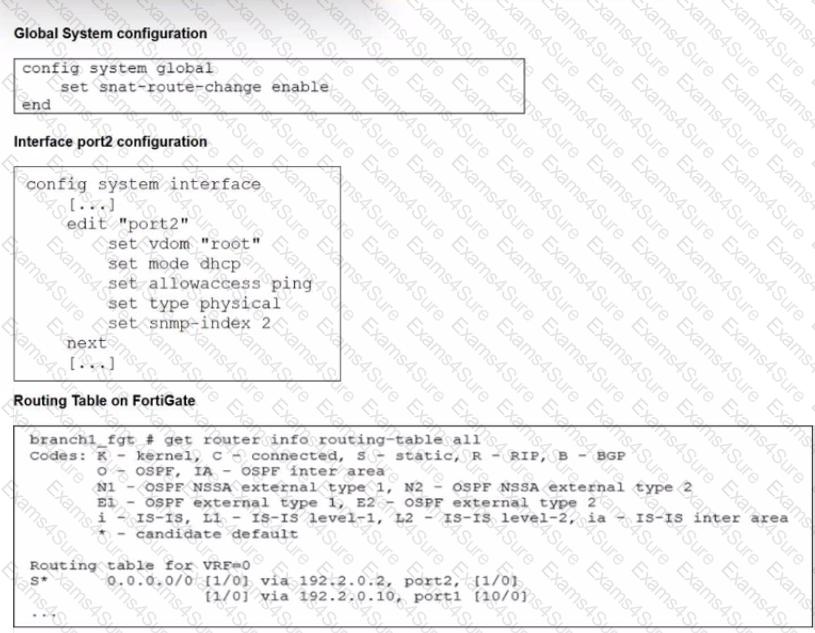
Refer to the exhibits.
Question # 11

The exhibits show the source NAT (SNAT) global setting. port2 interface settings, and the routing table on FortiGate.

The administrator increases the member priority on port2 to 20.

Upon configuration changes and the receipt of new packets, which two actions does FortiGate perform on existing sessions established over port2? (Choose two.)

Options:

A.  

FortiGate continues routing all existing sessions over port2.

B.  

FortiGate routes only new sessions over port2.

C.  

FortiGate flags the SNAT session as dirty only if the administrator has assigned an IP pool to the firewall policies with NAT.

D.  

FortiGate flags the sessions as dirty.

E.  

FortiGate updates the gateway information of the sessions with SNAT so that they use port1 instead of port2.

Discussion 0
Question # 12

Exhibit.

Question # 12

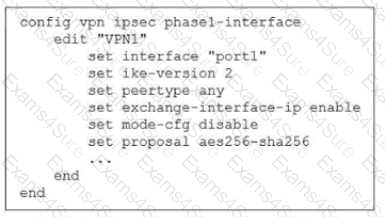
The administrator configured the IPsec tunnel VPN1 on a FortiGate device with the parameters shown in exhibit.

Based on the configuration, which three conclusions can you draw about the characteristics and requirements of the VPN tunnel? (Choose three.)

Options:

A.  

The tunnel interface IP address on the spoke side is provided by the hub.

B.  

The remote end can be a third-party IPsec device.

C.  

The administrator must manually assign the tunnel interface IP address on the hub side

D.  

The remote end must support IKEv2.

E.  

This configuration allows user-defined overlay IP addresses.

Discussion 0
Question # 13

Refer to the exhibits.

Question # 13

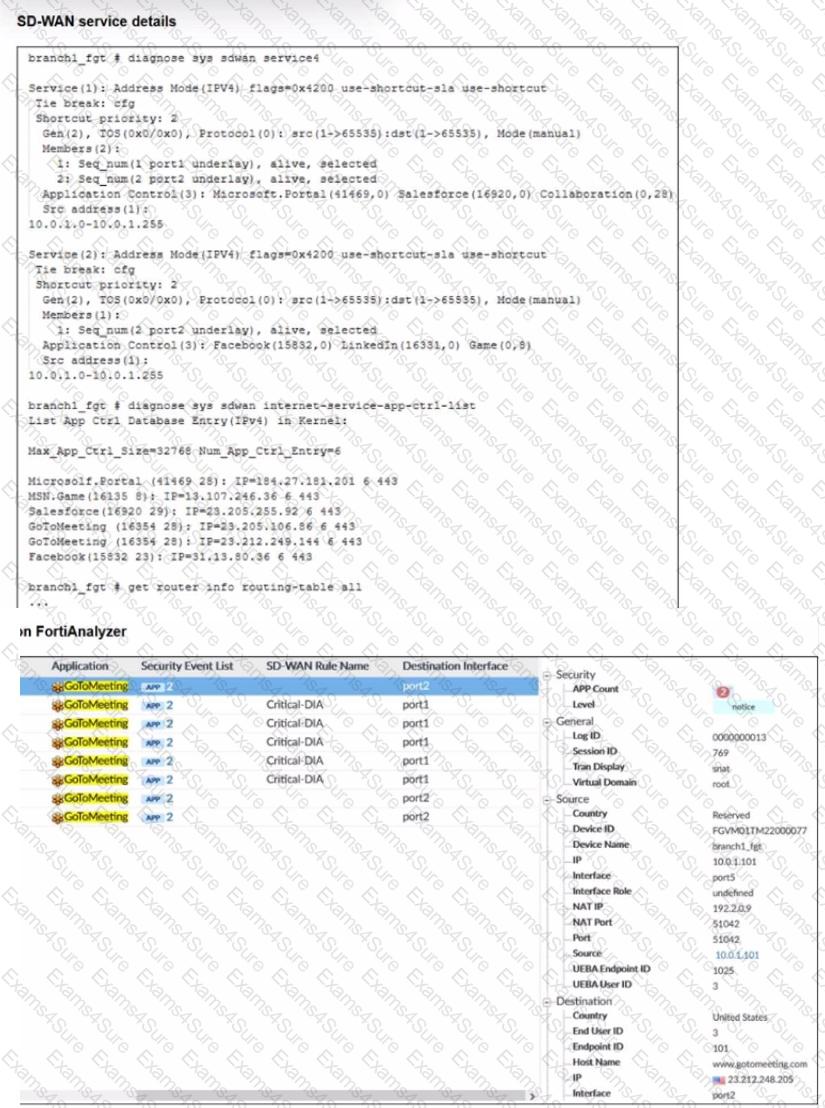
An administrator is testing application steering in SD-WAN. Before generating test traffic, the administrator collected the information shown in the first exhibit. After generating GoToMeeting test traffic, the administrator examined the corresponding traffic log on FortiAnalyzer, which is shown in the second exhibit.

The administrator noticed that the traffic matched the implicit SD-WAN rule, but they expected the traffic to match rule ID 1.

Which two reasons explain why some log messages show that the traffic matched the implicit SD-WAN rule? (Choose two.)

Options:

A.  

Full SSL inspection is not enabled on the matching firewall policy.

B.  

The session 3-tuple did not match any of the existing entries in the ISDB application cache.

C.  

FortiGate could not refresh the routing information on the session after the application was detected.

D.  

No configured SD-WAN rule matches the traffic related to the collaboration application GoToMeeting

Discussion 0
Question # 14

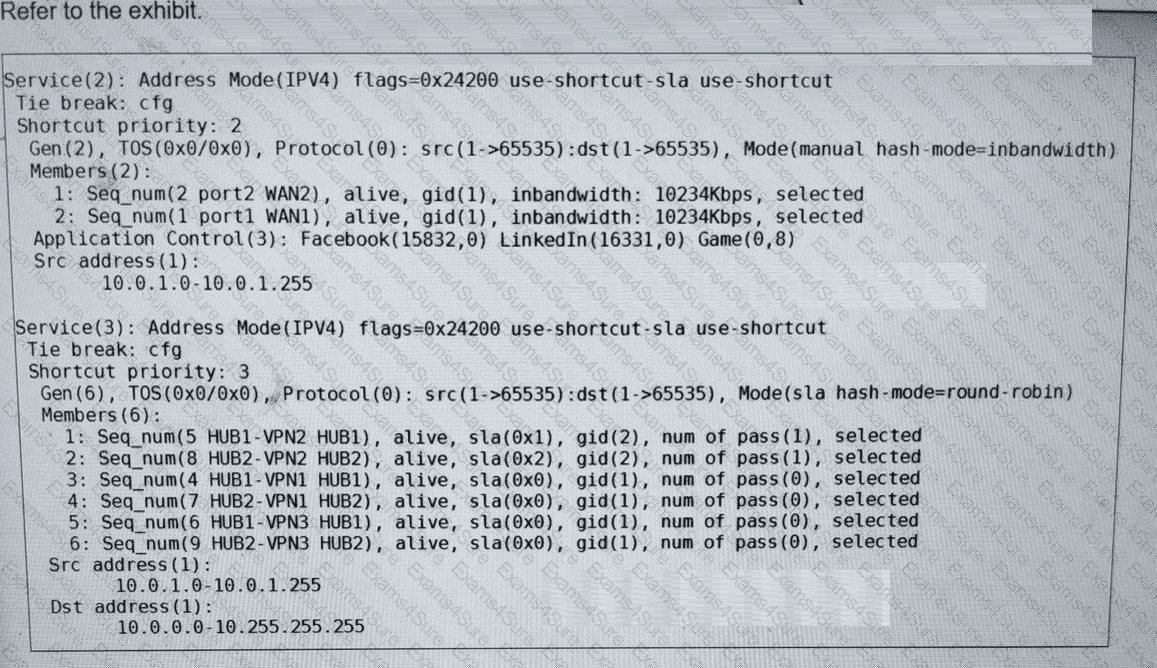
(Refer to the exhibit. The administrator configured two SD-WAN rules to load balance the traffic.
Question # 14

Which interfaces does FortiGate use to steer the traffic from 10.0.1.124 to 10.0.0.254? Choose one answer.)

Options:

A.  

HUB2-VPN2

B.  

HUB1-VPN2 or HUB2-VPN2

C.  

port1 or port2

D.  

Any interface in the HUB1 or HUB2 zones

Discussion 0
Question # 15

Refer to the exhibit.

Question # 15

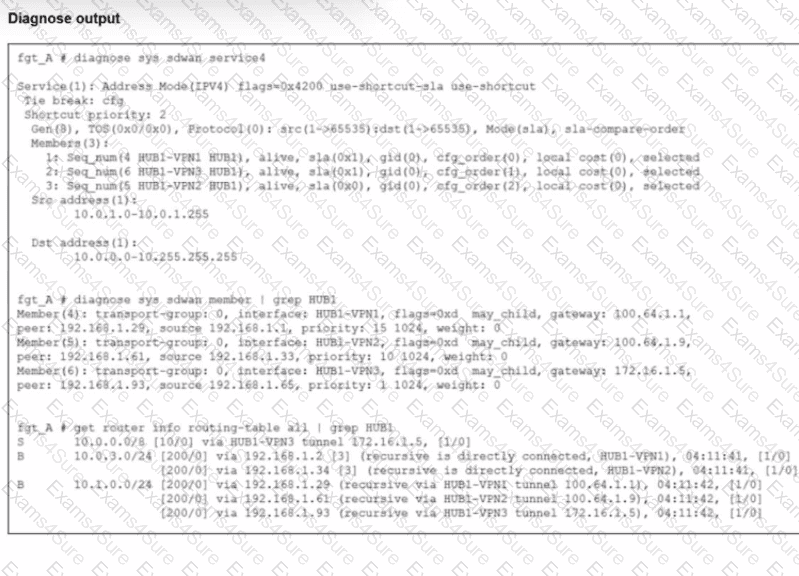
An administrator is troubleshooting SD-WAN on FortiGate. A device behind branch1_fgt generates traffic to the 10.0.0.0/8 network.

The administrator expects the traffic to match SD-WAN rule ID 1 and be routed over HUB1-VPN1. However, the traffic is routed over HUB1-VPN3.

Based on the output shown in the exhibit, which two reasons, individually or together, could explain the observed behavior? (Choose two.)

Options:

A.  

HUB1-VPN3 has a higher member configuration priority than HUB1-VPN1.

B.  

The traffic matches a regular policy route configured with HUB1-VPN3 as the outgoing device

C.  

HUB1-VPN1 does not have a valid route to the destination

D.  

HUB1-VPN3 has a lower route priority value (higher priority) than HUB1-VPN1.

Discussion 0
Question # 16

You are tasked with configuring ADVPN 2.0 on an SD-WAN topology already configured for ADVPN. What should you do to implement ADVPN 2.0 in this scenario?
Options:

A.  

Update the IPsec tunnel configurations on the hub.

B.  

Update the SD-WAN configuration on the branches.

C.  

Update the IPsec tunnel configuration on the branches.

D.  

Delete the existing ADVPN configuration and configure ADVPN 2.0.

Discussion 0
Question # 17

Question # 17

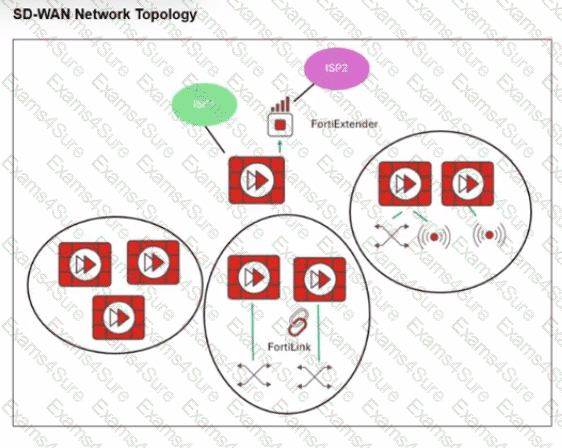
Refer to the exhibit.

You want to configure SD-WAN on a network as shown in the exhibit.

The network contains many FortiGate devices. Some are used as NGFW, and some are installed with extensions such as FortiSwitch. FortiAP. or Forti Ex tender.

What should you consider when planning your deployment?

Options:

A.  

You can build an SD-WAN topology that includes all devices. The hubs can be FortiGate devices with Forti Extender.

B.  

You can build an SD-WAN topology that includes all devices. The hubs must be devices without extensions.

C.  

You must use FortiManager to manage your SD-WAN topology.

D.  

You must build multiple SD-WAN topologies. Each topology must contain only one type of extension.

Discussion 0
Question # 18

What are three key routing principles of SD-WAN? (Choose three.)

Options:

A.  

Directly connected routes have precedence over SD-WAN rules.

B.  

Policy routes have precedence over SD-WAN rules.

C.  

SD-WAN rules are skipped if the best route to the destination is a static route

D.  

SD-WAN rules are skipped if the best route to the destination is not an SD-WAN member.

E.  

SD-WAN members are skipped if they do not have a valid route to the destination.

Discussion 0
Question # 19

(Refer to the exhibit.

Question # 19

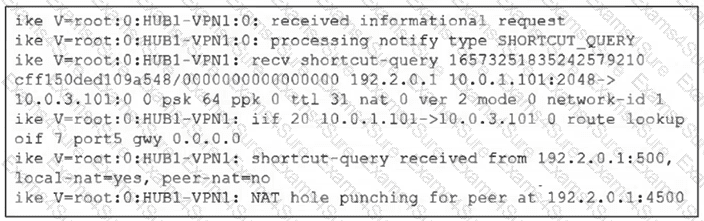
Which statement correctly describes the role of the ADVPN device in handling traffic? Choose one answer.)

Options:

A.  

This device is a spoke that has received a direct shortcut query from a remote spoke.

B.  

This device is a hub, and two spokes, 192.2.0.1 and 10.0.3.101, established a shortcut.

C.  

This device is a hub that has received a shortcut query from a spoke and has forwarded it to another spoke.

D.  

This device is a spoke that has received a shortcut query from a remote hub.

Discussion 0
Question # 20

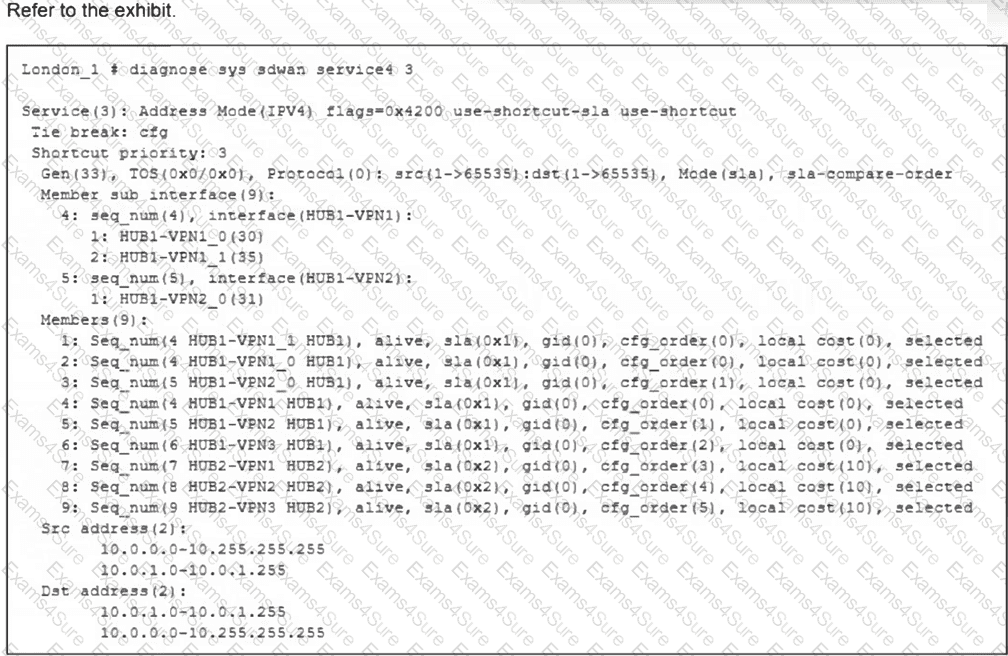
(Refer to the exhibit.

Question # 20

What can you conclude from the output shown? Choose one answer.)

Options:

A.  

It is a spoke device. SD-WAN rule 3 is configured with nine members.

B.  

It is a spoke device. The members of SD-WAN rule 3 are grouped into two zones.

C.  

It is a hub device. It allowed the establishment of three auto-discovery VPN (ADVPN) shortcuts.

D.  

It is a spoke device. SD-WAN rule 4 allows three shortcut tunnels.

Discussion 0
Get FCSS_SDW_AR-7.6 dumps and pass your exam in 24 hours!

Free Exams Sample Questions