

Summer Sale Limited Time 65% Discount Offer - Ends in 0d 00h 00m 00s - Coupon code: 65pass65

H12-351_V1.0 HCIE-WLAN (Written) V1.0 is now Stable and With Pass Result | Test Your Knowledge for Free

Exams4sure Dumps

H12-351_V1.0 Practice Questions

HCIE-WLAN (Written) V1.0

Last Update 2 days ago
Total Questions : 163

Dive into our fully updated and stable H12-351_V1.0 practice test platform, featuring all the latest HCIE-WLAN exam questions added this week. Our preparation tool is more than just a Huawei study aid; it's a strategic advantage.

Our free HCIE-WLAN practice questions crafted to reflect the domains and difficulty of the actual exam. The detailed rationales explain the 'why' behind each answer, reinforcing key concepts about H12-351_V1.0. Use this test to pinpoint which areas you need to focus your study on.

H12-351_V1.0 PDF

H12-351_V1.0 PDF (Printable)
$54.25
$154.99

H12-351_V1.0 Testing Engine

H12-351_V1.0 PDF (Printable)
$59.5
$169.99

H12-351_V1.0 PDF + Testing Engine

H12-351_V1.0 PDF (Printable)
$74.55
$212.99
Question # 21

Which of the following statements about EAP relay and EAP termination are false? (Select All that apply)

Options:

A.  

In EAP termination mode, an access device encapsulates EAP packets sent by an 802. IX client Into RADIUS packets, without processing the data in the EAP packets.

B.  

In EAP relay mode, an access device extracts information from EAP packets, encapsulates the information into RADIUS packets, and sends the RADIUS packets to an authentication server.

C.  

In EAP termination mode, an access device extracts client authentication information from the EAP packets sent by a client and encapsulates the information using the standard RADIUS protocol. The access device supports only the EAP MD5-Challenge authentication method.

D.  

The EAP termination mode simplifies the processing on an access device and supports various authentication methods. However, this mode requires an authentication server to support EAP and have high processing capability.

Discussion 0
Question # 22

Campuslnsight draws the client access journey based an the client access history, and displays the following Information: access AP. frequency band, SSIO, client IP address, roaming information, as well as the time required for association, authentication, and DHCP.

Options:

A.  

TRUE

B.  

FALSE

Discussion 0
Question # 23

iMaster NCE-Campuslnsight provides Intelligent radio calibration for high-load APs to increase the frequency bandwidth. This function applies to both 5 GHz and 2.4 GHz frequency bands.

Options:

A.  

True

B.  

False

Discussion 0
Question # 24

Which of the following types of non-Wi-R devices can be identified by Huawei APs? (Select All that Apply)

Options:

A.  

Bluetooth device

B.  

ZigBee device

C.  

Game controller

D.  

2.4 GHz wireless video and audio transmitter

Discussion 0
Question # 25

After adaptive multicast-to-unicast conversion is enabled on a WAC, an AP will automatically switch the multicast group containing the minimum number of terminals to the unicast mode if the air interface performance becomes a bottleneck during multicast-to-unicast conversion.

Options:

A.  

TRUE

B.  

FALSE

Discussion 0
Question # 26

The tunnel detection function can be used to check the tunnel status, for example, whether the tunnel is reachable. Which of the following mechanisms is used for GRE tunnel detection?

Options:

A.  

TTL

B.  

FEC

C.  

Heartbeat

D.  

Keepalive

Discussion 0
Question # 27

Drag the short-range wireless IoT technologies on the left to their corresponding descriptions on the right.
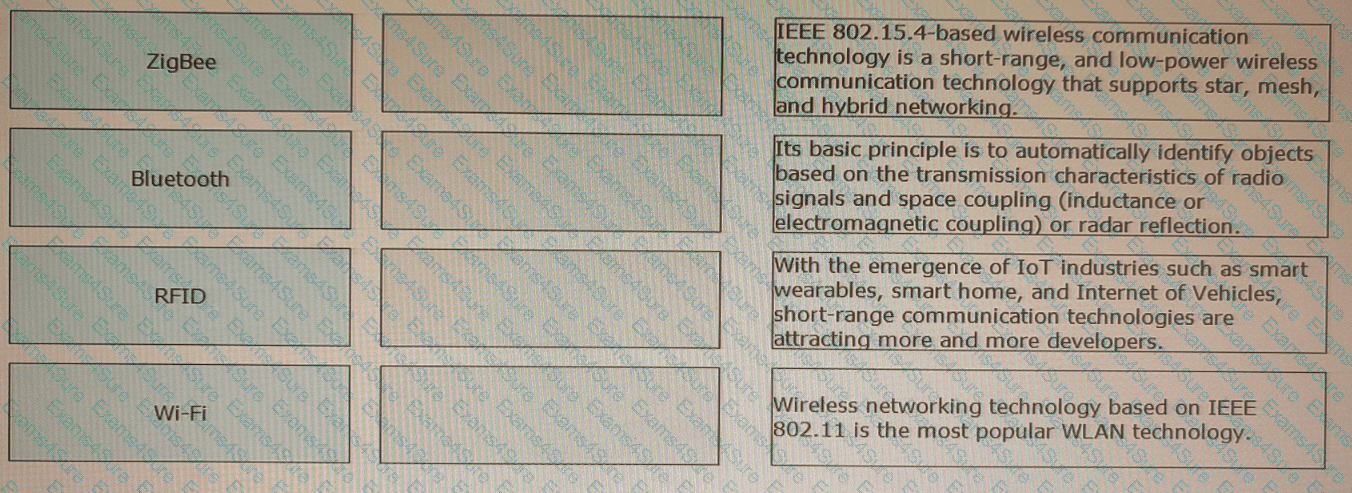
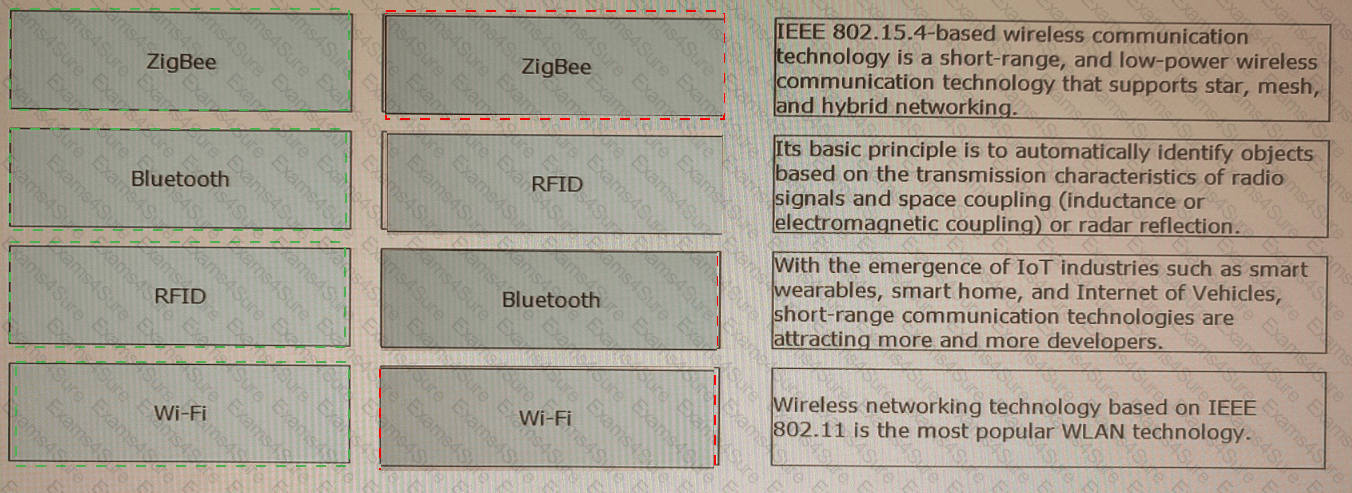
Question # 27

Options:

Discussion 0
Question # 28

In large-scale campus network design, which of the following security technologies are recommended to be deployed at the access layer?

Options:

A.  

Port isolation

B.  

Broadcast storm suppression

C.  

DHCP snooping

D.  

IPSG and DAI

Discussion 0
Question # 29

Which of the following statements about attack defense is true?

Options:

A.  

Defense against flood attacks can be used to defend against Ping of Death attacks.

B.  

Attack defense allows APs to analyze the contents and behaviors of incoming packets on ports to determine whether packets have attack characteristics. The APs then take defense measures on the packets that have attack characteristics.

C.  

Attack defense can defend against spoofing packet attacks, malformed packet attacks, fragmentation attacks, and flood attacks.

D.  

Fragmentation attack defense enables a device to detect packet fragments in real time and discard or rate-limit them to protect the device.

Discussion 0
Question # 30

As shown in the figure. API and AP2 belong to Group 1, and AP3 belongs to Group2. Apple TV1 and iPad1 access the network through API; iPhone1 accesses the network through AP2; and iPhone2 and Apple TV2 access the network through AP3. To enable a client to accurately discover mDNS service provider devices, you can use mDNS policy control functionality. The customer wants iPad1 and iPhone1 to discover Apple TVI but not Apple TV?, and iPhone2 to discover only Apple TV2. Which of the following mDNS policy control functions can be used to meet this requirement?
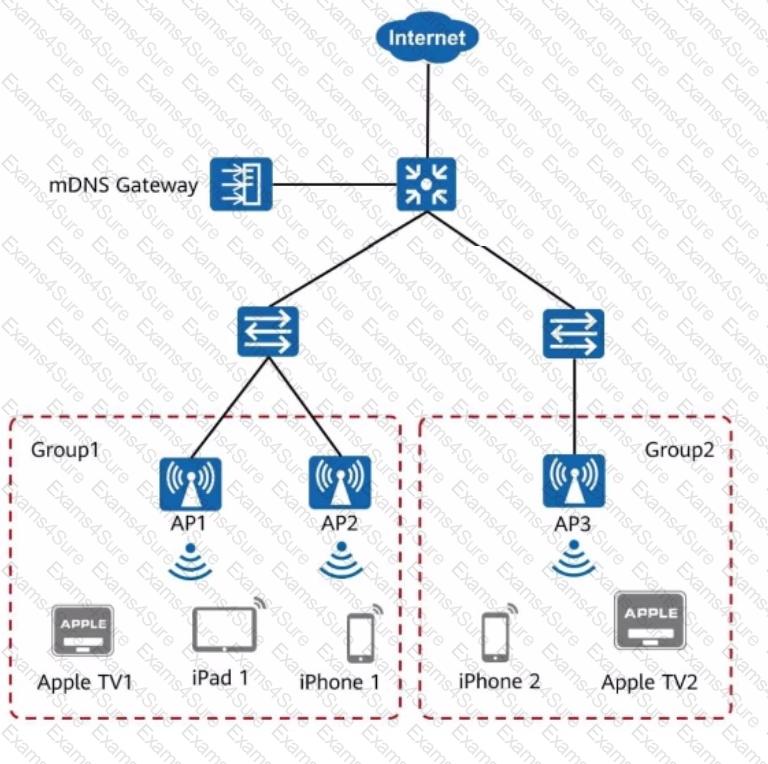

Question # 30

Options:

A.  

Service provider- and AP location-based control policy

B.  

Service type- and AP location-based control policy

C.  

Service type- and AP ID-based control policy

D.  

Service provider- and AP ID-based control policy

Discussion 0
Get H12-351_V1.0 dumps and pass your exam in 24 hours!

Free Exams Sample Questions


