Pre-Winter Sale Limited Time 65% Discount Offer - Ends in 0d 00h 00m 00s - Coupon code: 65pass65

Free Service Provider Routing and Switching - Specialist (JNCIS-SP) Practice Questions

Exams4sure Dumps

Exam style questions across every JN0-364 domain

Last Update 2 days ago
Total Questions : 65

Start with our free JN0-364 practice questions, carefully crafted to mirror the domains, phrasing, and difficulty of the real JNCIS-SP exam. Each JN0-364 exam question comes with a detailed rationale that explains not just which answer is correct but why the others fall short. That's how concepts stick. Use the free set to benchmark yourself: identify your Juniper weak domains, see where you're losing marks, and build a focused study plan in minutes.

JN0-364 PDF

JN0-364 PDF (Printable)
$54.25
$154.99

JN0-364 Testing Engine

JN0-364 PDF (Printable)
$59.5
$169.99

JN0-364 PDF + Testing Engine

JN0-364 PDF (Printable)
$74.55
$212.99
Question # 1

How are routing loops prevented in internal BGP networks?

Options:

A.  

Internal BGP routes are never readvertised to other internal BGP neighbors.

B.  

External BGP routes are never readvertised to other external BGP neighbors.

C.  

External BGP routes are never readvertised to other internal BGP neighbors.

D.  

Internal BGP routes are never readvertised to other external BGP neighbors.

Discussion 0
Question # 2

You are configuring LDP in a service provider network. After enabling LDP on core interfaces, you notice that labels are being advertised for every loopback IPv4 address that is in your IGP. Which label distribution mode is being used in this scenario?

Options:

A.  

conservative retention

B.  

ordered control

C.  

downstream unsolicited

D.  

downstream on demand

Discussion 0
Question # 3

Which IS-IS packet type will establish and maintain neighbor relationships?

Options:

A.  

link-state PDU

B.  

hello PDU

C.  

partial sequence number PDU

D.  

update PDU

Discussion 0
Question # 4

Exhibit:

user@R2> show route 198.51.100.1

inet.0: 19 destinations, 19 routes (19 active, 0 holddown, 0 hidden)

Restart Complete

+ = Active Route, - = Last Active, * = Both

198.51.100.1/32 *[Static/5] 5d 21:02:26

> to 203.0.113.65 via ge-0/0/3.0

user@R2> show route 172.20.110.0/24

inet.0: 19 destinations, 19 routes (19 active, 0 holddown, 0 hidden)

Restart Complete

+ = Active Route, - = Last Active,

* = Both

172.20.110.0/24 *[Static/5] 10:43:01

> via gr-0/0/0.0

Referring to the exhibit, traffic destined to which network will be sent through the tunnel?

Options:

A.  

172.20.110.0/24

B.  

203.0.113.65

C.  

0.0.0.0/0

D.  

198.51.100.1/32

Discussion 0
Question # 5

By default, which routing table contains a list of all ingress LSPs?

Options:

A.  

inet.2

B.  

inet.3

C.  

inet.1

D.  

inet.0

Discussion 0
Question # 6

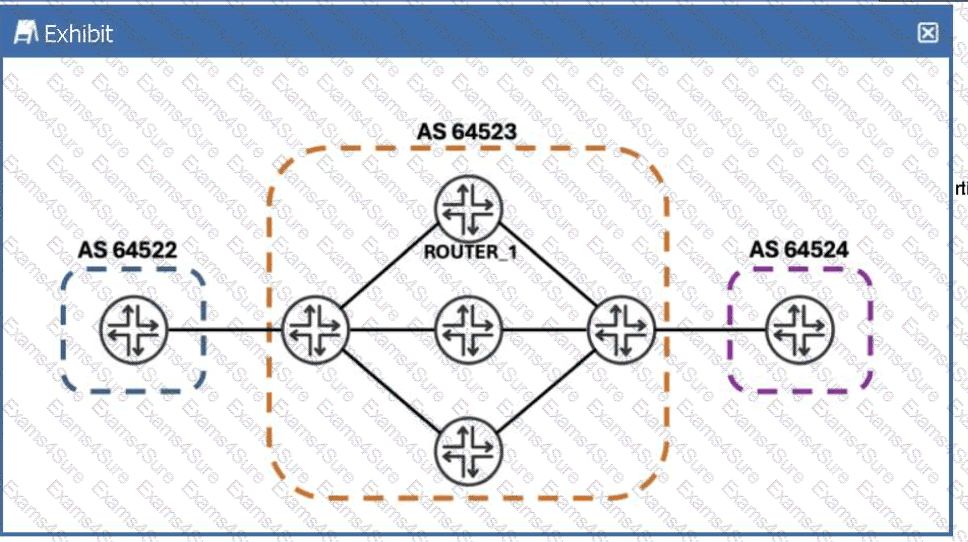
Exhibit:

Question # 6

You must configure the router called ROUTER_1 to take all valid prefixes learned from internal BGP peers in AS 64523, and then re-advertise them to other internal BGP peers in the same autonomous system.

Referring to the exhibit, which configuration must you deploy on ROUTER_1 to accomplish this task?

Options:

A.  

Configure ROUTER_1's internal BGP group with a routing policy that exports prefixes learned from internal BGP.

B.  

Configure ROUTER_1's internal BGP group with the keyword cluster, followed by a unique 32-bit number.

C.  

Configure a routing policy on ROUTER_1 that removes the no-export BGP community from all received prefixes.

D.  

Configure ROUTER_1 to belong to a different autonomous system than the other BGP routers in your network.

Discussion 0
Question # 7

In IS-IS, what would you use to control which external routes are installed in the routing table?

Options:

A.  

export policy

B.  

import policy

C.  

route preference

D.  

interface metric

Discussion 0
Question # 8

Which OSPF packet type is used to initiate and maintain neighbor relationships?

Options:

A.  

Hello

B.  

Database Description

C.  

Link-State Update

D.  

Link-State Acknowledgment

Discussion 0
Question # 9

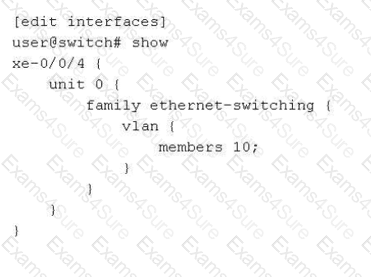
Exhibit:

Question # 9

on a Juniper switch. It shows interfacexe-0/0/4withunit 0andfamily ethernet-switching. Under vlan, it lists members 10;`]

Referring to the exhibit, which two statements are true? (Choose two.)

Options:

A.  

The interface receives tagged traffic.

B.  

The interface is a part of a VLAN that uses VLAN ID 10.

C.  

The interface receives untagged traffic.

D.  

The interface is a member of the VLAN named 10.

Discussion 0
Question # 10

You are configuring BGP for IPv6 operations. In this scenario, which two statements are correct? (Choose two.)


Options:

A.  

The Autonomous System Number (ASN) must be a 64-bit value.

B.  

The router ID uses a 128-bit identifier value.

C.  

The router ID uses a 32-bit identifier value.

D.  

The Autonomous System Number (ASN) can be either a 32-bit or 64-bit value.

Discussion 0

Free Exams Sample Questions