Summer Sale Limited Time 65% Discount Offer - Ends in 0d 00h 00m 00s - Coupon code: 65pass65

NSE5_FWB_AD-8.0 Fortinet NSE 5 - FortiWeb 8.0 Administrator is now Stable and With Pass Result | Test Your Knowledge for Free

Exams4sure Dumps

NSE5_FWB_AD-8.0 Practice Questions

Fortinet NSE 5 - FortiWeb 8.0 Administrator

Last Update 3 days ago
Total Questions : 36

Dive into our fully updated and stable NSE5_FWB_AD-8.0 practice test platform, featuring all the latest NSE 5 Network Security Analyst exam questions added this week. Our preparation tool is more than just a Fortinet study aid; it's a strategic advantage.

Our free NSE 5 Network Security Analyst practice questions crafted to reflect the domains and difficulty of the actual exam. The detailed rationales explain the 'why' behind each answer, reinforcing key concepts about NSE5_FWB_AD-8.0. Use this test to pinpoint which areas you need to focus your study on.

NSE5_FWB_AD-8.0 PDF

NSE5_FWB_AD-8.0 PDF (Printable)
$54.25
$154.99

NSE5_FWB_AD-8.0 Testing Engine

NSE5_FWB_AD-8.0 PDF (Printable)
$59.5
$169.99

NSE5_FWB_AD-8.0 PDF + Testing Engine

NSE5_FWB_AD-8.0 PDF (Printable)
$74.55
$212.99
Question # 1

Refer to the exhibits.

Question # 1

Question # 1

You are configuring a FortiWeb device in reverse proxy mode, placed downstream from a FortiGate. The server pool includes two back-end web servers: 10.1.1.21 and 10.1.1.22, and you’ve defined a health check policy.

After completing the server policy configuration and applying it to a virtual server, you notice that FortiWeb is not forwarding traffic to the back-end servers. No errors or health check failures appear in the logs.

Based on the configuration shown in the exhibit, which change should you make to restore back-end traffic flow?

Options:

A.  

Select the correct server pool in the FortiWeb server policy.

B.  

Enable Client Real IP to ensure traffic goes to the back-end servers.

C.  

Change the virtual server IP address to match one of the back-end servers.

D.  

Configure FortiGate to forward traffic to the back-end IP addresses directly.

Discussion 0
Question # 2

Refer to the exhibits.

Question # 2

Question # 2

A new domain, https://finance.fortinet.demo, was added but not explicitly mapped. Users report the site loads correctly, but you’re unsure which back-end server is being used.

Why is this request succeeding despite no explicit routing rule for finance.fortinet.demo?

Options:

A.  

The inherited certificate has a wildcard entry for all subdomains.

B.  

FortiWeb auto-generates fallback policies for new domains.

C.  

The connection is passed to FortiGate for secondary routing.

D.  

The request defaults to app_server_1 because it is marked as the default route.

Discussion 0
Question # 3

Refer to the exhibit.

Question # 3

Question # 3

A FortiWeb administrator tests a new form input value after training the machine learning (ML) anomaly detection system.

The hidden Markov model (HMM) flags the input as abnormal, while the support vector machine (SVM) model classifies it as normal. FortiWeb allows the request.

What does this result indicate about the FortiWeb ML anomaly detection behavior?

Options:

A.  

The anomaly detection thresholds are too low and must be increased.

B.  

One of the ML models should be disabled to avoid inconsistent results.

C.  

FortiWeb is correctly allowing an unusual but non-malicious input based on combined HMM and SVM evaluation.

D.  

FortiWeb failed to detect an attack and should have blocked the request.

Discussion 0
Question # 4

A FortiWeb administrator wants to create a machine learning (ML)-based bot detection system.

Which three actions must the administrator take to build and activate this ML model? (Choose three.)

Options:

A.  

Collect traffic samples for training.

B.  

Verify the model manually on test data only.

C.  

Apply Bayesian analysis to the model output.

D.  

Build the detection model using collected data.

E.  

Run the model in the live environment.

Discussion 0
Question # 5

A third-party penetration test reveals that users can bypass login controls through a mobile API. Your current FortiWeb configuration includes zero trust network access (ZTNA) profiles and cookie security, but API protection and client management are not enabled. The security team asks you to recommend the most effective way to close this gap.

Which FortiWeb adjustment would best prevent future unauthorized API access?

Options:

A.  

Switch to a reverse-proxy mode to bypass cookie-based controls.

B.  

Enable API protection and client management to enforce identity checks on mobile API traffic.

C.  

Replace ZTNA with bot protection to reduce false positives.

D.  

Log only API traffic and rely on FortiAnalyzer for future alerts.

Discussion 0
Question # 6

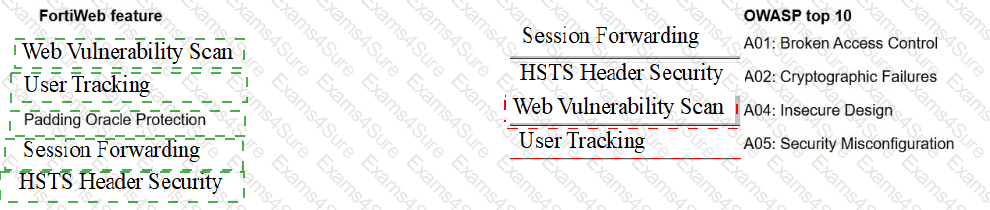
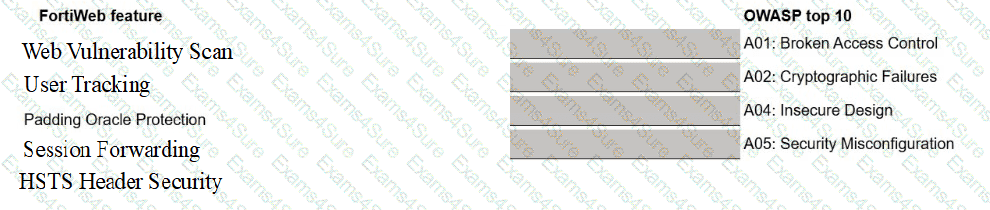
A FortiWeb administrator is reviewing issues found during a security audit. The audit lists shortcomings based on behavior, configuration, and data protection.

The administrator must break down the findings and match them with the correct FortiWeb feature.

Select each FortiWeb feature in the left column, hold and drag it to the blank space next to the OWASP issue in the column on the right. Once you match a FortiWeb

feature to the OWASP issue, you can move it again if you want to change your answer by clicking on the FortiWeb feature. You need to match five FortiWeb features to

the OWASP issue in the work area.
Question # 6

Options:

Discussion 0
Question # 7

While reviewing FortiWeb logs, you notice a suspicious login request that failed authentication. You suspect it may be part of an injection attack targeting the login form.

Which input pattern is an example of a typical SQL injection attempt that could bypass authentication checks?

Options:

A.  

'||(SELECT password FROM users WHERE role='admin')||'

B.  

< sql > select(ALL USERS); < /sql >

C.  

< script > document.location='/steal?cookie='+document.cookie < /script >

D.  

SELECT username FROM accounts WHERE username='admin';-- ' AND password='password';

Discussion 0
Question # 8

A FortiWeb administrator needs to allow a known web indexer to scan the website for search engine visibility.

What is the easiest way to allow this on FortiWeb?

Options:

A.  

Add the web indexer IP address to the trusted IP address list.

B.  

Add the web indexer IP address to an IP exception list inside the inline protection profile.

C.  

Add the web indexer IP address to the FortiGuard Known Search Engines category.

D.  

Add the web indexer user-agent string to a custom signature exception rule.

Discussion 0
Question # 9

Which situation best explains when a FortiWeb administrator should enable automatic HTTP-to-HTTPS redirection?

Options:

A.  

The organization prefers to keep both HTTP and HTTPS available for flexibility.

B.  

Users are accessing a static website that does not handle sensitive data.

C.  

The back-end server uses only HTTP and cannot support encryption.

D.  

The web application handles logins or personal data and must ensure encrypted communication.

Discussion 0
Question # 10

Refer to the exhibit.

Question # 10

You are a FortiWeb administrator reviewing the biometrics-based detection rule shown in the exhibit. Your goal is to configure a rule that detects bots that avoid typical human interactions like using a mouse or clicking. You also want to log the detection event and apply a high-severity alert.

Based on the current configuration, which settings should you change to meet this goal?

Options:

A.  

Select Screen Touch and Page Focus , set the severity to Low , and keep action as Deny (no log) .

B.  

Select Keyboard and Scroll , change the action to Alert , and set the severity to High .

C.  

Select Mouse Movement and Click , change the action to Alert , and set the severity to High .

D.  

Do not select any client events to monitor, enable Bot Trait Checking , keep the current severity, and keep the action as Deny (no log) .

Discussion 0
Get NSE5_FWB_AD-8.0 dumps and pass your exam in 24 hours!

Free Exams Sample Questions