
Exam style questions across every 3V0-23.25 domain
Last Update 2 days ago
Total Questions : 77
Start with our free 3V0-23.25 practice questions, carefully crafted to mirror the domains, phrasing, and difficulty of the real VCAP-Storage exam. Each 3V0-23.25 exam question comes with a detailed rationale that explains not just which answer is correct but why the others fall short. That's how concepts stick. Use the free set to benchmark yourself: identify your VMware weak domains, see where you're losing marks, and build a focused study plan in minutes.

An administrator is planning the deployment of a new VMware Cloud Foundation (VCF) Workload Domain. The storage design decisions for the solution are:
• NFS
• NVMe over RDMA
• No local storage is available to the hosts
What is the storage solution build order for the Workload Domain?
A firm is migrating to VMware Cloud Foundation (VCF) and will leverage its existing enterprise Fibre Channel SAN for workload domain storage.
Their priorities include seamless integration into VCF, automated lifecycle management via VCF Operations, consistent VM-level performance control, and alignment with best practices for large-scale VI environments. Management does not require vSAN, and operational simplicity is critical.
Which design meets all of the specified requirements?
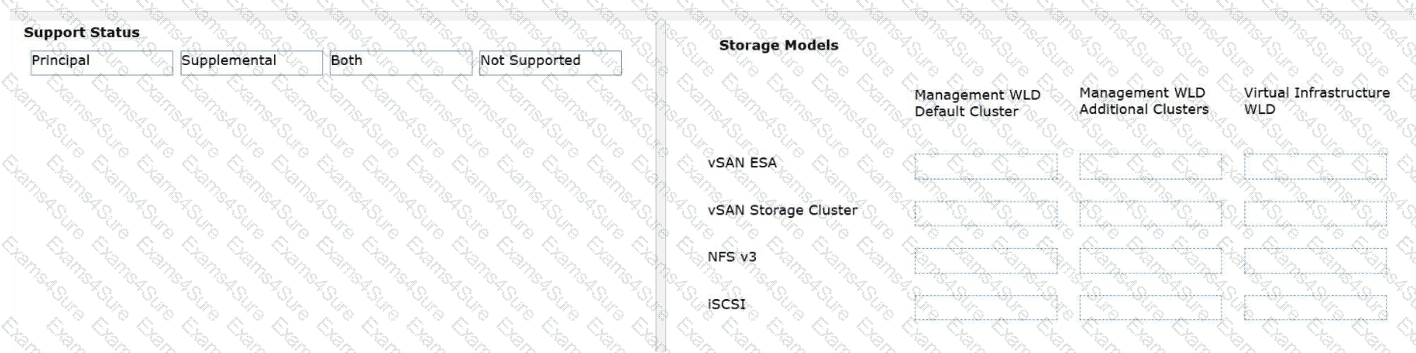
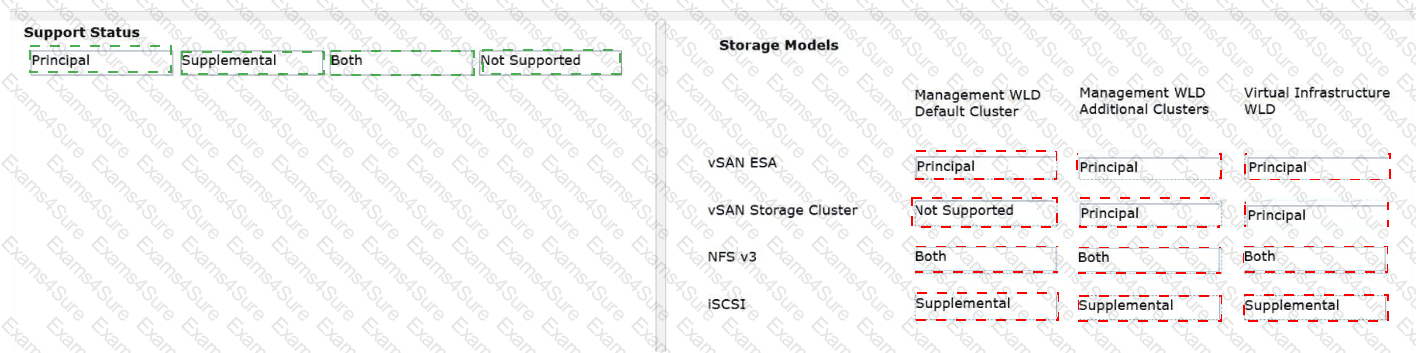
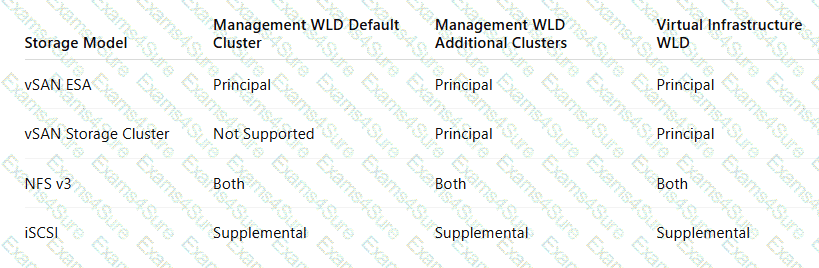
An administrator is responsible for a VMware Cloud Foundation (VCF) Private Cloud and has been tasked with identifying which storage model is supported in the different VCF Workload Domains.
Drag and drop the Support Status of each storage model on the left to each type of Workload Domain on the right.
An administrator is tasked with enabling vSAN Data Protection.
Which action is required to enable vSAN Data Protection?
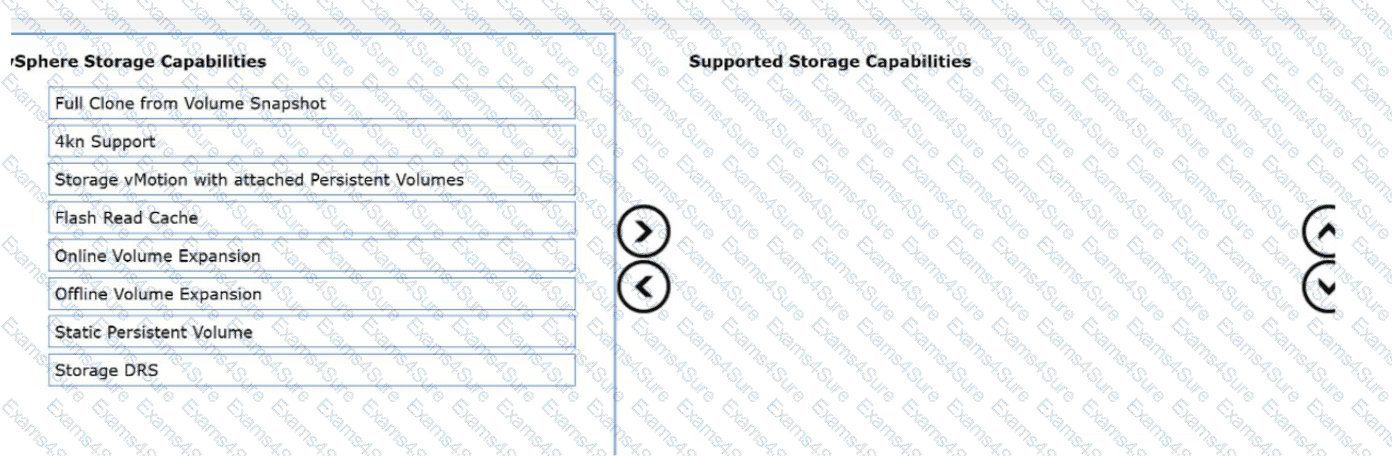
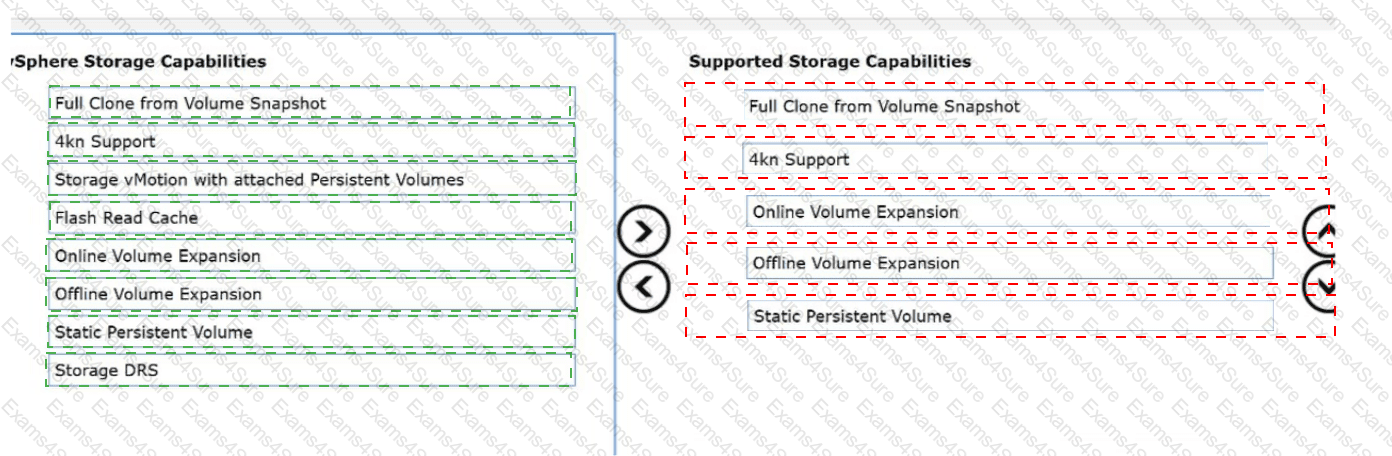
Select the storage capabilities supported for use with persistent volumes in the VMware Kubernetes Service (VKS) in VMware Cloud Foundation (VCF).
Drag and drop the five supported capabilities from the vSphere Storage Capabilities list on the left and place them into the Supported Storage Capabilities list on the right in any order. (Choose five.)
A vSAN ESA solution is configured using the following requirements:
• Seven ESX Hosts, each host contains:
32 CPU
256 GB memory
25 GbE network
12 storage devices 4 TB each
One storage pool using the 12 storage devices • RAID-6 with FTT=2 If a storage device on a single host fails, what percentage of that host’s capacity is impacted?
An administrator has successfully deployed a vSAN Stretched Cluster and needs to ensure that any Virtual Machines (VMs) that are created are placed in the appropriate site.
Which two steps are required to complete the task? (Choose two.)
A clustered legacy application is scheduled for decommissioning at the end of the month. While in use, it stored application and quorum data on a pair of vSAN iSCSI Target LUNs.
After the vSAN iSCSI Target Service is disabled, what will happen to the existing targets and LUNs?
An administrator is monitoring a vSAN ESA backed workload domain that is dedicated for running AI inferencing. When the administrator navigates to the Storage Performance dashboard in VMware Cloud Foundation Operations, the performance dashboard shows:
• High backend write latency ( > 8 ms)
• Low read latency ( < 1 ms)
• Normal network throughput
• Disk Group Health = Green
Based on the readings above, what would be the explanation?
An administrator is using an external Key Management Server (KMS) with a vSAN Data-at-Rest Encryption cluster.
The KMS becomes temporarily unavailable.
What happens if a host without a Trusted Platform Module in the cluster is rebooted during this outage?



