
Click on the exhibit below.
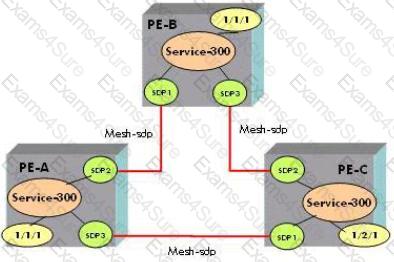
Assume a CE router is connected to the SAP of each P
E.
The arp cache of all CE routers is empty and the FDB for VPLS 300 is empty. The CE router connected to PE-A initiates a ping towards the CE router connected to PE-C.
The ping is successful. Which of the following statements are true? (Choose 2)An l-VPLS is configured with a service id of 511. What will the value of the l-SID be assuming a default configuration?
Click on the exhibit below.
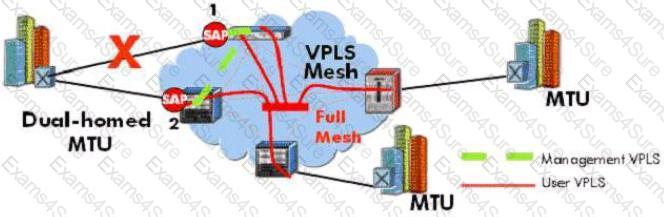
In the diagram below, SAP 1 is put into the blocking state as a result of the spanning tree protocol. What will occur in the VPLS instance if SAP 2 goes down and SAP 1 transitions to the forwarding state? Select the most accurate statement.
Click on the exhibit below.
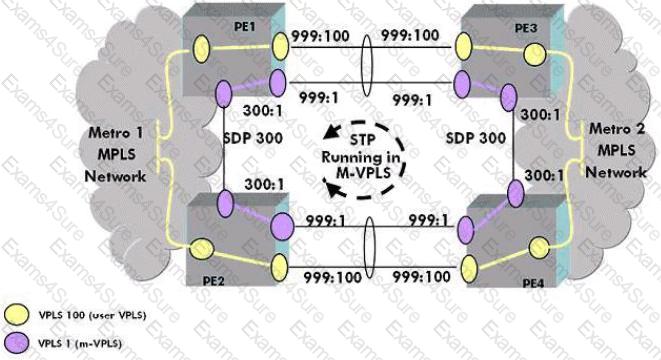
Study the network diagram. Which of the following configurations is correct for user VPLS 100 on PE4?
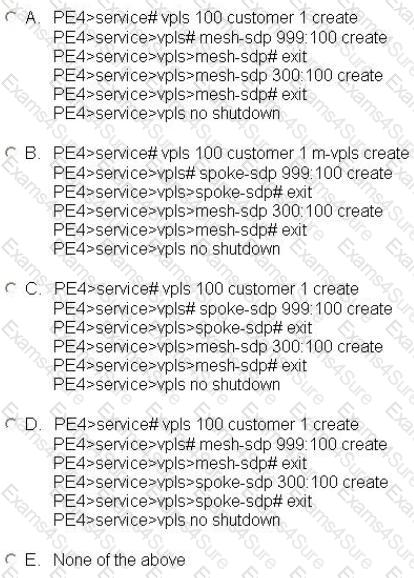
Click on the exhibit below.
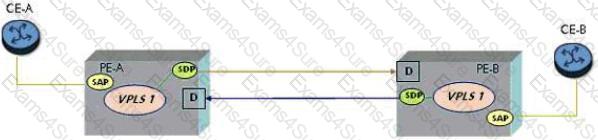
The SAP on PE-A has been configured with dot1q encapsulation. The SAP on PE-B has been configured with qinq encapsulation. CE-A sends frames with a single tag of 100. The VLAN tag from CE-A must be passed transparently. CE-B is expecting a frame with a top tag of 200 and bottom tag of 100. Which of the following is the correct SAP id for PE-B?
What function in IEEE 802.1 ah helps to limit the amount of MAC addresses learned in the core?
Which OAM tool can be used to dynamically learn the MAC address of a CE device connected to a SAP within a VPLS service?
Consider a large metro-to-metro VPLS network interconnected with a mesh of mesh-SDPs. Which of the following statements does NOT apply to this situation?