
You use Azure Machine Learning to tram a model.
You must use Baylean sampling to Tune hyperparaters.
You need to select a learning_rate parameter distribution.
Which two distributions can you use? Each correct answer presents a complete solution.
NOTE Each correct selection is worth one point.
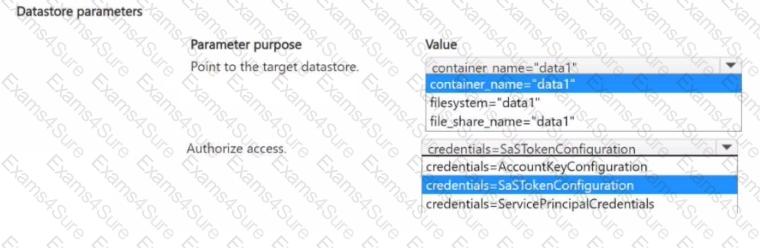
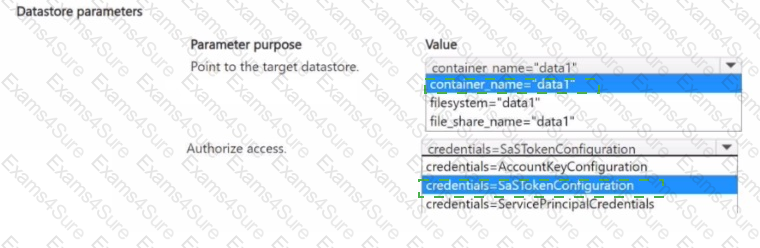
You manage an Azure Machine Learning workspace named Workspace1 and an Azure Blob Storage accessed by using the URL https://storage1.blob.core.wmdows.net/data1.
You plan to create an Azure Blob datastore in Workspace1. The datastore must target the Blob Storage by using Azure Machine Learning Python SDK v2. Access authorization to the datastore must be limited to a specific amount of time.
You need to select the parameters of the Azure Blob Datastore class that will point to the target datastore and authorize access to it.
Which parameters should you use? To answer, select the appropriate options in the answer area
NOTE: Each correct selection is worth one point.
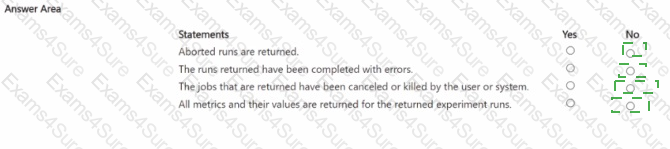
You manage an Azure Machine Learning workspace. You create an experiment named experiment1 by using the Azure Machine Learning Python SDK v2 and MLflow. You are reviewing the results of experiment1 by using the following code segment:
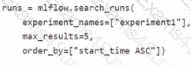
For each of the following statements, Select Yes if the statement is true Otherwise, select No.

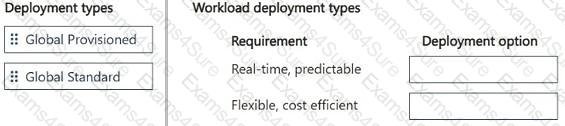
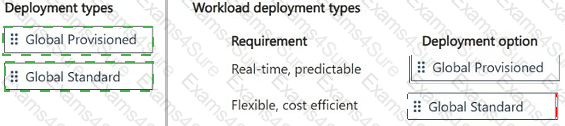
An organization is deploying generative AI solutions by using Microsoft Foundry to support multiple production workloads.
The organization has the following workload requirements:
• One workload must be real-time, latency-sensitive, and have predictable global usage patterns that demand consistent performance.
• One workload must have variable performance and be optimized for cost-efficient operation.
You need to select a global deployment type for each workload.
Which type of deployment should you use for each workload requirement? To answer, move the appropriate deployment types to the correct requirements. You may use each deployment type once, more than once, or not at all. You may need to move the split bar between panes or scroll to view content.
NOTE: Each correct selection is worth one point.
You manage an Azure Machine Learning workspace named workspace1.
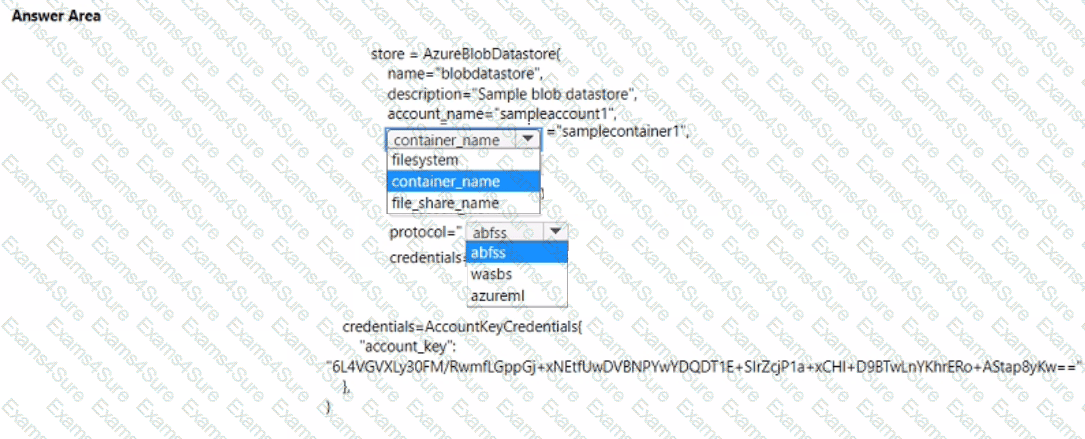
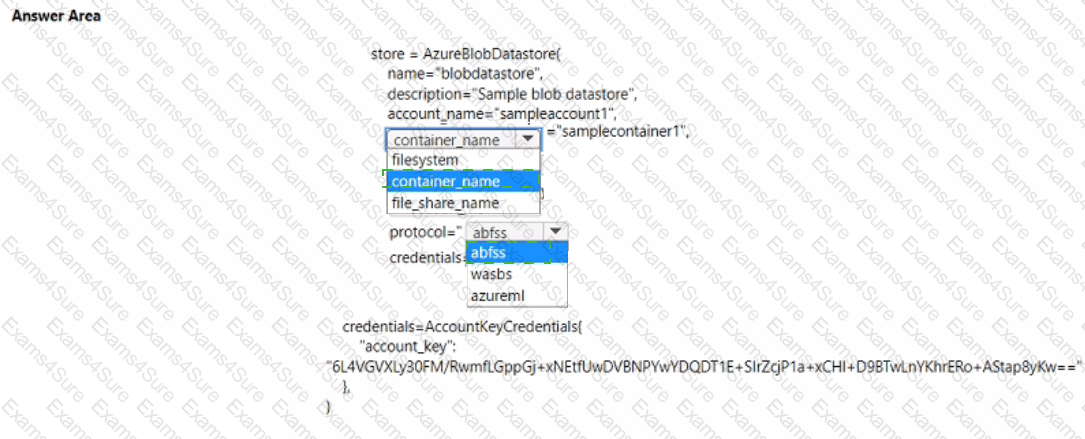
You must register an Azure Blob storage datastore in workspace1 by using an access key. You develop Python SDK v2 code to import all modules required to register the datastore.
You need to complete the Python SDK v2 code to define the datastore.
How should you complete the code? To answer, select the appropriate options in the answer area.
NOTE: Each correct selection is worth one point.
You manage a Retrieval-Augmented Generation (RAG) system that retrieves internal policy documents from a vector index.
Recent analysis shows that:
Retrieved results frequently include duplicated content from the same document.
Retrieved chunks sometimes span unrelated policy sections.
You review the following retrieval and ingestion configurations:
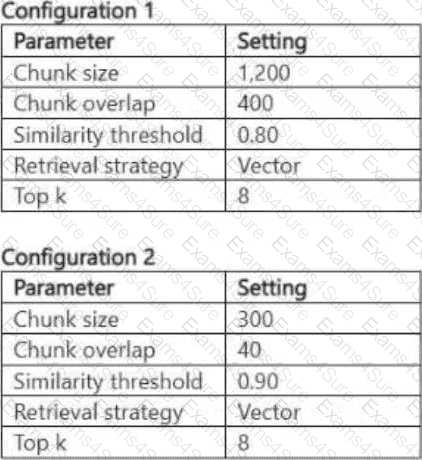
You need to reduce duplicated retrieval results and improve chunk relevance across policy sections.
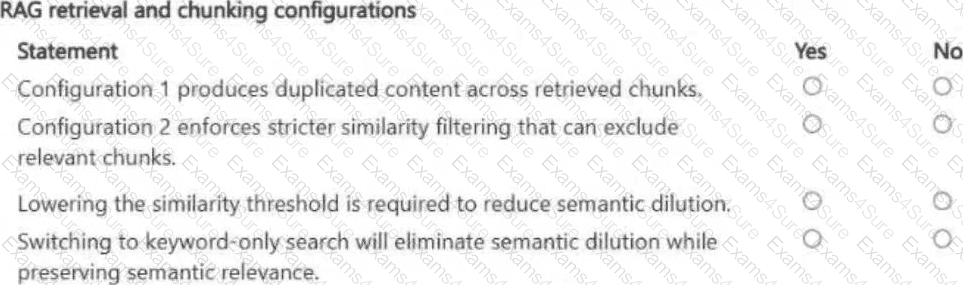
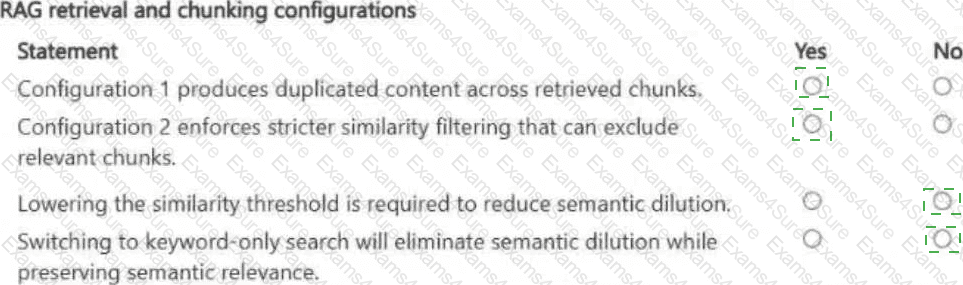
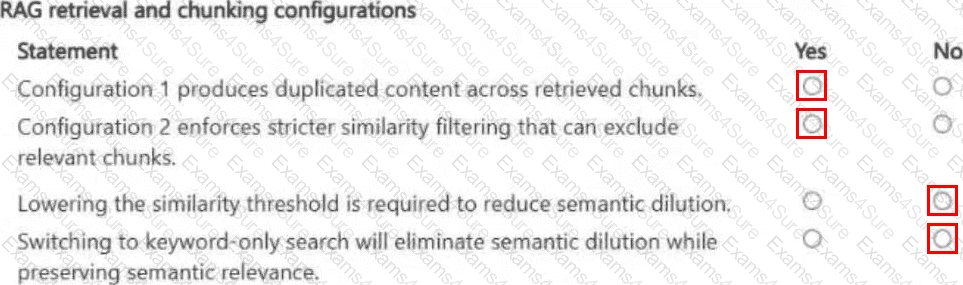
For each of the following statements, select Yes if the statement is true. Otherwise, select No. NOTE: Each correct selection is worth one point.
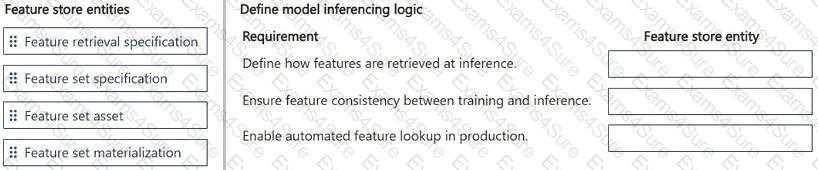
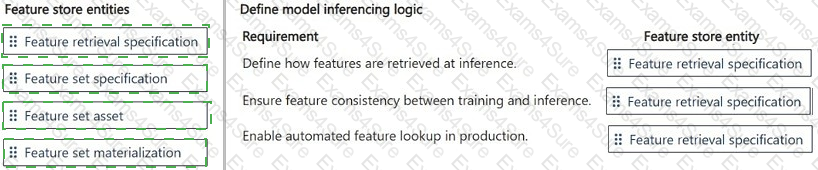
A data science team trains a model that depends on features that are stored in a managed feature store.
The model is registered in Azure Machine Learning and will be deployed to a real-time endpoint.
After deployment, the model must:
• Retrieve feature values dynamically at inference time.
• Use the same feature definitions that were used during training.
• Run without manual configuration changes across environments.
You need to define feature store entities so that feature retrieval behaves as expected when the model is deployed.
Which feature store entity should you select for each requirement? To answer, move the appropriate feature store entities to the correct requirements. You may use each feature store entity once, more than once, or not at all. You may need to move the split bar between panes or scroll to view content.
NOTE: Each correct selection is worth one point.
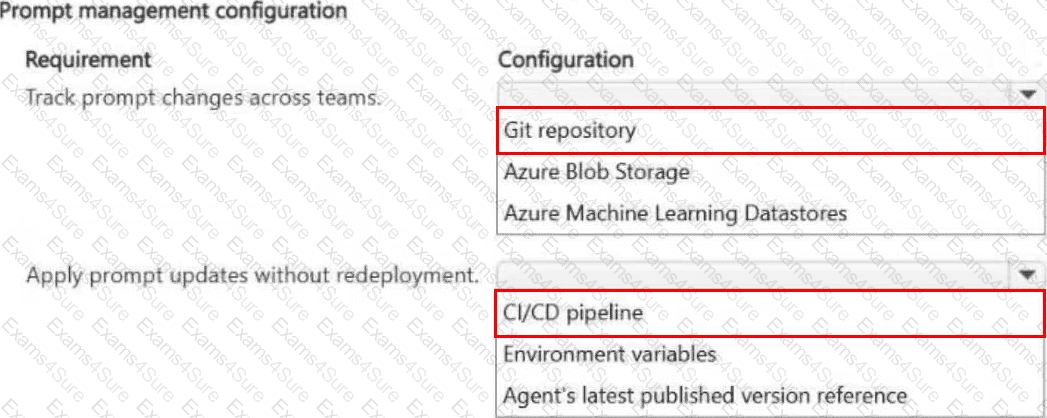
A team is building a generative AI agent by using Retrieval-Augmented Generation (RAG) in Microsoft Foundry.
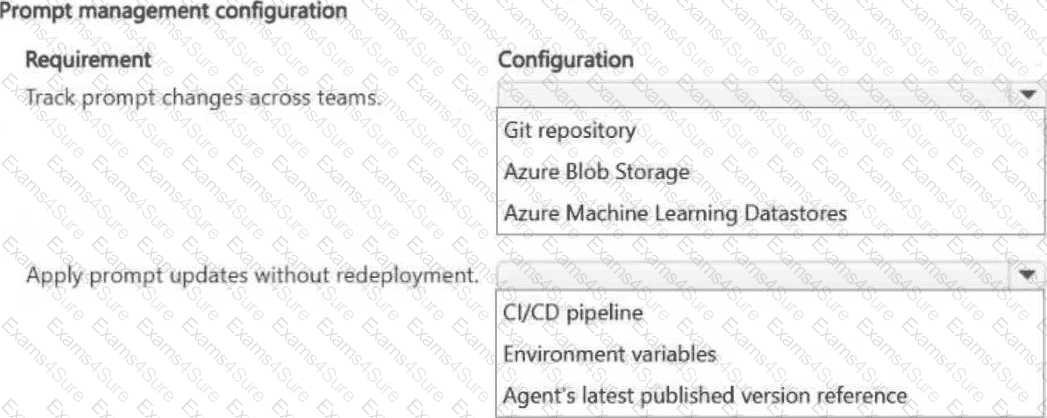
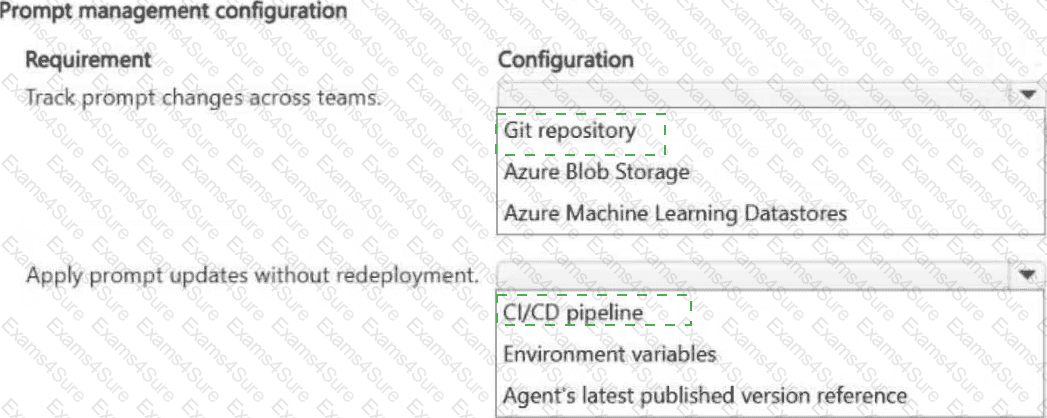
The team frequently updates prompt content. The team must be able to track changes across contributors while avoiding full application redeployments.
You need to enable rapid prompt iteration with traceability. Applications consuming the agent must be able to use updated prompts without requiring redeployment.
What should you configure for each requirement? To answer, select the appropriate options in the answer area. NOTE: Each correct selection is worth one point.
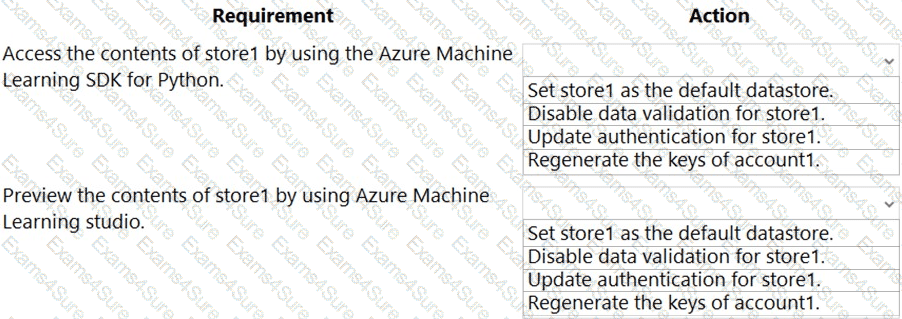
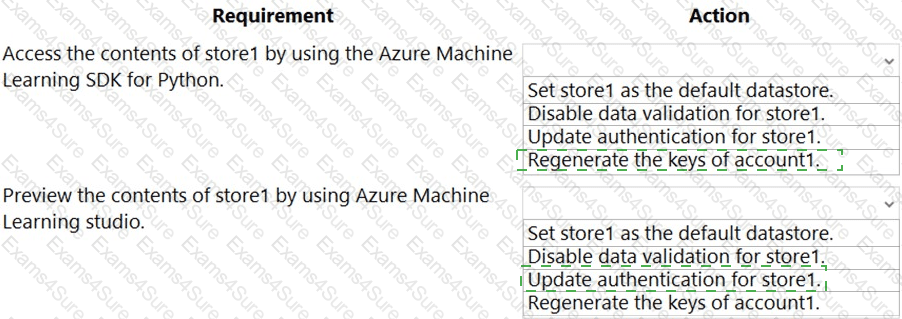
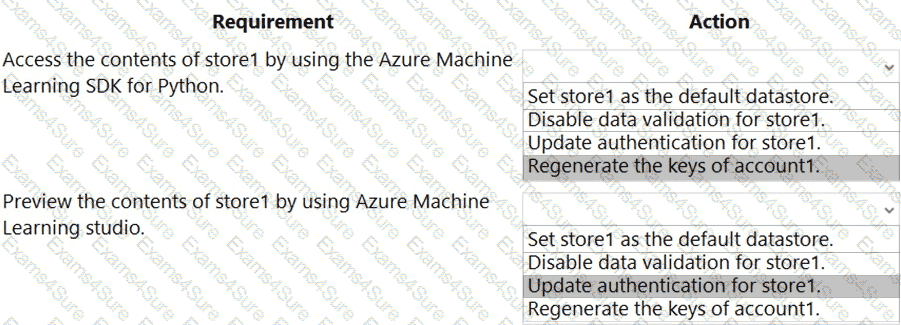
You have an Azure Machine Learning workspace named workspace1 that is accessible from a public endpoint. The workspace contains an Azure Blob storage datastore named store1 that represents a blob container in an Azure storage account named account1. You configure workspace1 and account1 to be accessible by using private endpoints in the same virtual network.
You must be able to access the contents of store1 by using the Azure Machine Learning SDK for Python. You must be able to preview the contents of store1 by using Azure Machine Learning studio.
You need to configure store1.
What should you do? To answer, select the appropriate options in the answer area.
NOTE: Each correct selection is worth one point.
An organization uses Microsoft Foundry to develop generative AI projects that access shared Azure resources such as storage accounts and vector databases.
The organization s security policy requires eliminating secret key-based authentication and enforcing least-privilege access.
You must configure identity and access so that:
Services authenticate without stored credentials.
Permissions are scoped appropriately across projects and shared resources.
You need to configure the appropriate identity or access mechanism for each requirement.
What should you configure in Microsoft Foundry to meet each requirement? To answer, move the appropriate configuration mechanisms to the correct requirements. You may use each configuration mechanism once, more than once, or not at all. You may need to move the split bar between panes or scroll to view content. NOTE: Each correct selection is worth one point.