
Exam style questions across every AI-300 domain
Last Update 1 day ago
Total Questions : 187
Start with our free AI-300 practice questions, carefully crafted to mirror the domains, phrasing, and difficulty of the real Microsoft Certified: Machine Learning Operations (MLOps) Engineer exam. Each AI-300 exam question comes with a detailed rationale that explains not just which answer is correct but why the others fall short. That's how concepts stick. Use the free set to benchmark yourself: identify your Microsoft weak domains, see where you're losing marks, and build a focused study plan in minutes.

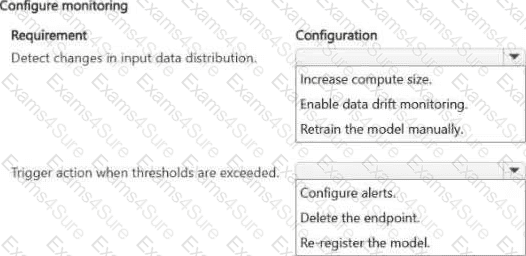
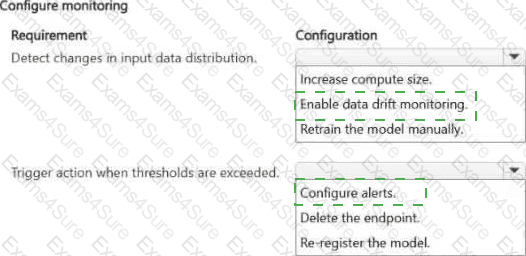
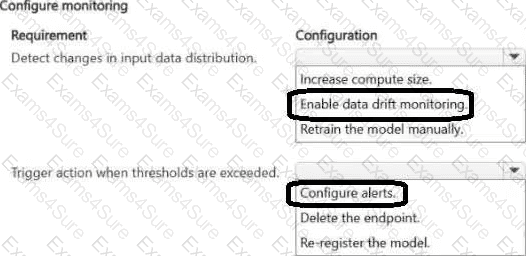
A machine learning model is deployed to production in Azure Machine Learning and is actively serving predictions for a business application. The model was trained by using a historical dataset that represented expected input patterns at the time of deployment.
The team working on the model must ensure the following:
Changes in input data distribution are detected.
Appropriate actions are triggered when predefined thresholds are exceeded.
You need to configure monitoring to meet the requirements.
Which configuration should you use for each requirement? To answer, select the appropriate options in the answer area. NOTE: Each correct selection is worth one point.
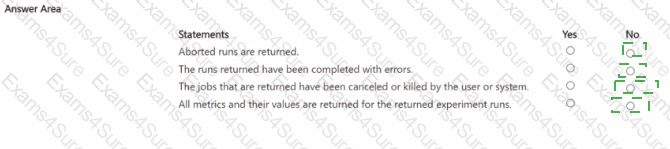
You manage an Azure Machine Learning workspace. You create an experiment named experiment1 by using the Azure Machine Learning Python SDK v2 and MLflow. You are reviewing the results of experiment1 by using the following code segment:
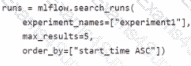
For each of the following statements, Select Yes if the statement is true Otherwise, select No.

When comparing prompt variants, the team plans to assess whether the generated responses are grammatically correct.
You need to evaluate the quality of the language from the generated responses.
Which evaluator should you use?
Note: This question is part of a series of questions that present the same scenario. Each question in the series contains a unique solution that might meet the stated goals. Some question sets might have more than one correct solution, while others might not have a correct solution.
After you answer a question in this section, you will NOT be able to return to it. As a result, these questions will not appear on the review screen.
You work in Microsoft Foundry with a prompt flow.
You must manually evaluate prompts and compare results across prompt variants.
You need to capture the inputs, outputs, token usage, and latencies for each flow run for the evaluation.
Solution: Use the prompt flow SDK to enable tracing for the flow before executing runs. Then run the flow to generate traceable results.
Does the solution meet the goal?
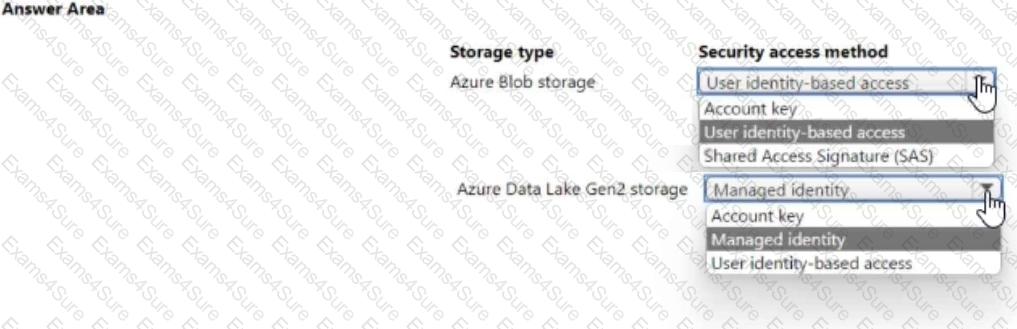
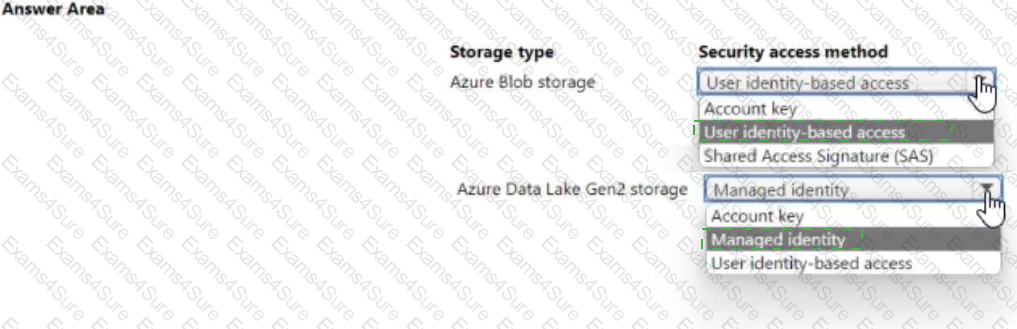
You manage an Azure Machine Learning workspace named workspace1 by using the Python SDK v2.
You must register datastores in workspace1 for Azure Blob and Azure Data Lake Gen2 storage to meet the following requirements:
• Data scientists accessing the datastore must have the same level of access.
• Access must be restricted to specified containers or folders.
You need to configure a security access method used to register the Azure Blob and Azure Data lake Gen? storage in workspace1. Which security access method should you configure? To answer, select the appropriate options in the answers area.
NOTE: Each correct selection is worth one point.
-
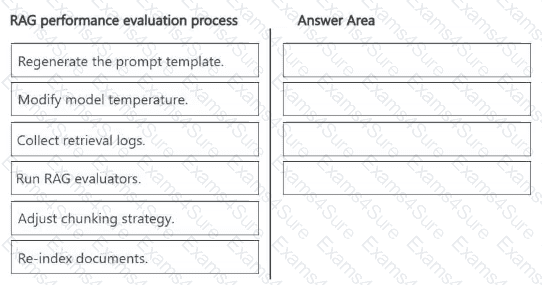
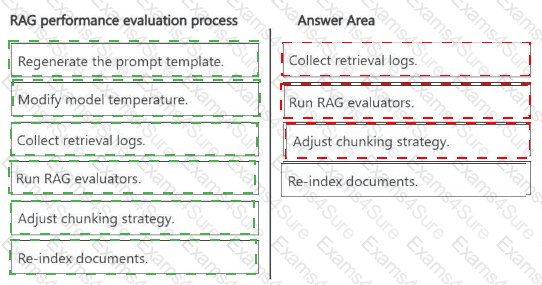
A team is developing a Retrieval-Augmented Generation (RAG) system.
The team requires improvements to the system ' s retrieval quality to ensure accurate, grounded responses.
You need to assess RAG performance before you can suggest an improvement strategy.
Which four actions should you perform in sequence? To answer, move the appropriate actions from the list of actions to the answer area and arrange them in the correct order.
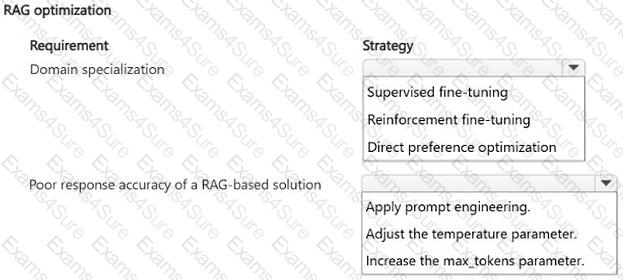
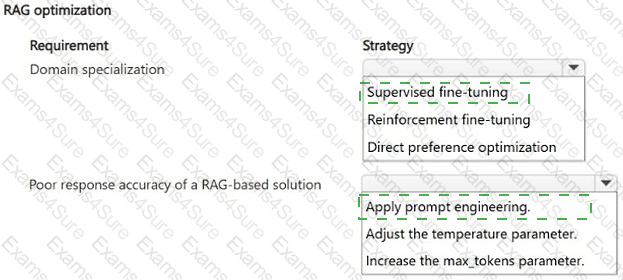
Fabrikam Inc. needs to improve the performance of a GPT-5 model based on the stated technical requirements.
Which action should you perform first?
You need to configure an optimization method to meet Fabrikam Inc.’s technical requirements.
Which strategy should you apply first? To answer, select the appropriate options in the answer area.
NOTE: Each correct selection is worth one point.
Fabrikam Inc. must improve its deployment process because traditional machine learning models are deployed manually and the organization has limited rollback capability .
You need to recommend a deployment approach that supports staged rollout and rollback while minimizing operational overhead.
Which deployment approach should you recommend?
You need to recommend an experiment-tracking strategy that ensures consistent experiment results.
What should you recommend?