
AZ-801 Practice Questions
Configuring Windows Server Hybrid Advanced Services
Last Update 1 day ago
Total Questions : 281
Dive into our fully updated and stable AZ-801 practice test platform, featuring all the latest Microsoft Certified: Windows Server Hybrid Administrator Associate exam questions added this week. Our preparation tool is more than just a Microsoft study aid; it's a strategic advantage.
Our free Microsoft Certified: Windows Server Hybrid Administrator Associate practice questions crafted to reflect the domains and difficulty of the actual exam. The detailed rationales explain the 'why' behind each answer, reinforcing key concepts about AZ-801. Use this test to pinpoint which areas you need to focus your study on.

You have an Azure subscription. The subscription contains a virtual machine named VM1 that runs Windows Server. The subscription contains the storage accounts shown in the following table.
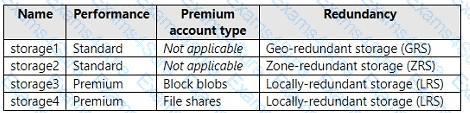
You plan to enable boot diagnostics for VM1.
You need to configure storage for the boot diagnostics logs and snapshots.
Which storage account should you use?
Your network contains an on-premises Active Directory Domain Services (AD DS) domain. The domain contains two virtual machines named VM1 and VM2 that run Windows Server.
You plan to implement a failover cluster named Cluster1 that will use VM1 and VM2 as nodes.
You need to ensure that Cluster1 can use floating IP addresses.
Which two components should you deploy? Each correct answer presents part-of the solution.
NOTE: Each correct selection is worth one point.
You deploy Azure Migrate to an on-premises network.
You have an on-premises physical server named Server1 that runs Windows Server and has the following configurations:
• Operating system disk; 600 GB
• Data disk: 3 TB
• NIC Teaming: Enabled
• Mobility service: Installed
• Windows Defender Firewall: Enabled
• Microsoft Defender Antivirus: Enabled
You need to ensure that you can use Azure Migrate to migrate Server1.
Solution: You disable Windows Defender Firewall on Server 1.
Does this meet the goal?
You have two servers named Server1 and Server2 that run W indows Server. Both servers have the Hyper-V server role installed.
Server1 hosts three virtual machines named VM1, VM2, and VM3. The virtual machines replicate to Server2.
Server1 experiences a hardware failure.
You need to bring VM1, VM2, and VM3 back online as soon as possible.
From the Hyper-V Manager console on Server2, what should you run for each virtual machine?
You have a server named Served that runs Windows Server 2022 and is part of a three-node failover cluster. You need to upgrade Server1 to Windows Server 2025. The solution must minimize downtime for the cluster. What should you do first?
Note: This question is part of a series of questions that present the same scenario. Each question in the seri es contains a unique solution that might meet the stated goals. Some question sets might have more than one correct solution, while others might not have a correct solution.
After you answer a question in this section, you will NOT be able to return to it . As a result, these questions will not appear in the review screen.
You have a failover cluster named Cluster1 that hosts an application named App1.
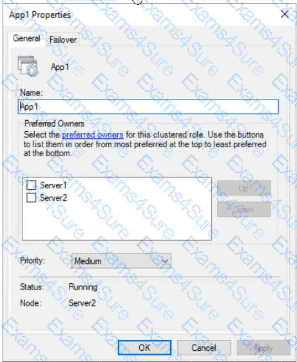
The General tab in App1 Properties is shown in the General exhibit. (Click the General tab.)
The Fai lover tab in App1 Properties is shown in the Failover exhibit. (Click the Failover tab.)
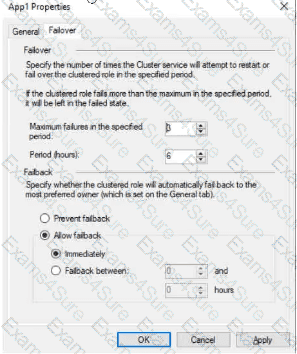
Server1 shuts down unexpectedly.
You need to ensure that when you start Server1, App1 continues to run on Server2.
Solution: From the Failover settings, you select Prevent failback .
Does this meet the goal?
You have an on-premises server named Served that runs Windows Server. You have an Azure subscription. You plan to back up the files and folders on Server1 to Azure by using Azure Backup. You need to define how long the backups will be retained. What should you use to configure the retention?
Your on-premises network contains an Active Directory Domain Services (AD DS) domain. The domain contains 100 servers that run Windows Server and are Azure Arc-enabled.
You have an Azure subscription.
You need to automatically change the password for the built-in local administrator account on each computer in the domain. The solution must meet the following requirements:
• The password must change automatically every 30 days.
• Administrative effort must be minimized.
What should you use?
Q
A.
an Azure policyO
B.
a Password Settings Object (PSO)(8)
C.
Windows Local Administrator Password Solution (Windows LAPS)group managed service accounts (gMSAs)
Your network contains an on-premises Active Directory Domain Services (AD DS) domain.
The domain contains the servers shown in the following table.
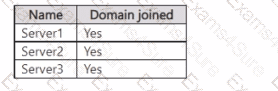
Server1 has the connection security rule as shown in the Server1 exhibit. (Click the Server1 tab.)

Server2 has the connection security rule as shown in the Server2 exhibit. (Click the Server2 tab.)

Server1 has the inbound firewall rules as shown in the Server1 inbound rules exhibit. (Click the Server1 inbound rules tab.)
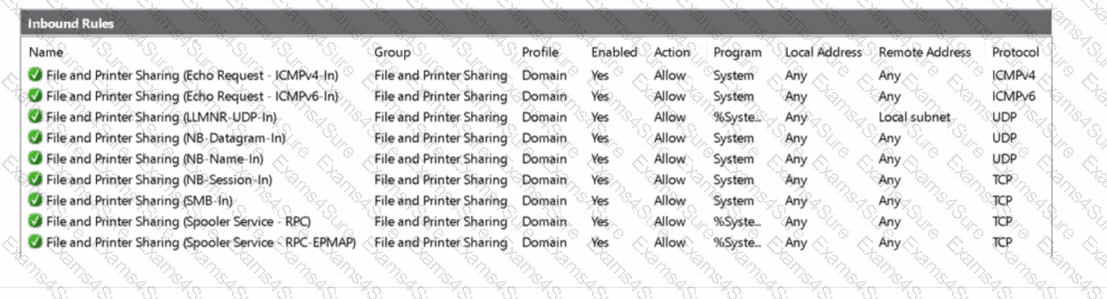
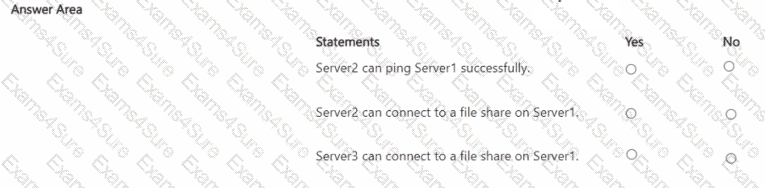
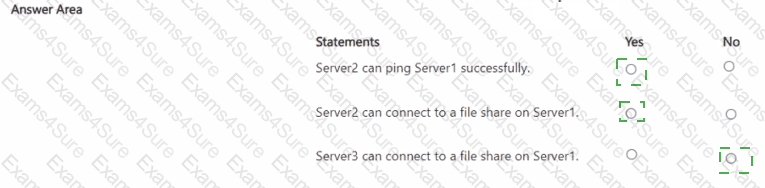
For each of the following statements, select Yes if the statement is true. Otherwise, select No.
You have a Windows Server Failover Cluster (WSFQ that contains five nodes.
You need to ensure that if a network link fails on one of the nodes, the workloads are distributed across the remaining nodes during a failover. The solution must ensure that the workloads are distributed across all the nodes as evenly as possible.
Which command should you run?