Weekend Limited Time 70% Discount Offer - Ends in 0d 00h 00m 00s - Coupon code: merry71

CCAR-P Claude Certified Architect - Professional is now Stable and With Pass Result | Test Your Knowledge for Free

Exams4sure Dumps

CCAR-P Practice Questions

Claude Certified Architect - Professional

Last Update 2 days ago
Total Questions : 114

Dive into our fully updated and stable CCAR-P practice test platform, featuring all the latest Claude Certified Architect exam questions added this week. Our preparation tool is more than just a Anthropic study aid; it's a strategic advantage.

Our free Claude Certified Architect practice questions crafted to reflect the domains and difficulty of the actual exam. The detailed rationales explain the 'why' behind each answer, reinforcing key concepts about CCAR-P. Use this test to pinpoint which areas you need to focus your study on.

CCAR-P PDF

CCAR-P PDF (Printable)
$46.5
$154.99

CCAR-P Testing Engine

CCAR-P PDF (Printable)
$51
$169.99

CCAR-P PDF + Testing Engine

CCAR-P PDF (Printable)
$63.9
$212.99
Question # 11

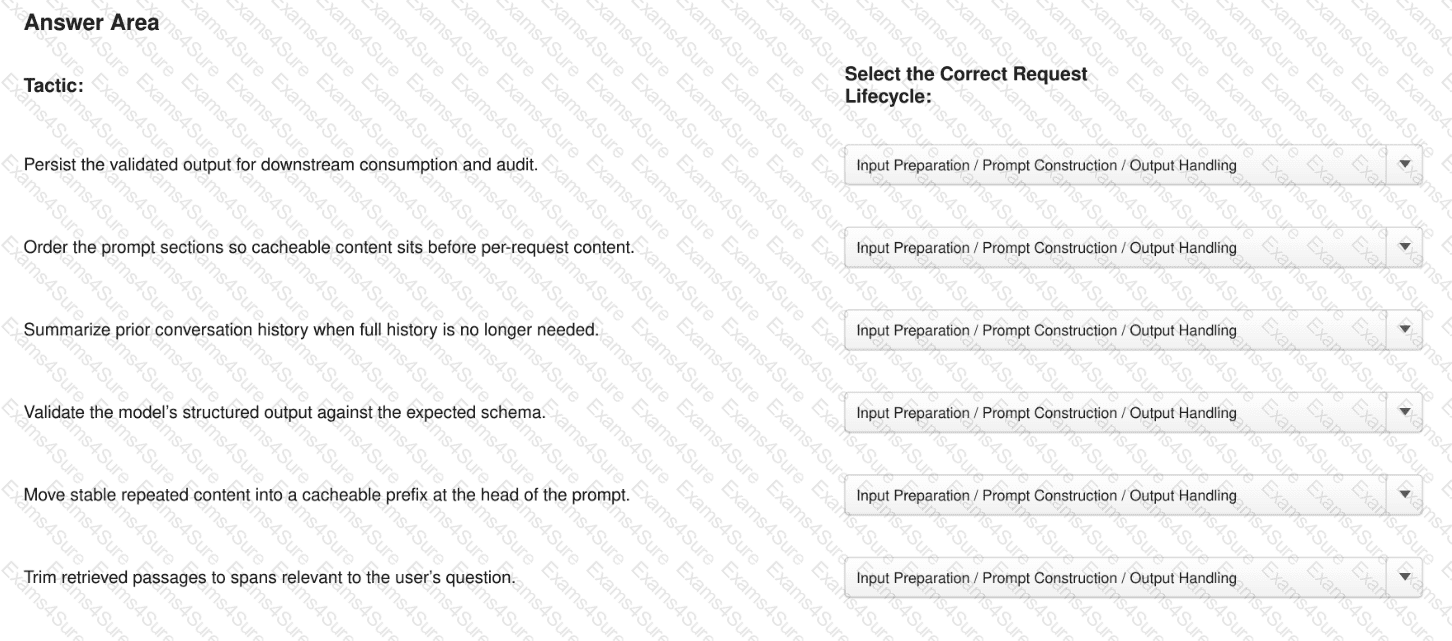
You are evaluating model-selection claims used by a peer team.

For each statement, select yes if the statement is generally true. Otherwise, select no.

Question # 11

Options:

Discussion 0
Question # 12

A Claude-based research assistant begins producing responses that confidently contradict its retrieved source documents despite no change to the retrieval pipeline.

Which two diagnostic actions most directly identify the root cause of this behavior? (Select two.)

Options:

A.  

Increase the context-window size to allow more retrieved chunks per query.

B.  

Switch the retrieval index to a denser embedding model to improve chunk-relevance scores.

C.  

Determine whether the failure reproduces on the previous model version to test for a model mismatch.

D.  

Reduce the temperature setting to lower response variance across all query types.

E.  

Inspect the system-prompt grounding instructions to determine whether citation constraints remain intact.

Discussion 0
Question # 13

You are compiling continuity practices that span the deployment lifecycle.

Which two practices belong on the list? (Select two.)

Each correct answer presents a complete solution.

Options:

A.  

Maintain a stakeholder register and notify the listed parties at every phase transition event.

B.  

Carry the evaluation framework and reference set forward across iterations rather than rebuilding each time.

C.  

Archive every phase deliverable in long-term storage to preserve a record of what was produced.

D.  

Capture lessons learned at the end of each phase and surface them as inputs to the next phase.

E.  

Lock decisions made in early phases to prevent revisiting them as later phases begin.

Discussion 0
Question # 14

You are designing a feedback session for a deployment in flight.

Which structure best supports productive stakeholder feedback?

Options:

A.  

Hold an open-ended meeting with no pre-distributed agenda or artifacts, and rely on participants’ memory to carry decisions and follow-up owners forward.

B.  

Define a focused agenda, share the artifacts in advance, capture decisions and follow-ups in writing, and confirm action owners and dates.

C.  

Distribute artifacts at the session start rather than in advance, so stakeholders review materials in real time without preparation before the discussion begins.

D.  

End the session without recording decisions, follow-up items, action owners, or dates, relying on participant memory to carry the session’s outcomes forward.

Discussion 0
Question # 15

You are classifying chunking strategies by the corpus type each is best suited to.

For each chunking strategy, select the appropriate corpus type: “Long Structured Documents,” “Heterogeneous Short Records,” or “Code or Hierarchical Specifications.”

Question # 15

Options:

Discussion 0
Question # 16

You are identifying signals that a deployment should re-enter design rather than continue iterating in place.

Which signal most directly indicates the need for a new design cycle?

Options:

A.  

A runbook step requires a clarification edit to improve on-call guidance accuracy, which can be handled as a documentation update without changes to component responsibilities or core contracts.

B.  

A dashboard alert threshold needs a small numerical adjustment to reduce false-positive noise, which can be handled as an operational configuration change without a new design cycle.

C.  

A minor copy edit is requested in a customer-facing string within the existing UI, which can be handled as a localized content change without altering component responsibilities or contracts.

D.  

The system’s current architecture cannot meet the new requirements without changes to component responsibilities or core contracts.

Discussion 0
Question # 17

You are running a controlled experiment to compare two prompts and must complete the design steps before executing the experiment.

Which two steps must be completed BEFORE running the experiment with random assignment? (Select two.)

Each correct answer presents part of the solution.

Options:

A.  

Determine the minimum detectable effect size and the sample size needed for power.

B.  

Decide whether to promote, reject, or iterate the candidate based on the analysis.

C.  

Define the hypothesis and the primary success metric for the comparison.

D.  

Analyze the results against the predefined success metric and significance threshold.

E.  

Document the recommendation, the trade-offs accepted, and the alternatives considered.

Discussion 0
Question # 18

A Claude Architect is reviewing a post-deployment performance report for an AI-assisted legal-document summarization system. The report includes these observations:

    Average summarization time decreased from 47 minutes to 6 minutes per document.

    Associates spend less time on summaries, but overall billable output has not measurably changed.

    Infrastructure costs increased by 22% because redundant retry logic generated additional API calls.

    Some summaries require attorney correction, adding an average of 8 minutes of review per document.

Which analysis correctly attributes each observation to the appropriate business-value pillar?

Options:

A.  

Observations 1 and 2 both indicate efficiency gains; Observation 3 is a solution-cost issue; Observation 4 is a performance-SLA issue.

B.  

Observation 1 is a transformation outcome; Observation 2 is an efficiency gain; Observation 3 is a performance-SLA degradation; Observation 4 is a solution-cost issue.

C.  

Observations 1 and 4 together indicate a net performance-SLA improvement; Observation 2 is a transformation gap; Observation 3 is a productivity drain from over-engineering.

D.  

Observation 1 indicates an efficiency gain; Observation 2 shows that productivity has not yet been realized; Observation 3 is a solution-cost issue; Observation 4 is an efficiency loss that partially offsets Observation 1.

Discussion 0
Question # 19

A document analysis service processes legal filings averaging 80,000 tokens each. Each filing is queried by attorneys an average of 14 times during a case. The current architecture sends the full filing on every query. The CFO has asked you to reduce per-query costs while preserving response quality. The security officer requires that filing contents not be stored outside Fabrikam's tenancy.

Which optimization approach should you recommend?

Options:

A.  

Summarize each filing once at intake and run all subsequent queries against the summary.

B.  

Cache the filing as the prompt prefix for reuse across the 14 queries per case.

C.  

Index filings in a vector store and retrieve only the relevant passages per query.

D.  

Move the workload to a smaller Claude model to reduce the per-token cost paid.

Discussion 0
Question # 20

You are explaining the precedence of Claude Code configuration scopes to the team.

Which precedence ordering, from highest to lowest, is correct?

Options:

A.  

Local → managed → user → command-line arguments → project

B.  

Project → user → managed → local → command-line arguments

C.  

Managed → command-line arguments → local → project → user

D.  

User → project → local → command-line arguments → managed

Discussion 0
Get CCAR-P dumps and pass your exam in 24 hours!

Free Exams Sample Questions