Summer Sale Limited Time 65% Discount Offer - Ends in 0d 00h 00m 00s - Coupon code: 65pass65

DP-700 Implementing Data Engineering Solutions Using Microsoft Fabric is now Stable and With Pass Result | Test Your Knowledge for Free

Exams4sure Dumps

DP-700 Practice Questions

Implementing Data Engineering Solutions Using Microsoft Fabric

Last Update 13 hours ago
Total Questions : 129

Dive into our fully updated and stable DP-700 practice test platform, featuring all the latest Microsoft Certified: Fabric Data Engineer Associate exam questions added this week. Our preparation tool is more than just a Microsoft study aid; it's a strategic advantage.

Our free Microsoft Certified: Fabric Data Engineer Associate practice questions crafted to reflect the domains and difficulty of the actual exam. The detailed rationales explain the 'why' behind each answer, reinforcing key concepts about DP-700. Use this test to pinpoint which areas you need to focus your study on.

DP-700 PDF

DP-700 PDF (Printable)
$54.25
$154.99

DP-700 Testing Engine

DP-700 PDF (Printable)
$59.5
$169.99

DP-700 PDF + Testing Engine

DP-700 PDF (Printable)
$74.55
$212.99
Question # 1

You are developing a data engineering solution in Fabric by using Apache Spark.

You need to monitor the performance of Spark workloads the solution must meet the following requirements

• Provide comprehensive information about the performance of the data engineering workloads.

• Identify stages and tasks that run slowly.

• Minimize administrative effort

What should you use?

Options:

A.  

Spark application logs

B.  

the Spark Ul

C.  

workspace metrics in Fabric

D.  

Spark job event logs

Discussion 0
Question # 2

You have a Fabric warehouse named DW1 that contains a Type 2 slowly changing dimension (SCD) dimension table named DimCustomer. DimCustomer contains 100 columns and 20 million rows. The columns are of various data types, including int, varchar, date, and varbinary.

You need to identify incoming changes to the table and update the records when there is a change. The solution must minimize resource consumption.

What should you use to identify changes to attributes?

Options:

A.  

a direct attributes comparison for the attributes in the source table.

B.  

a hash function to compare the attributes in the DimCustomer table.

C.  

a direct attributes comparison across the attributes in the DimCustomer table.

D.  

a hash function to compare the attributes in the source table.

Discussion 0
Question # 3

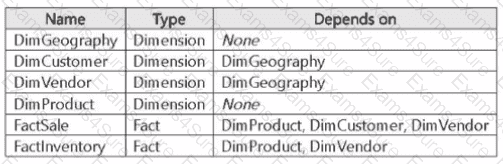
You have the development groups shown in the following table.

Question # 3

You have the projects shown in the following table.

Question # 3

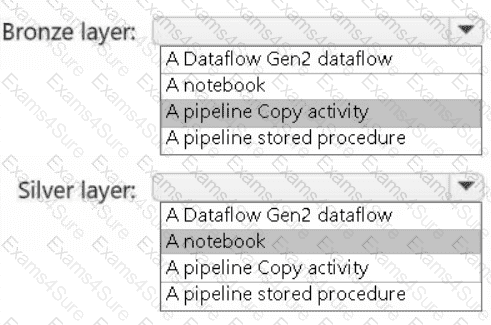
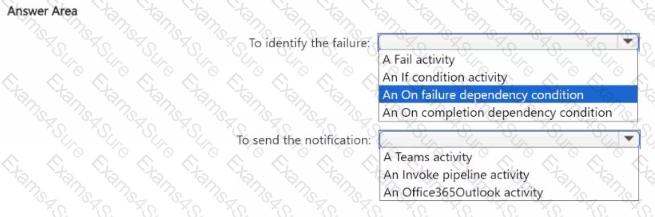
You need to recommend which Fabric item to use based on each development group ' s skillset The solution must meet the project requirements and minimize development effort

What should you recommend for each group? To answer, select the appropriate options in the answer area.

NOTE: Each correct selection is worth one point.
Question # 3

Options:

Discussion 0
Question # 4

HOTSPOT

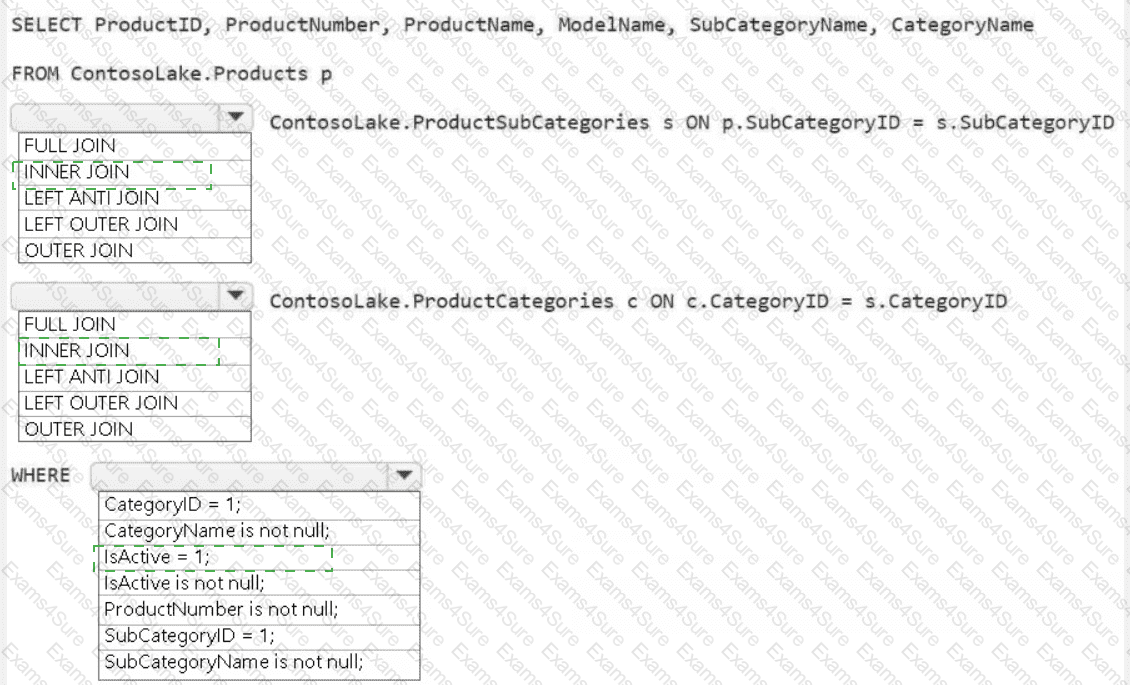
You have an Azure Event Hubs data source that contains weather data.

You ingest the data from the data source by using an eventstream named Eventstream1. Eventstream1 uses a lakehouse as the destination.

You need to batch ingest only rows from the data source where the City attribute has a value of Kansas. The filter must be added before the destination. The solution must minimize development effort.

What should you use for the data processor and filtering? To answer, select the appropriate options in the answer area.

NOTE: Each correct selection is worth one point.
Question # 4

Options:

Discussion 0
Question # 5

Note: This question is part of a series of questions that present the same scenario. Each question in the series contains a unique solution that might meet the stated goals. Some question sets might have more than one correct solution, while others might not have a correct solution.

After you answer a question in this section, you will NOT be able to return to it. As a result, these questions will not appear in the review screen.

You have a KQL database that contains two tables named Stream and Reference. Stream contains streaming data in the following format.

Question # 5

Reference contains reference data in the following format.

Question # 5

Both tables contain millions of rows.

You have the following KQL queryset.

Question # 5

You need to reduce how long it takes to run the KQL queryset.

Solution: You add the make_list() function to the output columns.

Does this meet the goal?

Options:

A.  

Yes

B.  

No

Discussion 0
Question # 6

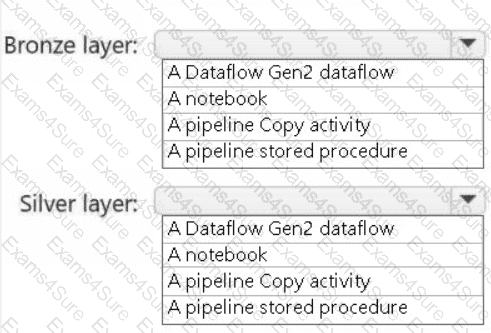
You have a Fabric workspace named Workspace1 that contains the items shown in the following table.

Question # 6

For Model1, the Keep your Direct Lake data up to date option is disabled.

You need to configure the execution of the items to meet the following requirements:

Notebook1 must execute every weekday at 8:00 AM.

Notebook2 must execute when a file is saved to an Azure Blob Storage container.

Model1 must refresh when Notebook1 has executed successfully.

How should you orchestrate each item? To answer, select the appropriate options in the answer area.

NOTE: Each correct selection is worth one point.
Question # 6

Options:

Discussion 0
Question # 7

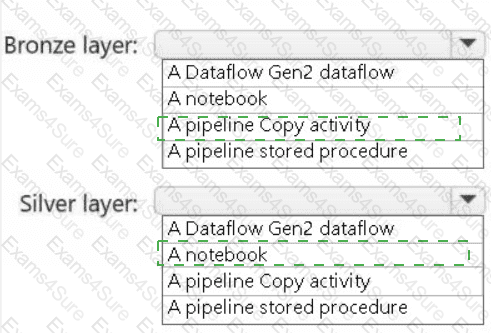
You have a Fabric workspace that contains a warehouse named Warehouse1 Warehousel contains a table named DimCustomers. DimCustomers contains the following columns:

• CustomerName

• CustomerlD

• Birth Date

• Email

You need to configure security to meet the following requirements:

• Birth Date in DimCustomer must be masked and display 1960-01-01

• Email in DimCustomer must be masked and display only the first leading character and the last five characters.

How should you complete the statement? To answer, select the appropriate options in the answer area.

NOTE: Each correct selection is worth one point.
Question # 7

Options:

Discussion 0
Question # 8

You are building a data loading pattern by using a Fabric data pipeline. The source is an Azure SQL database that contains 25 tables. The destination is a lakehouse.

In a warehouse, you create a control table named Control.Object as shown in the exhibit. (Click the Exhibit tab.)

You need to build a data pipeline that will support the dynamic ingestion of the tables listed in the control table by using a single execution.

Which three actions should you perform in sequence? To answer, move the appropriate actions from the list of actions to the answer area and arrange them in the correct order.

Question # 8

Options:

Discussion 0
Question # 9

You have an Azure SQL database named DB1.

In a Fabric workspace, you deploy an eventstream named EventStreamDBI to stream record changes from DB1 into a lakehouse.

You discover that events are NOT being propagated to EventStreamDBI.

You need to ensure that the events are propagated to EventStreamDBI.

What should you do?

Options:

A.  

Create a read-only replica of DB1.

B.  

Create an Azure Stream Analytics job.

C.  

Enable Extended Events for DB1.

D.  

Enable change data capture (CDC) for DB1.

Discussion 0
Question # 10

You have a Fabric workspace that contains a lakehouse and a notebook named Notebook1. Notebook1 reads data into a DataFrame from a table named Table1 and applies transformation logic. The data from the DataFrame is then written to a new Delta table named Table2 by using a merge operation.

You need to consolidate the underlying Parquet files in Table1.

Which command should you run?

Options:

A.  

VACUUM

B.  

BROADCAST

C.  

OPTIMIZE

D.  

CACHE

Discussion 0
Get DP-700 dumps and pass your exam in 24 hours!

Free Exams Sample Questions