
Exam style questions across every DP-750 domain
Last Update 4 days ago
Total Questions : 91
Start with our free DP-750 practice questions, carefully crafted to mirror the domains, phrasing, and difficulty of the real Microsoft Certified: Azure Databricks Data Engineer exam. Each DP-750 exam question comes with a detailed rationale that explains not just which answer is correct but why the others fall short. That's how concepts stick. Use the free set to benchmark yourself: identify your Microsoft weak domains, see where you're losing marks, and build a focused study plan in minutes.

You have an Azure Databricks workspace that is enabled for Unity Catalog and contains a Delta table named Orders
You load the Orders table into an Apache Spark DataFrame named df.
You need to create a DataFrame that excludes rows where the order amount is null.
Solution: You run the following expression.
df-fillna(0, subset=[ ' order_amount ' ])
Does this meet the goal?
You have an Azure Databricks workspace.
You have an Apache Spark Structured Streaming job named Job! that processes data continuously and fails periodically due to transient errors
You need to ensure that Job! meets the following requirements
• Resumes processing from the point that Job1 failed
• Minimizes how long it takes to restart Job!
• Minimizes the costs to restart Job!
What should you do?
You have an Azure Databricks workspace and a remote Git repository named Repo1. Repo1 contains two branches named main and Branch1.
You are on a development team that works in Repo1.
You commit changes to Branch1 and must merge the changes into main.
Before completing the merge, you need to meet the following requirements:
• Ensure that Branch1 includes the changes committed to main since Branch1 was created.
• Ensure that merge conflicts are detected and resolved.
What should you do first?
You need to develop the task logic for a new job in Lakeflow Jobs that processes telemetry data.
Each task must contain only the appropriate logic for its step in the pipeline. The solution must support the planned changes and meet the data ingestion and processing requirements.
What should you do?
You need to configure compute for the ingestion of telemetry data. The solution must meet the data ingestion and processing requirements.
What should you do?
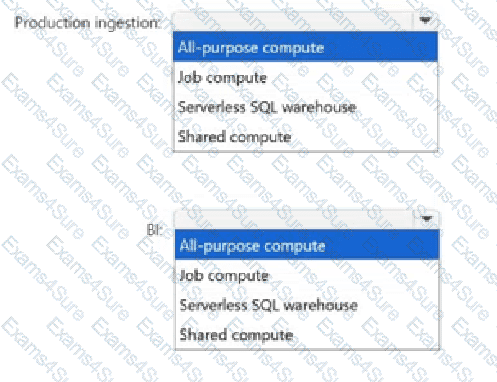
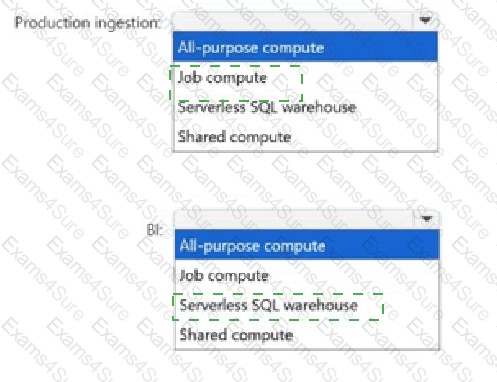
You need to recommend a compute type for the production ingestion workloads and BI workloads. The solution must meet the environment and compute requirements.
What should you recommend for each type of workload? To answer, select the appropriate options in the answer area.
NOTE: Each correct selection is worth one point.
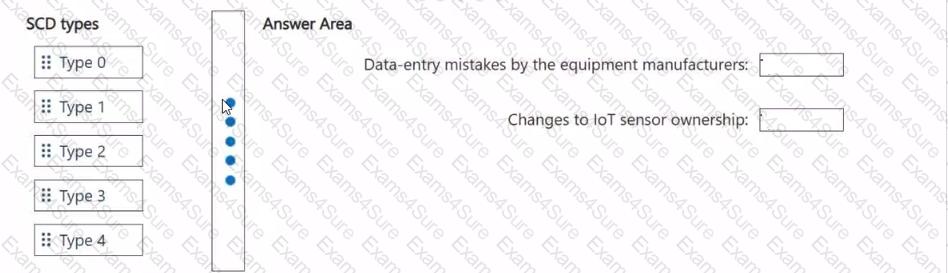
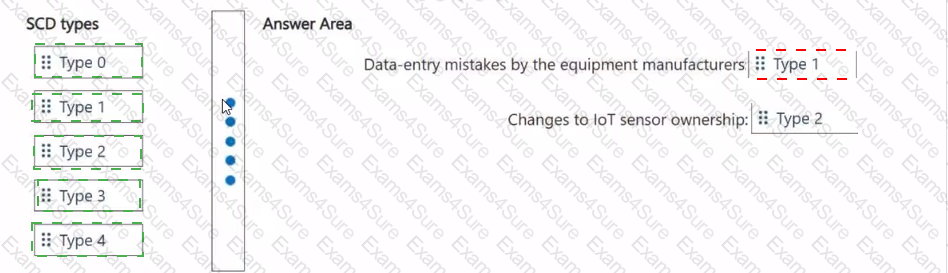
Which SCD type should you use to support the planned data modeling changes? To answer, drag the appropriate types to the correct issues. Each type may be used once, more than once, or not at all. You may need to drag the split bar between panes or scroll to view content.
NOTE: Each correct selection is worth one point.
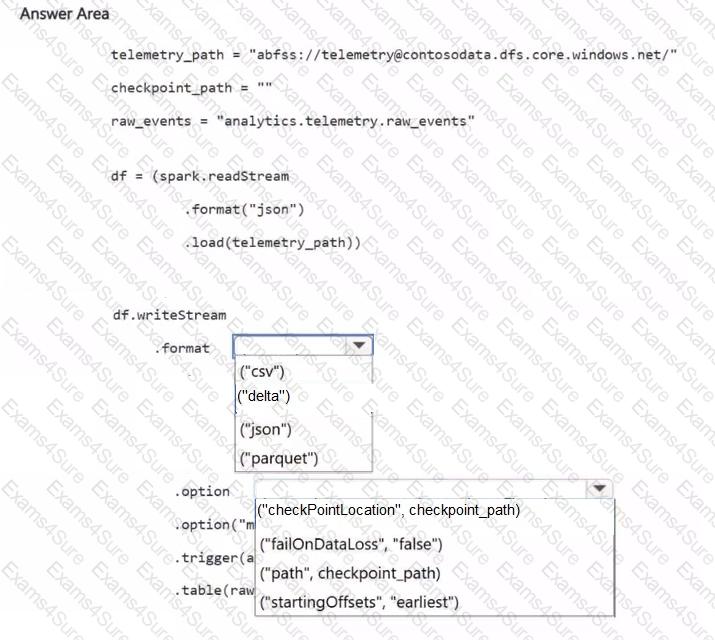
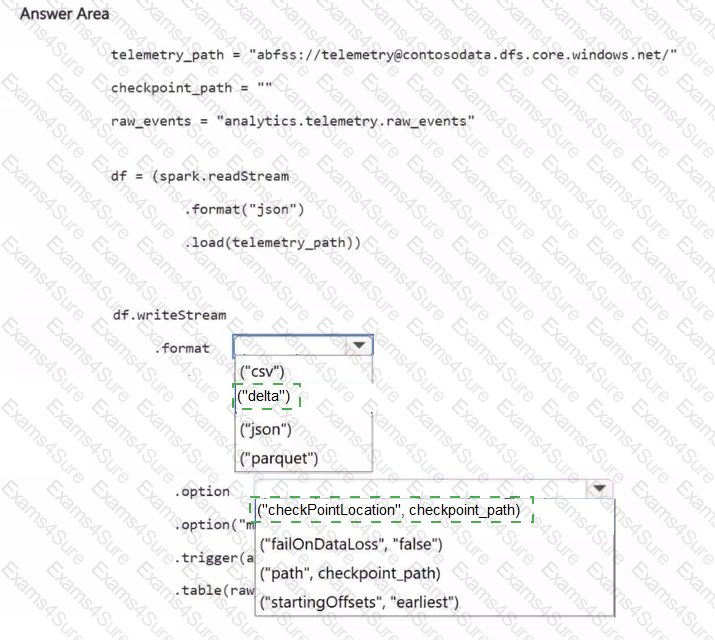
You need to complete the PySpark code for the Spark Structured Streaming pipelines. The solution must meet the data ingestion and processing requirements.
How should you complete the code segment? To answer, select the appropriate options in the answer area.
NOTE: Each correct selection is worth one point.
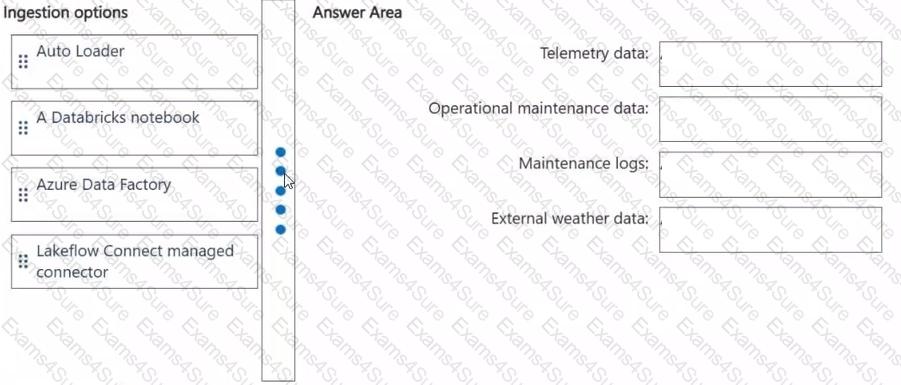
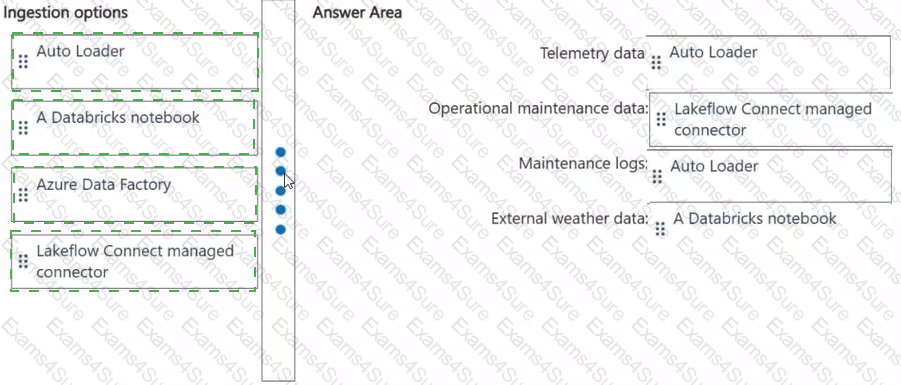
Which ingestion option should you recommend for each data source? To answer, drag the appropriate options to the correct data sources. Each option may be used once, more than once, or not at all. You may need to drag the split bar between panes or scroll to view content.
NOTE: Each correct selection is worth one point.
You have an Azure Databricks workspace named Workspace! that uses a Git repository. The repository contains a Databricks notebook named Notebook1.
From the main branch, you create a feature branch named Branch! and commit changes to Notebooks Another user commits changes to Notebook1 in main.
When you attempt to merge Branch! into main, the merge fails due to conflicts.
You need to merge Branch! into the main branch. The solution must ensure that Notebook1 includes all the changes from both the branches.
What should you do?