

E20-555 Practice Questions
Isilon Solutions and Design Specialist Exam for Technology Architects
Last Update 7 hours ago
Total Questions : 344
Dive into our fully updated and stable E20-555 practice test platform, featuring all the latest EMC Certification exam questions added this week. Our preparation tool is more than just a DELL EMC study aid; it's a strategic advantage.
Our free EMC Certification practice questions crafted to reflect the domains and difficulty of the actual exam. The detailed rationales explain the 'why' behind each answer, reinforcing key concepts about E20-555. Use this test to pinpoint which areas you need to focus your study on.

You are designing a new Isilon cluster that requires backup to tape for all files in the Legal and Accounting shared folders. The customer has sized their IP network to support the application workload, but no additional bandwidth is available.
What should be recommended for the backup solution?
An Isilon customer wants to have different snapshot policies and schedules on the same directory. Why is this possible on an Isilon cluster?
An Isilon has 6 X410 nodes and 4 NL410 nodes. How many job engine directors does the cluster have?
-- Exhibit --
We have been engaged by a research hospital to help upgrade their Isilon installation. They currently have 12 previous generation Isilon nodes with 200TB of capacity and run on a 1Gbps network. They currently have 6 Illumina Hi-Seq Sequencers and an HPC cluster to process data. They would like to expand Isilon to 2PB of active data and 1PB of archive data. They use a third party data and metadata management service (IRODs) to stage data for analysis. The Isilon cluster is mainly used for analysis work with the HPC cluster.
-- Exhibit --
The customer has a limited budget. What would be the best price/performance solution for their active data?
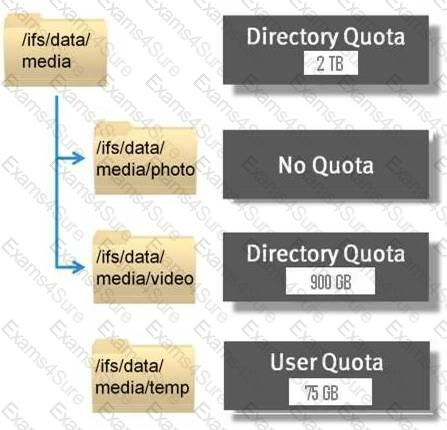
A 6 × F800 node Isilon cluster has one subnet with two IP pools with LACP aggregated 10GigE interfaces from
all the nodes in the ‘Data-Zone’ Access Zone. The ‘NFS-Pool’ with dynamic IP Allocation schema and ‘SMBPool’
with static IP Allocation schema are being used.
All the Linux clients are accessing Isilon exports using NFSv3 via the ‘NFS_Pool’. All the Windows clients are
accessing Isilon shares using SMBv3 via the ‘SMB_Pool’.
While deploying Isilon, the customer reserves the whole network subnet for Isilon. The customer is facing
performance issues with a new workload that is accessing the Isilon via Kerberized NFSv4.
What is recommended when creating a new IP pool for NFSv4 clients?
What is the relative latency of a cache hit to L1 cache compared to a hit to L2 cache in an Isilon cluster?
An Isilon customer has an environment supporting a wide range of different workloads. They want to assign clients to performance tiers based on the resources needed.
What can the customer use to meet this requirement?
-- Exhibit --
A European Sports TV network is considering Isilon for their Media Edit Storage for their editing workloads. They are also considering Isilon for near-line media archiving.
The network receives XDCAM HD footage which is loaded onto their existing Transcoding Storage platform. New footage that needs to be edited will be transferred from their Transcoding Storage platform to the proposed Media Edit Storage platform at the rate of ten simultaneous XDCAM HD files via FTP. Edited files will be transferred back to the Transcoding Storage platform at the rate of ten simultaneous XDCAM HD files via FTP.
The network currently has 15 Final Cut Pro edit stations, 15 Avid edit stations. Proxy software will be used to allow Isilon to act as the storage for the Final Cut Pro and Avid media. Three of those edit stations will be performing content compositing as needed.
The network expects 70 hours of new content per week, and 50 hours of edited content per week. They intend to keep the new and edited content on the proposed Media Edit Storage as a performance tier for 30 days. They would like to retain all new and edited footage proposed Media Edit Storage as a near-line tier for two years.
In addition to the current workloads, the network expects to implement a new Media Asset Management (MAM) solution and has requested the Isilon cluster be capable of supporting 120 MBps read and 120 MBps write to support the MAM requirements.
-- Exhibit --
Refer to the exhibit.
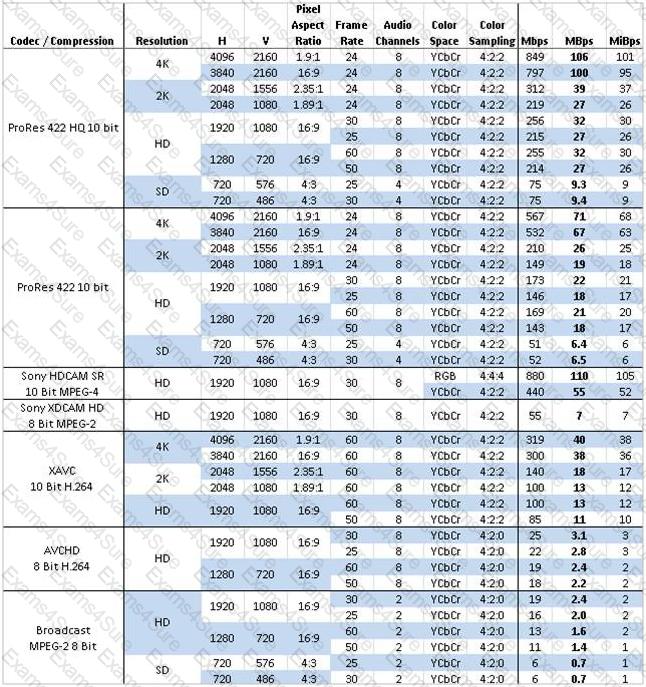
Based on the number of edit stations, and their intended use, what bandwidth requirements should be considered while sizing?
Refer to Exhibit below:
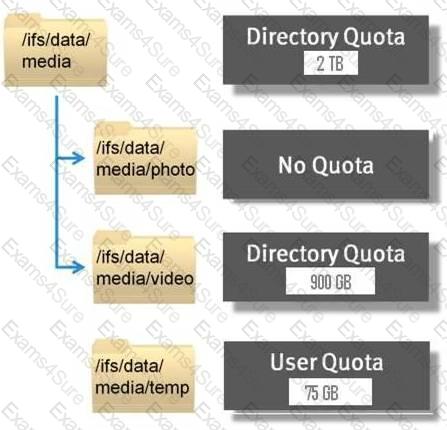
What is represented by the information shown in the exhibit?