

Exam style questions across every H12-821_V1.0 domain
Last Update 1 month ago
Total Questions : 376
Start with our free H12-821_V1.0 practice questions, carefully crafted to mirror the domains, phrasing, and difficulty of the real HCIP-Datacom exam. Each H12-821_V1.0 exam question comes with a detailed rationale that explains not just which answer is correct but why the others fall short. That's how concepts stick. Use the free set to benchmark yourself: identify your Huawei weak domains, see where you're losing marks, and build a focused study plan in minutes.

Which of the following scenarios is not suitable for deploying interface PBR?
Preferences of routing protocols determine the sequence In which a router selects a route among routes to the same destination /earned through different routing protocols.
Which of the following values is the Reserved/Circuit Type field in the IIH packets sent by a Level-1-2 router on an IS-IS network?
On an ISIS network, each router has at least one NET. If a router is configured with multiple NETs, ensure that these NETs have the same system I
D.
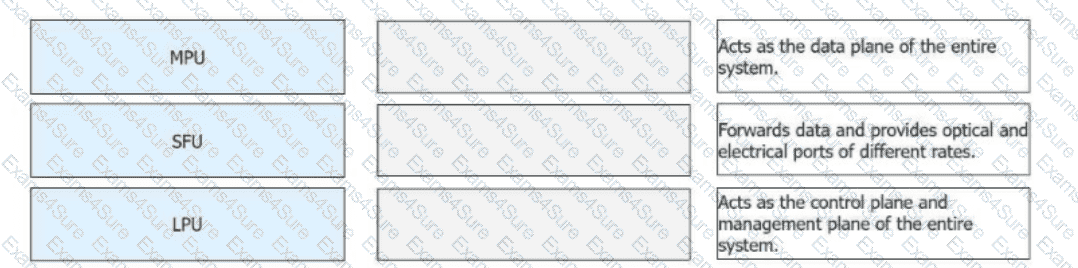
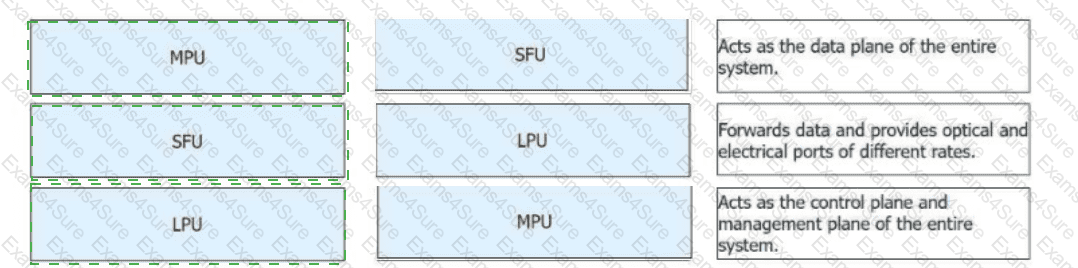
Huawei modular devices have multiple hardware modules that provide different functions. Match the following hardware modules with their functions.
On an IS-IS network, the length and components of a NET are the same as those of an NSAP . Which of the following NET fields is used to uniquely identify a host or router in an area?
Which of the following statements regarding OSPF multi-instance is false?
VRRP defines three states. Only the device in which state can forward packets destined for a virtual IP address?
(Write in full and capitalize the first letter.)
Which of the following is used as the destination port for single-hop BFD?