Summer Sale Limited Time 65% Discount Offer - Ends in 0d 00h 00m 00s - Coupon code: 65pass65

HCVA0-003 HashiCorp Certified: Vault Associate (003) Exam is now Stable and With Pass Result | Test Your Knowledge for Free

Exams4sure Dumps

HCVA0-003 Practice Questions

HashiCorp Certified: Vault Associate (003) Exam

Last Update 4 hours ago
Total Questions : 324

Dive into our fully updated and stable HCVA0-003 practice test platform, featuring all the latest HashiCorp Security Automation Certification exam questions added this week. Our preparation tool is more than just a HashiCorp study aid; it's a strategic advantage.

Our free HashiCorp Security Automation Certification practice questions crafted to reflect the domains and difficulty of the actual exam. The detailed rationales explain the 'why' behind each answer, reinforcing key concepts about HCVA0-003. Use this test to pinpoint which areas you need to focus your study on.

HCVA0-003 PDF

HCVA0-003 PDF (Printable)
$54.25
$154.99

HCVA0-003 Testing Engine

HCVA0-003 PDF (Printable)
$59.5
$169.99

HCVA0-003 PDF + Testing Engine

HCVA0-003 PDF (Printable)
$74.55
$212.99
Question # 11

Over a few years, you have a lot of data that has been encrypted by older versions of a Transit encryption key. Due to compliance regulations, you have to re-encrypt the data using the newest version of the encryption key. What is the easiest way to complete this task without putting the data at risk?

Options:

A.  

Rotate the encryption key used to encrypt the data

B.  

Decrypt the data manually and encrypt it with the latest version

C.  

Use the transit rewrap feature

D.  

Create a new master key used by Vault

Discussion 0
Question # 12

Which of the following are considered benefits of using policies in Vault? (Select three)

Options:

A.  

Policies are assigned to a token on a 1:1 basis to eliminate conflicting policies

B.  

Provides granular access control to paths within Vault

C.  

Policies have an implicit deny, meaning that policies are deny by default

D.  

Policies provide Vault operators with role-based access control

Discussion 0
Question # 13

True or False? Performing a rekey operation using the vault operator rekey command creates new unseal/recovery keys as well as a new root key?

Options:

A.  

True

B.  

False

Discussion 0
Question # 14

You are the primary Vault operator. During a routine audit, an auditor requested the ability to display all secrets under a specific path in Vault without seeing the actual stored data. Which policy permits the auditor to display the stored secrets without revealing their contents?

Options:

A.  

path " kv/apps/production/ " { capabilities = [ " list " ] }

B.  

path " kv/apps/+/ " { capabilities = [ " list " ] }

C.  

path " kv/+/production " { capabilities = [ " list " ] }

D.  

path " kv/apps/* " { capabilities = [ " list " , " read " ] }

Discussion 0
Question # 15

You have a CI/CD pipeline using Terraform to provision AWS resources with static privileged credentials. Your security team requests that you use Vault to limit AWS access when needed. How can you enhance this process and increase pipeline security?

Options:

A.  

Enable the SSH secrets engine and have Terraform generate dynamic credentials when deploying resources in AWS

B.  

Enable the Transit secrets engine to encrypt the AWS credentials and have Terraform retrieve these credentials when needed

C.  

Store the AWS credentials in the Vault KV store and use the Vault provider to obtain these credentials on each terraform apply

D.  

Enable the aws secrets engine and configure Terraform to dynamically generate a short-lived AWS credential on each terraform apply

Discussion 0
Question # 16

You have a new team member on the Vault operations team. Their first task is to rotate the encryption key in Vault as part of the organization’s security policy. However, when they log in, they get an access denied error when attempting to rotate the key. The policy being used is below. Why can’t the user rotate the encryption key?

path " auth/* " {

capabilities = [ " create " , " read " , " update " , " delete " , " list " ]

}

path " sys/rotate " {

capabilities = [ " read " , " update " ]

}

Options:

A.  

The policy requires sudo privileges since it is a root-protected path

B.  

The policy doesn’t include create privileges so a new encryption key can’t be created

C.  

The policy should include sys/rotate/ < name of key > as part of the path

D.  

The encryption key has a minimum TTL, therefore the key cannot be rotated until that time expires

Discussion 0
Question # 17

A large organization uses Vault for various use cases with multiple auth methods enabled. A user can authenticate via LDAP, OIDC, or a local userpass account, but they receive different policies for each method and often need to log out and back in for different actions. What can be configured in Vault to ensure users have consistent policies regardless of their authentication method?

Options:

A.  

Enable the SSH secrets engine and instruct the user to obtain credentials using the new secrets engine

B.  

Create a new entity and map the aliases from each of the available auth methods

C.  

Assign the default policy to the user ' s policy used by each auth method

D.  

Provide the user with an AppRole role-id and secret-id for authentication

Discussion 0
Question # 18

You need to write a new policy for Vault for a group of users on the automation team. The requirements stipulate that each user (and all future users) get access to their own private section of a KV secrets engine at the path kv/team/ and be able to manage their own secrets. Which policy below meets these requirements while minimizing the administrative effort and following the principle of least privilege?

Options:

A.  

path " secret/data/groups/{{identity.groups.ids.2f62-9503-42aa7A869741.name}}/ " { capabilities = [ " list " ] }

B.  

path " kv/team/frank/ " { capabilities = [ " create " , " update " , " read " , " delete " ] } path " kv/team/steve/ " { capabilities = [ " create " , " update " , " read " , " delete " ] } path " kv/team/bryan/ " { capabilities = [ " create " , " update " , " read " ,

C.  

path " kv/team/ " { capabilities = [ " create " , " update " , " read " , " delete " ] }

D.  

path " kv/team/{{identity.entity.id}}/ " { capabilities = [ " create " , " update " , " read " , " delete " ] } path " kv/team/{{identity.entity.id}} " { capabilities = [ " create " , " update " , " read " , " delete " ] }

Discussion 0
Question # 19

You are working on a new project and need to retrieve a secret from Vault. You log into the Vault UI and browse to the path where the secret is stored. Based on the screenshot below, what is true about the secrets stored in this path? (Select four)
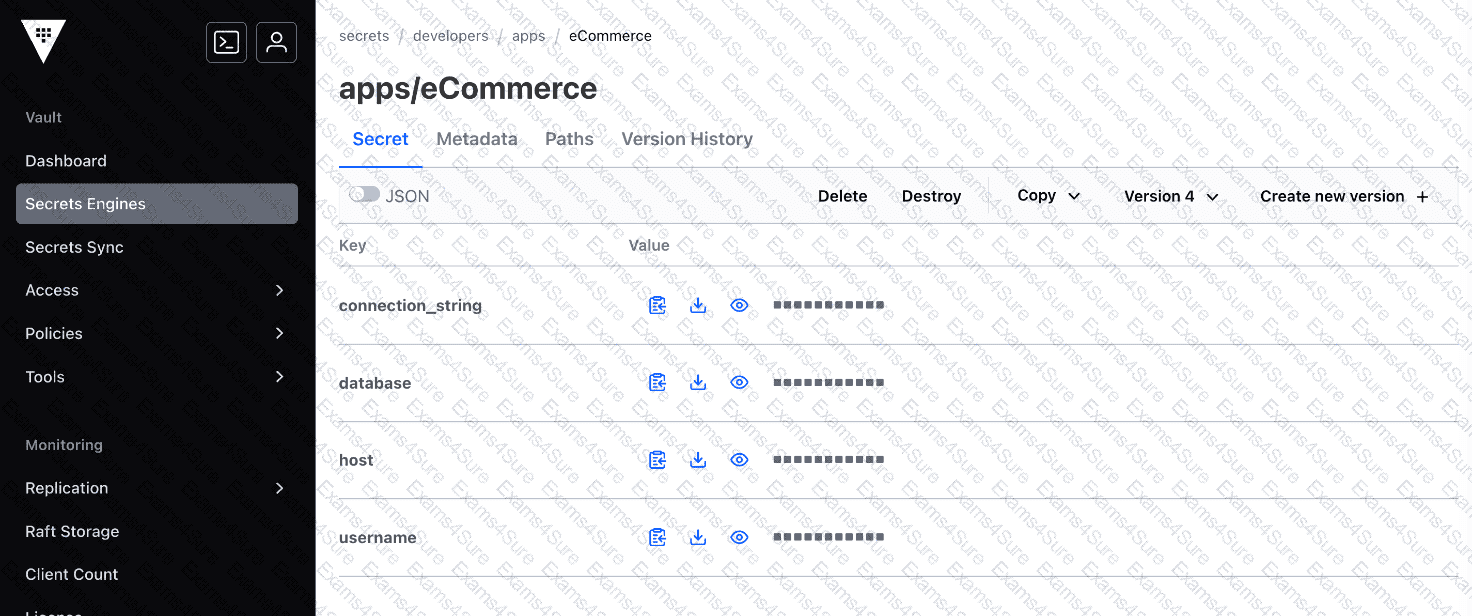
Question # 19

Options:

A.  

The secrets are stored in a KV v1 secrets engine

B.  

The user does not have permission to delete the secret

C.  

The secrets are stored in a KV v2 secrets engine

D.  

The secrets engine is mounted at the path developers/

E.  

There are four previous versions of the secret

F.  

The user has additional permissions on the path beyond just list and read

Discussion 0
Question # 20

Your organization audited an essential application and found it isn’t securely storing data. For added security, auditors recommended encrypting all data before storing it in a backend database, and the application server should not store encryption keys locally. Which secrets engine meets these requirements?


Options:

A.  

PKI secrets engine

B.  

SSH secrets engine

C.  

Transit secrets engine

D.  

Cubbyhole secrets engine

Discussion 0
Get HCVA0-003 dumps and pass your exam in 24 hours!

Free Exams Sample Questions