
HPE7-A03 Practice Questions
HPE Aruba Networking Certified Network Architect - Campus Access
Last Update 1 day ago
Total Questions : 96
Dive into our fully updated and stable HPE7-A03 practice test platform, featuring all the latest Aruba Certified Professional - Campus Access exam questions added this week. Our preparation tool is more than just a HP study aid; it's a strategic advantage.
Our free Aruba Certified Professional - Campus Access practice questions crafted to reflect the domains and difficulty of the actual exam. The detailed rationales explain the 'why' behind each answer, reinforcing key concepts about HPE7-A03. Use this test to pinpoint which areas you need to focus your study on.

You are designing a solution with Aruba OS10-based access points and redundant gateways and these are the requirements:
• W1-F16E based access points
• support for tunneled traffic
• application visibility
• rogue APs
• live upgrades
• Air Slice
• Cloud Guest Authentication
• Ai insights
Which licenses are needed? (Select two.)
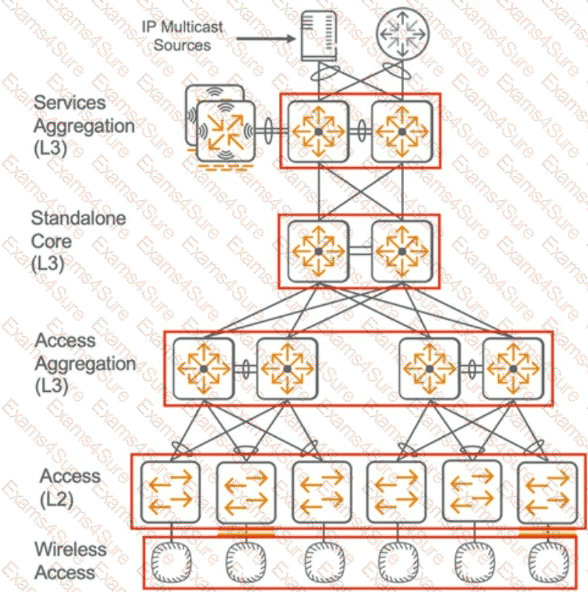
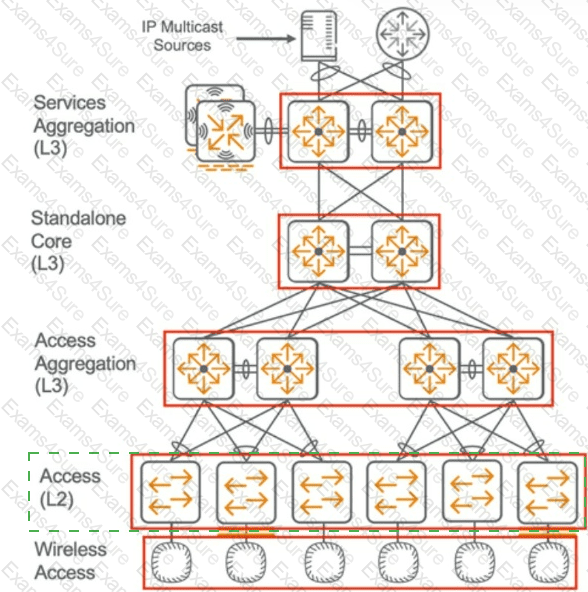
Place the + in the layer where IGMP Snooping should be activated. The correct area encompasses the entire layer Anywhere in the layer will be marked correctly.
A global cruise line company needs to refresh its current fleet. They win refresh the insides' of the ship to be cost-effective and increase their sustain ability. They Mill replace the complete WLAN/LAN hardware of the ship. In this refresh, the company will not refresh Us current security requirements. The CIO also wants to limit the number of unused ports in the switches. Future expansion will always mean a refresh of hardware. They start with the smallest ship with a maximum of 800 guests
Each ship has a LAN infrastructure consisting of two core switches, up to 10 redundant distribution switches, and up to 500 access switches (400 cabins. 100 technical rooms). The Core switches are located in the MDF of the ship and the distribution switches are located in the IDFs of the ship. Each cabin and technical room gets one single access switch.
The cabling structure of the ship will not be refreshed. Each IDF is connected to the MDF by SM
F.
of which two pairs are available for the interconnect between the core and distribution. The length of SM fiber between MDF and IDF is less than 300 meters (930 ft) and the type used is 0S1. Each cabin is connected by a single 0M2 pair to the IDF.
the maximum length is 60 meters (200 ft). Each technical room is connected by a single 0M2 pail to the IDF.
with lengths between 100 and 150 meters (320 and 500 ft).For each cabin/technical room the customer is looking to replace their current fan-less 2530/2540 without changing the requirements, except they need to upgrade the uplink to distribution switch to 10GbEto handle the increased network traffic, and the technical rooms need redundant power.
The WLAN infrastructure will be 1:1 refreshed without new cabling or new AP locations. Their WLAN Infrastructure is based on the 200/300 series Indoor and outdoor APs running instantOS (less than 300 APs). the customer has no change in WLAN requirements.
The cruise line company will replace its current Internet connection before the LAN/WLAN refresh. The new Internet connection will provide a 99.8% uptime, which is needed to ensure the paid guest Wi-Fi is always operational. With this new internet connection, the CIO of the cruise line wants to base the design on the ESP architecture from Aruba because Internet connection is guaranteed.
Based on the best practices and customer requirements, what is the correct WUN approach?
What type of cable is needed for a direct connection between two CX 8325 equipped with Aruba 100G QSFP28 SR4 transceivers?
The current IT staff is used to working with legacy Aruba OS-S (ProCurve> equipment. They are worried that they cannot handle Aruba OS-CX switches due to the different command syntax. What are two ways to make the transition easier for them? (Select two.)
A large multinational financial institution has contracted you to design a new full-stack wired and wireless network for their new 6-story regional office building. The bottom two floors of this facility will be retail space for a large banking branch. The upper floors will be carpeted office space for corporate users, each floor being approximately 100.000 sq ft (9290 sqm). Data centers are all off site and will be out of scope for this project. The customer is underserved by its existing L2-based network infrastructure and would like to take advantage of modern best practices in the new design. The network should be fully resilient and fault-tolerant, with dynamic segmentation at the edge.
The retail space will include public guest Wi-Fi access. Retail associates will have corporate tablets for customer service, and there will be a mix of wired and wireless devices throughout the retail floors. The corporate users will primarily use wireless for connectivity, but several wired clients, printers, and hard VoIP phones will be in use.
The customer is also planning on renovating the corporate office space in order to take advantage of "smart office' technology. These improvements will drive blue-dot wayfinding. presence analytics, and other location-based services
The client decides that they would like for all of their exposed printer, conference room, and VoIP phone
connections to be controlled by a stateful firewall
What could be planned to ensure that these ports will meet the customer's requirements?
A large multinational financial institution has contracted you to design a new full-stack wired and wireless network for their new 6-story regional office building. The bottom two floors of this facility will be retail space for a large banking branch. The upper floors will be carpeted office space for corporate users, each floor being approximately 100.000 sq ft (9290 sqm). Data centers are all off site and will be out of scope for this project. The customer is underserved by its existing L2-based network infrastructure and would like to take advantage of modern best practices in the new design. The network should be fully resilient and fault-tolerant, with dynamic segmentation at the edge.
The retail space will include public guest Wi-Fi access. Retail associates will have corporate tablets for customer service, and there will be a mix of wired and wireless devices throughout the retail floors. The corporate users will primarily use wireless for connectivity, but several wired clients, printers, and hard VoIP phones will be in use.
The customer is also planning on renovating the corporate office space in order to take advantage of "smart office' technology. These improvements will drive blue-dot wayfinding. presence analytics, and other location-based services
The client decided that they would like to manage two wiring closets as a single stack with a total of 10 switches and a minimum transport speed or 25Gbps over OM4 MM fiber They would also like to keep the stacking cabling cost to a minimum.
Which stacking components would be required to meet the customer's requirements in the most cost-effective way if the closets were 190 m (620 ft) apart? (Select two.)
A global cruise line company needs to refresh its current fleet. They win refresh the insides' of the ship to be cost-effective and increase their sustain ability. They Mill replace the complete WLAN/LAN hardware of the ship. In this refresh, the company will not refresh Us current security requirements. The CIO also wants to limit the number of unused ports in the switches. Future expansion will always mean a refresh of hardware. They start with the smallest ship with a maximum of 800 guests
Each ship has a LAN infrastructure consisting of two core switches, up to 10 redundant distribution switches, and up to 500 access switches (400 cabins. 100 technical rooms). The Core switches are located in the MDF of the ship and the distribution switches are located in the IDFs of the ship. Each cabin and technical room gets one single access switch.
The cabling structure of the ship will not be refreshed. Each IDF is connected to the MDF by SM
F.
of which two pairs are available for the interconnect between the core and distribution. The length of SM fiber between MDF and IDF is less than 300 meters (930 ft) and the type used is 0S1. Each cabin is connected by a single 0M2 pair to the IDF.
the maximum length is 60 meters (200 ft). Each technical room is connected by a single 0M2 pail to the IDF.
with lengths between 100 and 150 meters (320 and 500 ft).For each cabin/technical room the customer is looking to replace their current fan-less 2530/2540 without changing the requirements, except they need to upgrade the uplink to distribution switch to 10GbEto handle the increased network traffic, and the technical rooms need redundant power.
The WLAN infrastructure will be 1:1 refreshed without new cabling or new AP locations. Their WLAN Infrastructure is based on the 200/300 series Indoor and outdoor APs running instantOS (less than 300 APs). the customer has no change in WLAN requirements.
The cruise line company will replace its current Internet connection before the LAN/WLAN refresh. The new Internet connection will provide a 99.8% uptime, which is needed to ensure the paid guest Wi-Fi is always operational. With this new internet connection, the CIO of the cruise line wants to base the design on the ESP architecture from Aruba because Internet connection is guaranteed.
Based on the best practices, what should you recommend as the correct optic type for the connection between the IDF and the cabins?



