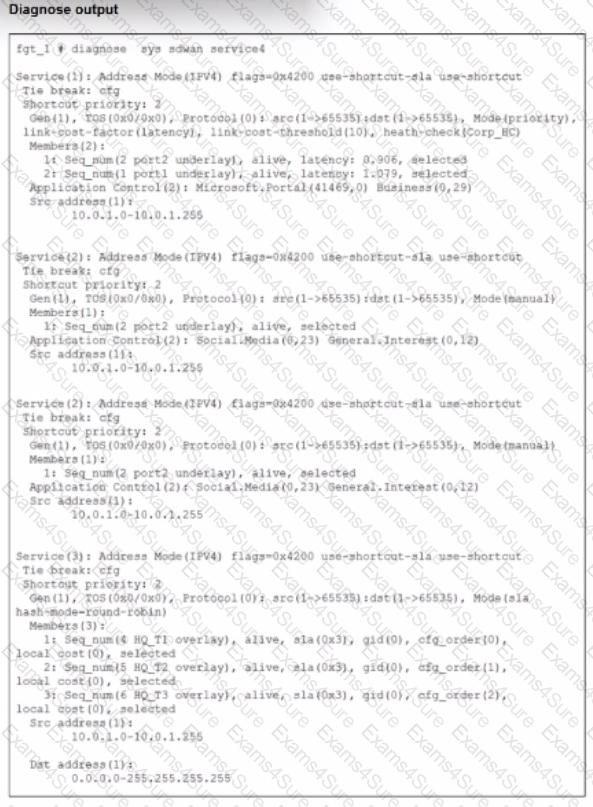
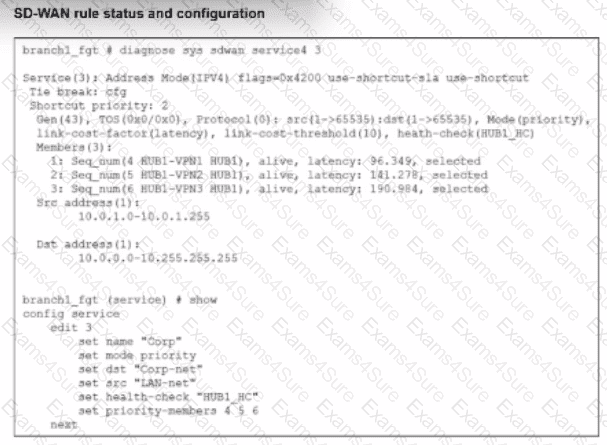
According to the SD-WAN 7.6 Core Administrator study guide and the Fortinet Document Library, the interaction between SD-WAN rules and SLA targets is governed by specific selection and measurement logic:
Usage by Strategy (Option B): SLA targets are fundamentally used by the Lowest Cost (SLA) strategy to determine which links are currently healthy enough to be considered for traffic steering. While other strategies like Best Quality use a " Measured SLA " to monitor metrics, they do not typically use the " Required SLA Target " to disqualify links unless specifically configured in a hybrid mode. In most curriculum contexts, the " Required SLA Target " field is specifically associated with the Lowest Cost and Maximize Bandwidth strategies.
SLA Compliance Checking (Option D): SD-WAN rules utilize SLA targets as a " pass/fail " gatekeeper. The engine checks if the preferred members meet the defined SLA requirements (latency, jitter, or packet loss thresholds). If a preferred member fails the SLA, the rule will move to the next member in the priority list that does meet the SL
A.
Single SLA Binding (Option E): When configuring an SD-WAN rule, the GUI and CLI allow you to select multiple SLA targets, but they must all belong to the same Performance SLA profile. You cannot mix and match targets from different health checks (e.g., Target 1 from " Google_HC " and Target 2 from " Amazon_HC " ) within a single SD-WAN rule.
Why other options are incorrect:
Option A: This is incorrect because a single SD-WAN rule can only be associated with one specific Performance SLA profile at a time; therefore, you cannot select targets from different SLAs.
Option C: This is incorrect because member metrics (latency, jitter, packet loss) are measured by the Performance SLA probes regardless of whether an SD-WAN rule is currently using that SLA target for steering decisions. Measurement is a function of the health-check, not the rule matching process.