
Consider the following statements about Architecture Partitioning:
The TOGAF ADM requires a partitioning model for architecture development
Architectures are partitioned when different teams need to work on different elements of the architecture at the same time
Partitions can be used to facilitate architecture re-use
Which statements are correct?
Which deliverable is first produced in Phase A, also updated in Phase E, and helps the architect to understand the baseline and target for the enterprise?
What can architects present to stakeholders to extract hidden agendas, principles, and requirements that could impact the final Target Architecture?
Which of the following describes the practice by which the enterprise architecture is managed and controlled at an enterprise-wide level?
Which section of the TOGAF template for Architecture Principles should describe the relationship to other principles?
Complete the sentence The TOGAF standard covers the development of four architecture domains. Business. Data, Technology and__________________.
Consider the following descriptions of deliverables consumed and produced across the TOGAF ADM cycle.
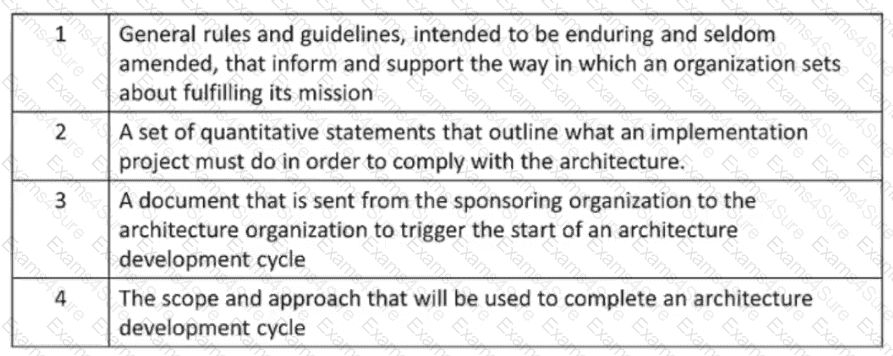
Which deliverables match these descriptions?
Full Question:
Consider the image showing basic architectural concepts.
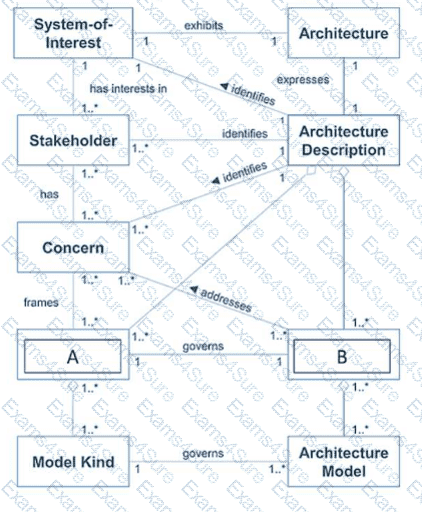
Complete the sentence: Item A ____________, while item B ____________.
Complete the sentence. Actions arising from the Business Transformation Readiness Assessment technique should be incorporated in the
Consider the following statements.
1. All processes, decision-making, and mechanisms used will be established so as to minimize or avoid potential conflicts of interest.
2. More effective strategic decision-making will be made by C-Level executives and business leaders.
3. All actions implemented and their decision support will be available for inspection by authorized organization and provider parties.
4. Digital Transformation and operations will be more effective and efficient.
Which statements highlight the value and necessity for Architecture Governance to be adopted within organizations?

Exam style questions across every OGEA-101 domain
Last Update 4 days ago
Total Questions : 172
Start with our free OGEA-101 practice questions, carefully crafted to mirror the domains, phrasing, and difficulty of the real Enterprise Architecture exam. Each OGEA-101 exam question comes with a detailed rationale that explains not just which answer is correct but why the others fall short. That's how concepts stick. Use the free set to benchmark yourself: identify your The Open Group weak domains, see where you're losing marks, and build a focused study plan in minutes.