
Winter Special Sale Limited Time 60% Discount Offer - Ends in 0d 00h 00m 00s - Coupon code: 2493360325

XDR-Analyst Palo Alto Networks XDR Analyst is now Stable and With Pass Result | Test Your Knowledge for Free

XDR-Analyst Practice Questions

Palo Alto Networks XDR Analyst

Last Update 3 days ago
Total Questions : 91

Dive into our fully updated and stable XDR-Analyst practice test platform, featuring all the latest Security Operations exam questions added this week. Our preparation tool is more than just a Paloalto Networks study aid; it's a strategic advantage.

Our Security Operations practice questions crafted to reflect the domains and difficulty of the actual exam. The detailed rationales explain the 'why' behind each answer, reinforcing key concepts about XDR-Analyst. Use this test to pinpoint which areas you need to focus your study on.

XDR-Analyst PDF

XDR-Analyst PDF (Printable)
$50
$124.99

XDR-Analyst Testing Engine

XDR-Analyst PDF (Printable)
$58
$144.99

XDR-Analyst PDF + Testing Engine

XDR-Analyst PDF (Printable)
$72.8
$181.99
Question # 1

A Linux endpoint with a Cortex XDR Pro per Endpoint license and Enhanced Endpoint Data enabled has reported malicious activity, resulting in the creation of a file that you wish to delete. Which action could you take to delete the file?
Options:

A.  

Manually remediate the problem on the endpoint in question.

B.  

Open X2go from the Cortex XDR console and delete the file via X2go.

C.  

Initiate Remediate Suggestions to automatically delete the file.

D.  

Open an NFS connection from the Cortex XDR console and delete the file.

Discussion 0
Question # 2

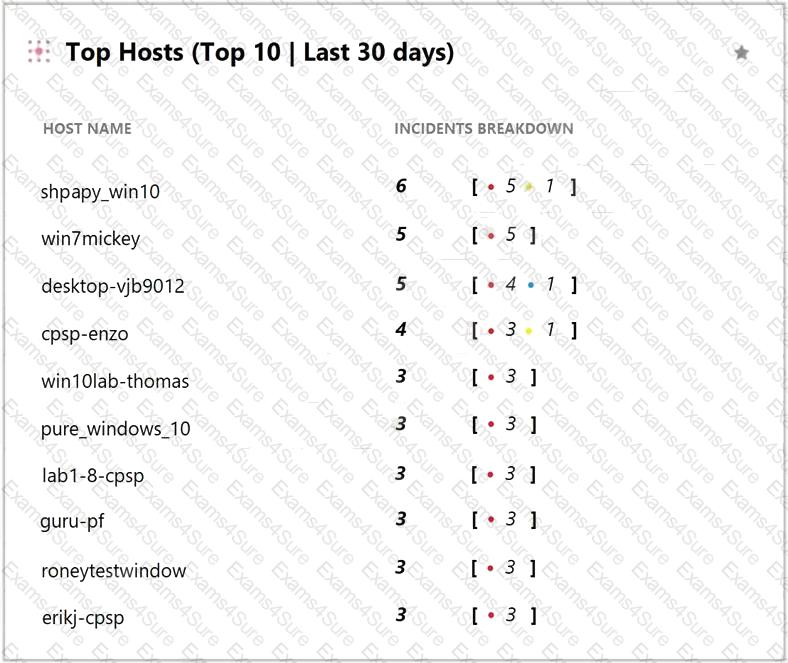
What does the following output tell us?

Question # 2

Options:

A.  

There is one low severity incident.

B.  

Host shpapy_win10 had the most vulnerabilities.

C.  

There is one informational severity alert.

D.  

This is an actual output of the Top 10 hosts with the most malware.

Discussion 0
Question # 3

What are two purposes of “Respond to Malicious Causality Chains” in a Cortex XDR Windows Malware profile? (Choose two.)

Options:

A.  

Automatically close the connections involved in malicious traffic.

B.  

Automatically kill the processes involved in malicious activity.

C.  

Automatically terminate the threads involved in malicious activity.

D.  

Automatically block the IP addresses involved in malicious traffic.

Discussion 0
Question # 4

What is the maximum number of agents one Broker VM local agent applet can support?

Options:

A.  

5,000

B.  

10,000

C.  

15,000

D.  

20,000

Discussion 0
Question # 5

What license would be required for ingesting external logs from various vendors?

Options:

A.  

Cortex XDR Pro per Endpoint

B.  

Cortex XDR Vendor Agnostic Pro

C.  

Cortex XDR Pro per TB

D.  

Cortex XDR Cloud per Host

Discussion 0
Question # 6

What kind of malware uses encryption, data theft, denial of service, and possibly harassment to take advantage of a victim?

Options:

A.  

Ransomware

B.  

Worm

C.  

Keylogger

D.  

Rootkit

Discussion 0
Question # 7

What is the outcome of creating and implementing an alert exclusion?

Options:

A.  

The Cortex XDR agent will allow the process that was blocked to run on the endpoint.

B.  

The Cortex XDR console will hide those alerts.

C.  

The Cortex XDR agent will not create an alert for this event in the future.

D.  

The Cortex XDR console will delete those alerts and block ingestion of them in the future.

Discussion 0
Question # 8

Live Terminal uses which type of protocol to communicate with the agent on the endpoint?

Options:

A.  

NetBIOS over TCP

B.  

WebSocket

C.  

UDP and a random port

D.  

TCP, over port 80

Discussion 0
Question # 9

Which engine, of the following, in Cortex XDR determines the most relevant artifacts in each alert and aggregates all alerts related to an event into an incident?


Options:

A.  

Sensor Engine

B.  

Causality Analysis Engine

C.  

Log Stitching Engine

D.  

Causality Chain Engine

Discussion 0
Question # 10

What is the function of WildFire for Cortex XDR?

Options:

A.  

WildFire runs in the cloud and analyses alert data from the XDR agent to check for behavioural threats.

B.  

WildFire is the engine that runs on the local agent and determines whether behavioural threats are occurring on the endpoint.

C.  

WildFire accepts and analyses a sample to provide a verdict.

D.  

WildFire runs entirely on the agent to quickly analyse samples and provide a verdict.

Discussion 0
Get XDR-Analyst dumps and pass your exam in 24 hours!

Free Exams Sample Questions

