
300-815 Practice Questions
Implementing Cisco Advanced Call Control and Mobility Services (CLACCM)
Last Update 2 days ago
Total Questions : 242
Dive into our fully updated and stable 300-815 practice test platform, featuring all the latest CCNP Collaboration exam questions added this week. Our preparation tool is more than just a Cisco study aid; it's a strategic advantage.
Our free CCNP Collaboration practice questions crafted to reflect the domains and difficulty of the actual exam. The detailed rationales explain the 'why' behind each answer, reinforcing key concepts about 300-815. Use this test to pinpoint which areas you need to focus your study on.

An administrator is configuring an Intercluster Lookup Service between 10 Cisco UCM clusters. Due to security requirements, certificate-based authentication must be used. Due to the deployment size, the administrator wants to avoid manually exchanging certificates between the clusters. Which two steps must be followed to meet these requirements? (Choose two)
Refer to the exhibit.
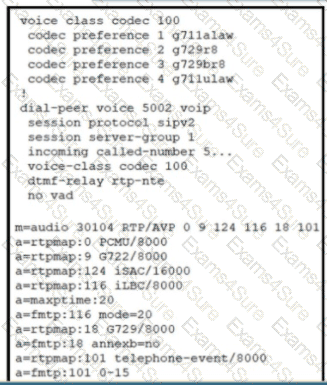
The Cisco Unified Border Element receives an INVITE matching inbound dial peer 5002. The outbound dial peer supports only iLB
C.
and a Local Transcoding Interface is allocated. Based on the configuration and SDP from the INVITE message, which codec is chosen by Cisco Unified Border Element for the inbound call leg?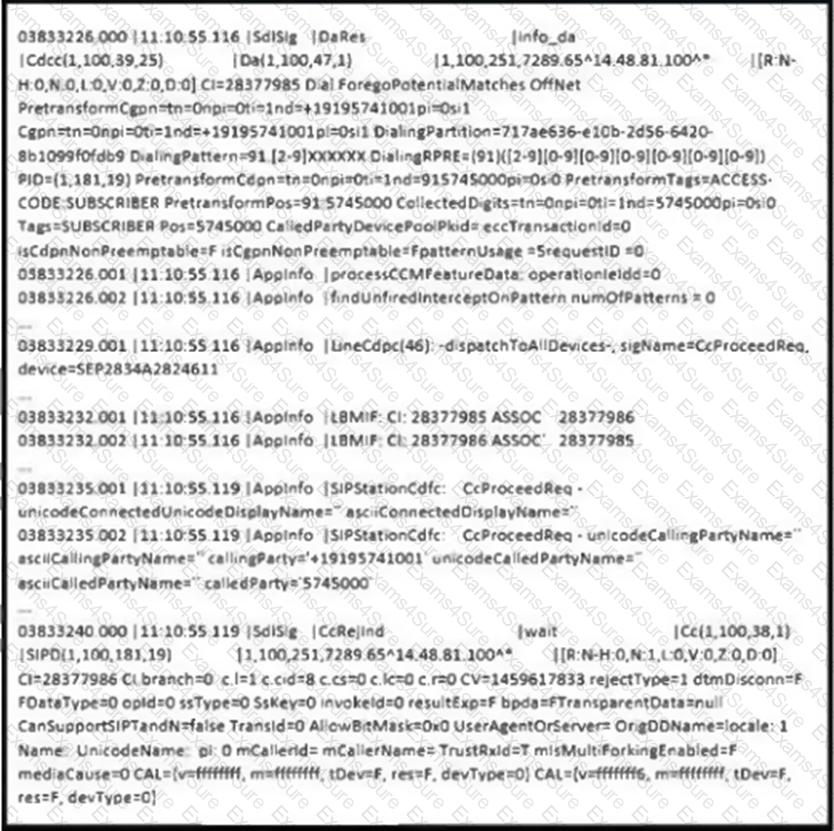
Refer to the exhibit. An administrator configured a new SIP trunk between Cisco UCM and Cisco Unified Border Element. Calls that use this new trunk are failing, and debugs from the Cisco Unified Border Element do not show any signaling received from Cisco UCM. The administrator verified that OPTIONS is enabled on the SIP profile configured on the trunk on Cisco UCM. The route pattern matched for this call is correctly configured to send calls to the Cisco Unified Border Element using this new trunk. What is the cause of this failure?
Which services are needed to successfully implement Cisco Extension Mobility in a standalone Cisco Unified Communications Manager server?
A single site reports that when they dial select numbers, the call connects, but they do not get audio. The administrator finds that the calls are not routing out of the normal gateway but out of another site's gateway due to a TEHO configuration. What is the next step to diagnose and solve the issue?
An engineer needs to deploy the local route group feature to a Cisco UCM server by using the standard local route group. For each device pool, the engineer needs to specify a different PSTN access for emergency calls. What must the engineer do?
Refer to the exhibit.
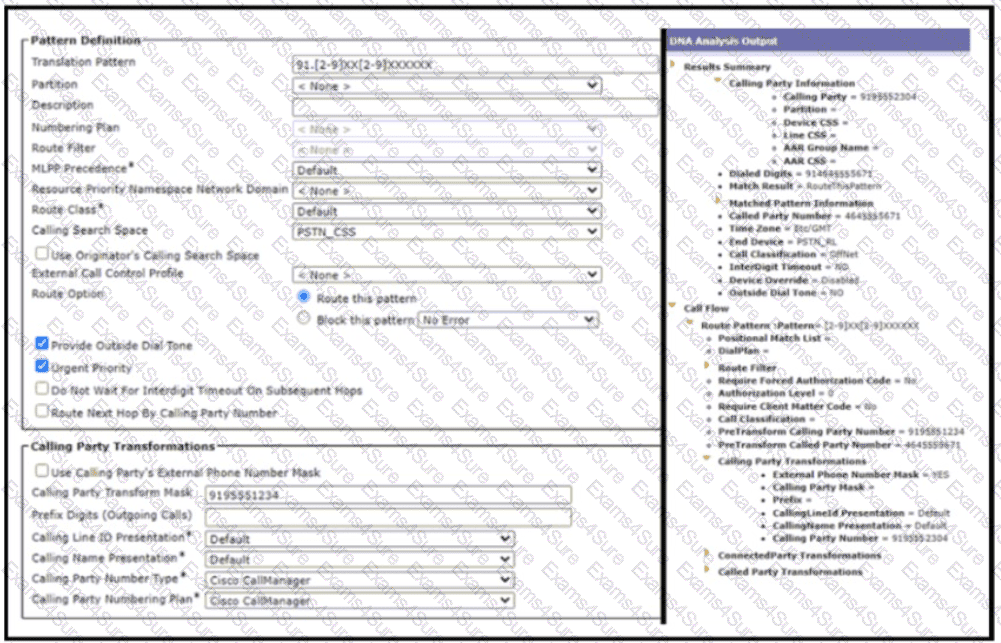
For long-distance calls, users must prefix their dialed number with “91.” The translation pattern was created to strip the 91 as the PSTN expects a 10- digit number. The PSTN also requires the calling number to be set to 9195551234. However, the service provider has said calls with a different calling number are being received. How is this issue resolved?
Refer to the exhibit.

A collaboration engineer is troubleshooting an issue where external callers cannot leave voicemail messages. Also, internal users report hearing the reorder tone (fast busy) when they attempt to retrieve voicemail messages from their Cisco IP phones. Which action resolves the issue?
Customers that call into a company’s IVR report that when they try to select an option, none of the prompts work. The administrator determines that the calls are coming in across an H.323 gateway. While analyzing the dial peer that points toward Cisco UCM, the administrator notices that no DTMF method is configured. Which command resolves this issue?