Pre-Summer Sale Limited Time 65% Discount Offer - Ends in 0d 00h 00m 00s - Coupon code: 65pass65

352-011 Cisco Certified Design Expert Practical Exam is now Stable and With Pass Result | Test Your Knowledge for Free

Exams4sure Dumps

352-011 Practice Questions

Cisco Certified Design Expert Practical Exam

Last Update 3 days ago
Total Questions : 249

Dive into our fully updated and stable 352-011 practice test platform, featuring all the latest CCDE exam questions added this week. Our preparation tool is more than just a Cisco study aid; it's a strategic advantage.

Our free CCDE practice questions crafted to reflect the domains and difficulty of the actual exam. The detailed rationales explain the 'why' behind each answer, reinforcing key concepts about 352-011. Use this test to pinpoint which areas you need to focus your study on.

352-011 PDF

352-011 PDF (Printable)
$48.3
$137.99

352-011 Testing Engine

352-011 PDF (Printable)
$52.5
$149.99

352-011 PDF + Testing Engine

352-011 PDF (Printable)
$65.45
$186.99
Question # 11

Which option describes the fundamental design differences between an IP-based network design and a SAN-based?

Options:

A.  

An IP-based design has redundant connectivity in the fabric and high amounts of east-west traffic, whereas a SAN-based design uses redundancy from a dual-attached host, which uses separate fabrics and has very little east-west traffic

B.  

An IP-based design has redundancy from the host and high amounts of east-west traffic, whereas a SAN-based design uses redundancy in the fabric and very little east-west traffic

C.  

An IP-based design has redundant connectivity in the fabric and high amounts of east-west traffic, whereas a SAN-based design uses zoning based redundancy which uses separate fabrics and has very little east-west traffic

D.  

An IP-based design has redundant connectivity in the fabric and very little east-west traffic, whereas a SAN-based design uses redundancy in the host, which uses separate fabrics and has high amounts of east-west traffic

Discussion 0
Question # 12

An operations engineer asks for your help with a new switching deployment. The engineer confirms that STP is enabled on an edge switch, and a particular port is connected to another switch. The switch is not receiving configuration BPDUs, although it appears that everything is functioning correctly in the network. What is the design explanation?

Options:

A.  

Bridge Assurance is enabled on the port

B.  

Storm control broadcast is enabled on the port

C.  

REP is enabled on the port

D.  

BPDU Guard is enabled on the port

Discussion 0
Question # 13

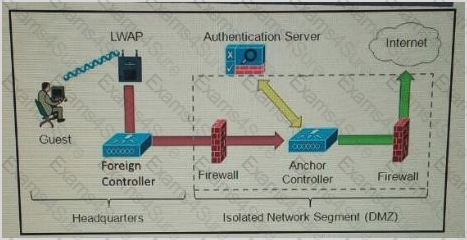
Refer to the exhibit.

Question # 13

Which solution must be used to send traffic from the foreign wireless LAN controller to the anchor wireless LAN controller?

Options:

A.  

Encapsulate packets into an EoIP tunnel and send them to the anchor controller

B.  

Send packets from the foreign controller to the anchor controller via Layer 3 MPLS VPN or VRF-Lite

C.  

Send packets from the foreign controller to the anchor controller via IPinIP or IPsec tunnel

D.  

Send packets without encapsulation to the anchor controller over the routed network

Discussion 0
Question # 14

Which design benefit of Bridge Assurance is true?

Options:

A.  

It prevents switched traffic from traversing suboptimal paths on the network.

B.  

It prevents switched loops caused by unidirectional point-to-point, link condition on Rapid PVST+ and MST

C.  

It allows small unmanaged switches to be plugged into ports of access scenes without the risk of switch loops.

D.  

It suppresses a spanning-tree topology change upon connecting and disconnecting a station on a port.

Discussion 0
Question # 15

Which multicast technology provides a large, many-to-many connectivity for a new application while minimizing load on the existing network infrastructure?

Options:

A.  

PIM Sparse Mode

B.  

Bidirectional PIM

C.  

Any-Source Multicast

D.  

Source Specific Multicast

Discussion 0
Question # 16

Which three items do you recommend for control plane hardening of an infrastructure device? (Choose three)

Options:

A.  

To enable unused services

B.  

Warning banners

C.  

Routing protocol authentication

D.  

Control Plane Policing

E.  

Redundant AAA servers

F.  

SNMPv3

Discussion 0
Question # 17

You are redesigning a single-level IS-IS network with 500 routers, which have short-haul and long-haul links Most of the time the routing domain is stable, but periodically interfaces on long-haul links bounce for a short period of time , causing 10 to 20 flaps in a few minutes. The probable cause is local road construction. Although fast convergence important, the client has concerns about taxing CPU cycles on the older routing platforms. What change should you recommend that both protects the CPU of the older routers during the short periods of excessive flapping, yet does not have an impact on fast convergence for all interface failures?

Options:

A.  

Modify hello timers on routers with short-haul links

B.  

Implement LSP generation throttling on routers with long-haul links

C.  

Modify the length of time than an LSP remains in the router database without being refreshed on all routers

D.  

Implement a delay between successive IS-IS LSP packet transmissions on routers with long-haul links

Discussion 0
Question # 18

Which two options are design considerations when introducing FCoE into an existing network? (Choose two)

Options:

A.  

The FCoE QoS markings may overlap with call signaling QoS markings

B.  

Optical cabling is needed to transmit FCoE traffic between a server and its directly connected Ethernet switch

C.  

The existing network must support a MTU of 3280 bytes

D.  

Twinaxial cabling can be used to transmit FCoE traffic between a server and its directly connected Ethernet switch, if it is less than 10 meters

E.  

All the servers in the data center must be retrofitted with converged Network Adapters

Discussion 0
Question # 19

What is design considerations of policy-based routing?

Options:

A.  

It decreases failure detection time

B.  

It can create microloops during network reconvergence

C.  

It routes traffic destined to a set of users through different exit points

D.  

It uses RSVP to differentiate traffic flows, so queuing mechanisms can prioritize them

Discussion 0
Question # 20

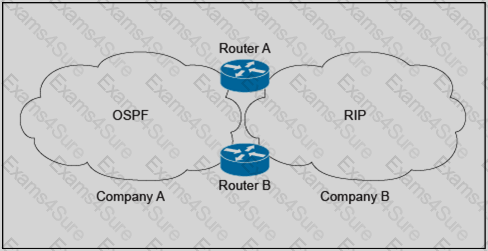
Refer to the exhibit.

Question # 20

Company A is running a single-area OSPF, and Company B is running RIP as the IGP with no overlapping IP address spaces. Company A has just acquired Company B and both networks must be merged. Which three design components are recommended to guarantee connectivity and redundancy between the two networks? (Choose three.)


Options:

A.  

Enable mutual redistribution between OSPF and RIP on one border router.

B.  

Enable mutual redistribution between OSPF and RIP on Router A and Router B using route tags.

C.  

Increase the administrative distance to 130 for the OSPF external prefixes on Router A and Router

B.  

D.  

Implement an ACL on Router A and Router B to prevent OSPF external routes from being installed in the OSPF database.

E.  

Filter external routes on Router A and Router B based on route tags.

Discussion 0
Get 352-011 dumps and pass your exam in 24 hours!

Free Exams Sample Questions