
The audit lifecycle describes the ISO 19011 process for conducting an individual audit.
Which two of the following are part of conducting the audit activities?
A chain of 10 paint shops in a city has established an EMS following the requirements of ISO 14001, which was third-party certified 10 years ago. You are performing a second-party audit. The audit plan included an interview with the General Manager.
The dialogue was as follows:
You: Hi, good evening. I have seen well-developed environmental risk assessment processes. However, I did not find the identification of emergency situations included in the results of this process. The Environmental Manager could not provide me with an acceptable answer to this question.
GM: The EM joined us two months ago, and he may not know some decisions we made some time ago, when we first certified our EMS. During those days, I met with all 10 supervisors and asked them what the emergencies were that they feared most. They unanimously said: fire. That was it. This is the only emergency we care of. As far as I remember we do not test the plan very often because the supervisors of all our 10 shops know it very well. The auditors of our certification body accepted this. We did not have a fire in the last 10 years.
What evidence would you need to review to determine conformity with ISO 14001 in this scenario? Select six.
A multi-level shopping centre is open every day to the public from 09:00-21:00. During an external audit of the centre to ISO 14001, you establish that there are 40 vending machines that are permanently switched on. Thirty of them do not sell perishable foodstuffs. You also note that there are eight escalators in the complex that run constantly during public access. When asked about environmental performance improvement objectives, the Centre Manager says that there are plans to increase the natural daylight by installing more skylights, thus saving on lighting costs, but the board has not yet approved the estimated budget for this.
You: I note that energy consumption is a significant environmental aspect in the centre. How do you mitigate the impacts of this?
EMS Manager: We try to reduce our energy costs by negotiating a better deal from the energy company. We are considering changing to one that only supplies electricity from renewable sources.
You: What steps have you taken to reduce overall consumption?
EMS Manager: We conducted awareness training for staff. For example, turning off lights in staff areas not being used.
You: I see that the escalators account for the highest usage of energy. Are there any objectives to try to reduce this?
EMS Manager: No, it would be too costly to change them.
You: How do you measure electricity consumption?
EMS Manager: We have meters installed on each floor of the centre. We take readings every hour, and we plot the consumption graph for every staff shift.
Select three options that would provide evidence of conformance with clause 9.1.1 of ISO 14001.
You are a third-party auditor of XM, a logistics organisation located in a European country, that distributes a wide range of products to local customers but also to customers in several neighbouring countries. Close to the distribution warehouse, you see many trucks loading and unloading goods. Almost 50 per cent of the trucks are owned by XM, the remainder are subcontracted from other organisations.
You have the following dialogue with the Warehouse Manager:
You: I see that not all trucks belong to XM.
WM: Sometimes we need additional trucks from other organisations nearby. Obviously, we cannot control their energy consumption since they come with the trucks half full of their own goods.
You: How did you inform them of the EMS?
WM: You know, they are not used to the complicated words in our policy. I have just told them: “Save energy”.
You: What about your trucks?
WM: We measure the fuel they used on each trip, the distance they drove and the weight of goods they distributed. They know the roads and we ask them to choose the shortest route — we rely on them.
You: Did you fix any indicators and objectives related to energy consumption?
WM: No, we know they are careful people, they do their best. We would not be able to improve consumption.
This dialogue is related to several clauses of ISO 14001. Identify which three clauses below are related to this dialogue.
An oil organisation has a natural gas treatment plant on land crossed by several small rivers. On one particular day, after heavy rainfall for 48 hours, some of those rivers burst their banks and flooded the water treatment facilities of the plant. The oil-contaminated water reached some scarcely populated areas nearby.
Soon after, an internal audit was carried out to particularly analyse this event that was considered a nonconformity. There were no records of such heavy rainfall in the past 200 years.
Which three of the following actions are ' corrections ' ?
Which one of the following outcomes of an audit does not require the auditee to respond?
Sparkle is an organisation that provides mobile car cleaning services at customers ' premises. It has been certified to ISO 14001 for some time and has appointed a full-time Environmental Management System Manager. The audit plan during a surveillance audit includes continual improvement and the auditor asks to see the most recent management review meeting minutes.
The minutes indicate that the Environmental Management System Manager reported that the last review of the organisation ' s environmental legislation register was made three years ago instead of annually as planned in the Environmental Management System. At that time, he asked for finances to employ a legislation expert to update the register but was denied the request by top management on the basis that it was unlikely that many changes to legislation had occurred. No related improvement actions were documented in the minutes.
Based on the scenario, select the two options which best describe the evidence for raising such a non-conformity.
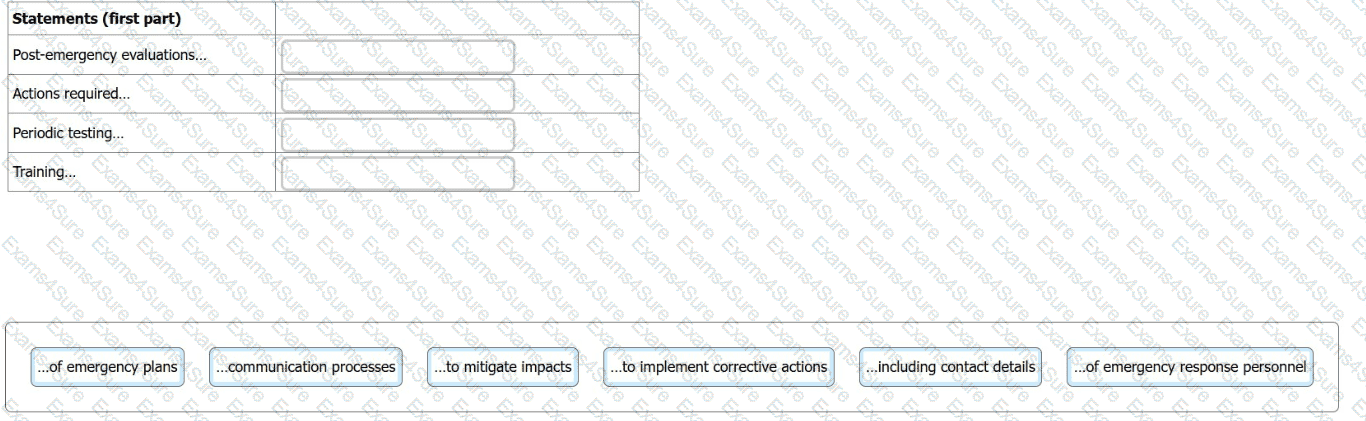
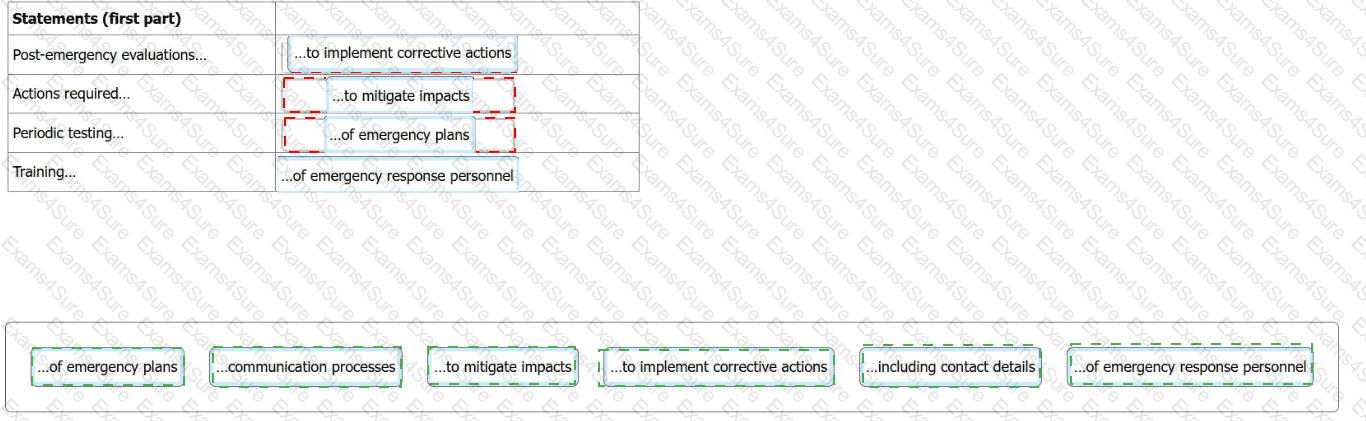
The following four statements relate to planning to respond to emergencies. Each statement is divided into two parts. Match the first part to the corresponding second part of each statement:
In the case of ISO 14001 EMS audits that follow the recommendations of ISO 19011, which two of the following statements are true?
During a Stage 1 audit, the EMS Manager asks that the audit includes coverage of a new storage site on the other side of town that they have taken over since the application was made.
Which two of the following actions should the auditor take?

Exam style questions across every ISO-14001-Lead-Auditor domain
Last Update 4 days ago
Total Questions : 96
Start with our free ISO-14001-Lead-Auditor practice questions, carefully crafted to mirror the domains, phrasing, and difficulty of the real ISO 14001 exam. Each ISO-14001-Lead-Auditor exam question comes with a detailed rationale that explains not just which answer is correct but why the others fall short. That's how concepts stick. Use the free set to benchmark yourself: identify your PECB weak domains, see where you're losing marks, and build a focused study plan in minutes.