
Pre-Summer Sale Limited Time 65% Discount Offer - Ends in 0d 00h 00m 00s - Coupon code: 65pass65

MuleSoft-Integration-Architect-I Salesforce Certified MuleSoft Platform Integration Architect (Mule-Arch-202) is now Stable and With Pass Result | Test Your Knowledge for Free

Exams4sure Dumps

MuleSoft-Integration-Architect-I Practice Questions

Salesforce Certified MuleSoft Platform Integration Architect (Mule-Arch-202)

Last Update 1 day ago
Total Questions : 273

Dive into our fully updated and stable MuleSoft-Integration-Architect-I practice test platform, featuring all the latest Salesforce MuleSoft exam questions added this week. Our preparation tool is more than just a Salesforce study aid; it's a strategic advantage.

Our free Salesforce MuleSoft practice questions crafted to reflect the domains and difficulty of the actual exam. The detailed rationales explain the 'why' behind each answer, reinforcing key concepts about MuleSoft-Integration-Architect-I. Use this test to pinpoint which areas you need to focus your study on.

MuleSoft-Integration-Architect-I PDF

MuleSoft-Integration-Architect-I PDF (Printable)
$43.75
$124.99

MuleSoft-Integration-Architect-I Testing Engine

MuleSoft-Integration-Architect-I PDF (Printable)
$50.75
$144.99

MuleSoft-Integration-Architect-I PDF + Testing Engine

MuleSoft-Integration-Architect-I PDF (Printable)
$63.7
$181.99
Question # 31

An organization has various integrations implemented as Mule applications. Some of these Mule applications are deployed to custom hosted Mule runtimes (on-premises) while others execute in the MuleSoft-hosted runtime plane (CloudHub). To perform the Integra functionality, these Mule applications connect to various backend systems, with multiple applications typically needing to access the backend systems.

How can the organization most effectively avoid creating duplicates in each Mule application of the credentials required to access the backend systems?

Options:

A.  

Create a Mule domain project that maintains the credentials as Mule domain-shared resources Deploy the Mule applications to the Mule domain, so the credentials are available to the Mule applications

B.  

Store the credentials in properties files in a shared folder within the organization's data center Have the Mule applications load properties files from this shared location at startup

C.  

Segregate the credentials for each backend system into environment-specific properties files Package these properties files in each Mule application, from where they are loaded at startup

D.  

Configure or create a credentials service that returns the credentials for each backend system, and that is accessible from customer-hosted and MuleSoft-hosted Mule runtimes Have the Mule applications toad the properties at startup by invoking that credentials service

Discussion 0
Question # 32

Which Exchange asset type represents configuration modules that extend the functionality of an API and enforce capabilities such as security?

Options:

A.  

Rulesets

B.  

Policies

C.  

RESTAPIs

D.  

Connectors

Discussion 0
Question # 33

An organization is evaluating using the CloudHub shared Load Balancer (SLB) vs creating a CloudHub dedicated load balancer (DLB). They are evaluating how this choice affects the various types of certificates used by CloudHub deplpoyed Mule applications, including MuleSoft-provided, customer-provided, or Mule application-provided certificates.

What type of restrictions exist on the types of certificates that can be exposed by the CloudHub Shared Load Balancer (SLB) to external web clients over the public internet?

Options:

A.  

Only MuleSoft-provided certificates are exposed.

B.  

Only customer-provided wildcard certificates are exposed.

C.  

Only customer-provided self-signed certificates are exposed.

D.  

Only underlying Mule application certificates are exposed (pass-through)

Discussion 0
Question # 34

An automation engineer needs to write scripts to automate the steps of the API lifecycle, including steps to create, publish, deploy and manage APIs and their implementations in Anypoint Platform.

What Anypoint Platform feature can be used to automate the execution of all these actions in scripts in the easiest way without needing to directly invoke the Anypoint Platform REST APIs?

Options:

A.  

Automated Policies in API Manager

B.  

Runtime Manager agent

C.  

The Mule Maven Plugin

D.  

Anypoint CLI

Discussion 0
Question # 35

An organization plans to extend its Mule APIs to the EU (Frankfurt) region.

Currently, all Mule applications are deployed to CloudHub 1.0 in the default North American region, from the North America control plane, following this naming convention: {API-name}—{environment} (for example, Orderssapi—dev, Orders-sapi-—qa, Orders-sapi-—prod, etc.).

There is no network restriction to block communications between APIs.

What strategy should be implemented in order to deploy the same Mule APIs to the CloudHub 1.0 EU region from the North America control plane,

as well as to minimize latency between APIs and target users and systems in Europe?

Options:

A.  

In Runtime Manager, for each Mule application deployment, set the Region property to EU (Frankfurt) and reuse the same Mule application mame as in the North Americanregion.Communicate the new urls {API-name}—{environment}.de-ci.cloudhub.io to the consuming API clients In Europe.

B.  

In API Manager, set the Region property to EU (Frankfurt) to create an API proxy named {API-name}—proxy—{environment} for each Mule application.Communicate the new url {API-name}—proxy—{environment}.de-c1.cloudhub.io to the consuming API clients In Europe.

C.  

In Runtime Manager, for each Mule application deployment, leave the Region propertyblank (default) and change the Mule application name to {API-name}—{environment).de-cl.Communicate the new urls {API-name}—{environment}.de-ci1.cloudhub.io to theconsuming API clients in Europe.

D.  

In API Manager, leave the Region property blank (default) to deploy an API proxy named {API-name}~proxy~- (environment}.de-cl for each Mule application.Communicate the new url {API-name}—proxy—{environment}.de-cl.cloudhub.io to the consuming API clients in Europe.

Discussion 0
Question # 36

Mule application muleA deployed in cloudhub uses Object Store v2 to share data across instances. As a part of new requirement , application muleB which is deployed in same region wants to access this Object Store.

Which of the following option you would suggest which will have minimum latency in this scenario?

Options:

A.  

Object Store REST API

B.  

Object Store connector

C.  

Both of the above option will have same latency

D.  

Object Store of one mule application cannot be accessed by other mule application.

Discussion 0
Question # 37

As a part of project , existing java implementation is being migrated to Mulesoft. Business is very tight on the budget and wish to complete the project in most economical way possible.

Canonical object model using java is already a part of existing implementation. Same object model is required by mule application for a business use case. What is the best way to achieve this?

Options:

A.  

Make use of Java module

B.  

Create similar model for Mule applications

C.  

Create a custom application to read Java code and make it available for Mule application

D.  

Use Anypoint exchange

Discussion 0
Question # 38

As an enterprise architect, what are the two reasons for which you would use a canonical data model in the new integration project using Mulesoft Anypoint platform ( choose two answers )

Options:

A.  

To have consistent data structure aligned in processes

B.  

To isolate areas within a bounded context

C.  

To incorporate industry standard data formats

D.  

There are multiple canonical definitions of each data type

E.  

Because the model isolates the back and systems and support mule applications from change

Discussion 0
Question # 39

A Mule application contains a Batch Job with two Batch Steps (Batch_Step_l and Batch_Step_2). A payload with 1000 records is received by the Batch Job.

How many threads are used by the Batch Job to process records, and how does each Batch Step process records within the Batch Job?

Options:

A.  

Each Batch Job uses SEVERAL THREADS for the Batch Steps Each Batch Step instance receives ONE record at a time as the payload, and RECORDS are processed IN PARALLEL within and between the two Batch Steps

B.  

Each Batch Job uses a SINGLE THREAD for all Batch steps Each Batch step instance receives ONE record at a time as the payload, and RECORDS are processed IN ORDER, first through Batch_Step_l and then through Batch_Step_2

C.  

Each Batch Job uses a SINGLE THREAD to process a configured block size of record Each Batch Step instance receives A BLOCK OF records as the payload, and BLOCKS of records are processed IN ORDER

D.  

Each Batch Job uses SEVERAL THREADS for the Batch Steps Each Batch Step instance receives ONE record at a time as the payload, and BATCH STEP INSTANCES execute IN PARALLEL to process records and Batch Steps in ANY order as fast as possible

Discussion 0
Question # 40

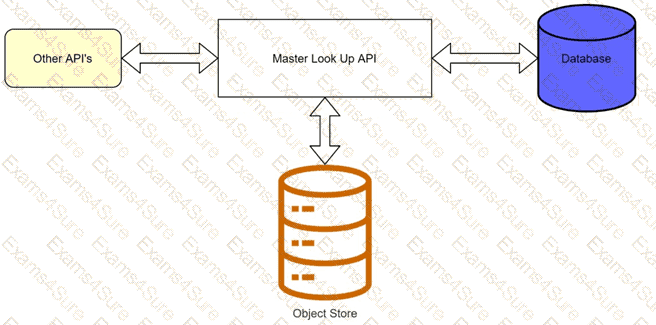
A banking company is developing a new set of APIs for its online business. One of the critical API's is a master lookup API which is a system API. This master lookup API uses persistent object store. This API will be used by all other APIs to provide master lookup data.
Question # 40

Master lookup API is deployed on two cloudhub workers of 0.1 vCore each because there is a lot of master data to be cached. Master lookup data is stored as a key value pair. The cache gets refreshed if they key is not found in the cache.

Doing performance testing it was observed that the Master lookup API has a higher response time due to database queries execution to fetch the master lookup data.

Due to this performance issue, go-live of the online business is on hold which could cause potential financial loss to Bank.

As an integration architect, which of the below option you would suggest to resolve performance issue?


Options:

A.  

Implement HTTP caching policy for all GET endpoints for the master lookup API and implement locking to synchronize access to object store

B.  

Upgrade vCore size from 0.1 vCore to 0,2 vCore

C.  

Implement HTTP caching policy for all GET endpoints for master lookup API

D.  

Add an additional Cloudhub worker to provide additional capacity

Discussion 0
Get MuleSoft-Integration-Architect-I dumps and pass your exam in 24 hours!

Free Exams Sample Questions

