
Pre-Summer Sale Limited Time 65% Discount Offer - Ends in 0d 00h 00m 00s - Coupon code: 65pass65

ARA-C01 SnowPro Advanced: Architect Certification Exam is now Stable and With Pass Result | Test Your Knowledge for Free

Exams4sure Dumps

ARA-C01 Practice Questions

SnowPro Advanced: Architect Certification Exam

Last Update 4 days ago
Total Questions : 182

Dive into our fully updated and stable ARA-C01 practice test platform, featuring all the latest SnowPro Advanced: Architect exam questions added this week. Our preparation tool is more than just a Snowflake study aid; it's a strategic advantage.

Our free SnowPro Advanced: Architect practice questions crafted to reflect the domains and difficulty of the actual exam. The detailed rationales explain the 'why' behind each answer, reinforcing key concepts about ARA-C01. Use this test to pinpoint which areas you need to focus your study on.

ARA-C01 PDF

ARA-C01 PDF (Printable)
$43.75
$124.99

ARA-C01 Testing Engine

ARA-C01 PDF (Printable)
$50.75
$144.99

ARA-C01 PDF + Testing Engine

ARA-C01 PDF (Printable)
$63.7
$181.99
Question # 21

An Architect is implementing a CI/CD process. When attempting to clone a table from a production to a development environment, the cloning operation fails.

What could be causing this to happen?

Options:

A.  

The table is transient.

B.  

The table has a masking policy.

C.  

The retention time for the table is set to zero.

D.  

Tables cannot be cloned from a higher environment to a lower environment.

Discussion 0
Question # 22

A company is following the Data Mesh principles, including domain separation, and chose one Snowflake account for its data platform.

An Architect created two data domains to produce two data products. The Architect needs a third data domain that will use both of the data products to create an aggregate data product. The read access to the data products will be granted through a separate role.

Based on the Data Mesh principles, how should the third domain be configured to create the aggregate product if it has been granted the two read roles?

Options:

A.  

Use secondary roles for all users.

B.  

Create a hierarchy between the two read roles.

C.  

Request a technical ETL user with the sysadmin role.

D.  

Request that the two data domains share data using the Data Exchange.

Discussion 0
Question # 23

A company is designing high availability and disaster recovery plans and needs to maximize redundancy and minimize recovery time objectives for their critical application processes. Cost is not a concern as long as the solution is the best available. The plan so far consists of the following steps:

1. Deployment of Snowflake accounts on two different cloud providers.

2. Selection of cloud provider regions that are geographically far apart.

3. The Snowflake deployment will replicate the databases and account data between both cloud provider accounts.

4. Implementation of Snowflake client redirect.

What is the MOST cost-effective way to provide the HIGHEST uptime and LEAST application disruption if there is a service event?

Options:

A.  

Connect the applications using the - URL. Use the Business Critical Snowflake edition.

B.  

Connect the applications using the - URL. Use the Virtual Private Snowflake (VPS) edition.

C.  

Connect the applications using the - URL. Use the Enterprise Snowflake edition.

D.  

Connect the applications using the - URL. Use the Business Critical Snowflake edition.

Discussion 0
Question # 24

A Snowflake Architect is designing a multiple-account design strategy.

This strategy will be MOST cost-effective with which scenarios? (Select TWO).

Options:

A.  

The company wants to clone a production database that resides on AWS to a development database that resides on Azure.

B.  

The company needs to share data between two databases, where one must support Payment Card Industry Data Security Standard (PCI DSS) compliance but the other one does not.

C.  

The company needs to support different role-based access control features for the development, test, and production environments.

D.  

The company security policy mandates the use of different Active Directory instances for the development, test, and production environments.

E.  

The company must use a specific network policy for certain users to allow and block given IP addresses.

Discussion 0
Question # 25

What are some of the characteristics of result set caches? (Choose three.)

Options:

A.  

Time Travel queries can be executed against the result set cache.

B.  

Snowflake persists the data results for 24 hours.

C.  

Each time persisted results for a query are used, a 24-hour retention period is reset.

D.  

The data stored in the result cache will contribute to storage costs.

E.  

The retention period can be reset for a maximum of 31 days.

F.  

The result set cache is not shared between warehouses.

Discussion 0
Question # 26

A new user user_01 is created within Snowflake. The following two commands are executed:

Command 1→ SHOW GRANTS TO USER user_01;

Command 2→ SHOW GRANTS ON USER user_01;

What inferences can be made about these commands?

Options:

A.  

Command 1 defines which user owns user_01Command 2 defines all the grants which have been given to user_01

B.  

Command 1 defines all the grants which are given to user_01Command 2 defines which user owns user_01

C.  

Command 1 defines which role owns user_01Command 2 defines all the grants which have been given to user_01

D.  

Command 1 defines all the grants which are given to user_01Command 2 defines which role owns user_01

Discussion 0
Question # 27

An Architect is designing a solution that will be used to process changed records in an orders table. Newly-inserted orders must be loaded into the f_orders fact table, which will aggregate all the orders by multiple dimensions (time, region, channel, etc.). Existing orders can be updated by the sales department within 30 days after the order creation. In case of an order update, the solution must perform two actions:

1. Update the order in the f_0RDERS fact table.

2. Load the changed order data into the special table ORDER _REPAIRS.

This table is used by the Accounting department once a month. If the order has been changed, the Accounting team needs to know the latest details and perform the necessary actions based on the data in the order_repairs table.

What data processing logic design will be the MOST performant?

Options:

A.  

Useone stream and one task.

B.  

Useone stream and two tasks.

C.  

Usetwo streams and one task.

D.  

Usetwo streams and two tasks.

Discussion 0
Question # 28

Files arrive in an external stage every 10 seconds from a proprietary system. The files range in size from 500 K to 3 M

B.  

The data must be accessible by dashboards as soon as it arrives.

How can a Snowflake Architect meet this requirement with the LEAST amount of coding? (Choose two.)

Options:

A.  

Use Snowpipe with auto-ingest.

B.  

Use a COPY command with a task.

C.  

Use a materialized view on an external table.

D.  

Use the COPY INTO command.

E.  

Use a combination of a task and a stream.

Discussion 0
Question # 29

The following statements have been executed successfully:

USE ROLE SYSADMIN;

CREATE OR REPLACE DATABASE DEV_TEST_DB;

CREATE OR REPLACE SCHEMA DEV_TEST_D

B.  

SCHTEST WITH MANAGED ACCESS;

GRANT USAGE ON DATABASE DEV_TEST_DB TO ROLE DEV_PROJ_OWN;

GRANT USAGE ON SCHEMA DEV_TEST_D

B.  

SCHTEST TO ROLE DEV_PROJ_OWN;

GRANT USAGE ON DATABASE DEV_TEST_DB TO ROLE ANALYST_PROJ;

GRANT USAGE ON SCHEMA DEV_TEST_D

B.  

SCHTEST TO ROLE ANALYST_PROJ;

GRANT CREATE TABLE ON SCHEMA DEV_TEST_D

B.  

SCHTEST TO ROLE DEV_PROJ_OWN;

USE ROLE DEV_PROJ_OWN;

CREATE OR REPLACE TABLE DEV_TEST_D

B.  

SCHTEST.CURRENCY (

COUNTRY VARCHAR(255),

CURRENCY_NAME VARCHAR(255),

ISO_CURRENCY_CODE VARCHAR(15),

CURRENCY_CD NUMBER(38,0),

MINOR_UNIT VARCHAR(255),

WITHDRAWAL_DATE VARCHAR(255)

);

The role hierarchy is as follows (simplified from the diagram):

    ACCOUNTADMIN└─ DEV_SYSADMIN└─ DEV_PROJ_OWN└─ ANALYST_PROJ

Separately:

    ACCOUNTADMIN└─ SYSADMIN└─ MAPPING_ROLE

Which statements will return the records from the table

DEV_TEST_D

B.  

SCHTEST.CURRENCY? (Select TWO)
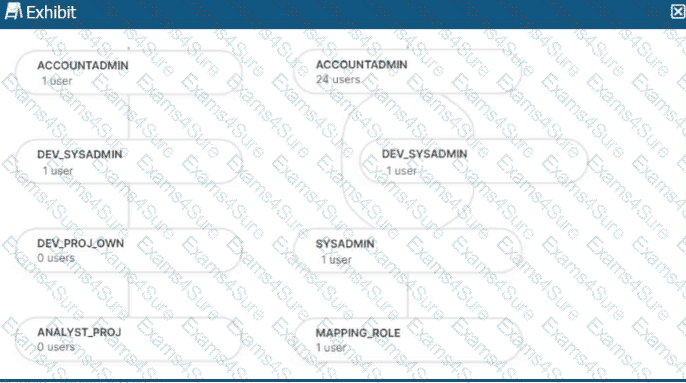
Question # 29

Options:

A.  

USE ROLE DEV_PROJ_OWN;

GRANT SELECT ON DEV_TEST_D

B.  

SCHTEST.CURRENCY TO ROLE ANALYST_PROJ;

USE ROLE ANALYST_PROJ;

SELECT * FROM DEV_TEST_D

B.  

SCHTEST.CURRENCY;

B.  

USE ROLE DEV_PROJ_OWN;

SELECT * FROM DEV_TEST_D

B.  

SCHTEST.CURRENCY;

C.  

USE ROLE SYSADMIN;

SELECT * FROM DEV_TEST_D

B.  

SCHTEST.CURRENCY;

D.  

USE ROLE MAPPING_ROLE;

SELECT * FROM DEV_TEST_D

B.  

SCHTEST.CURRENCY;

E.  

USE ROLE ACCOUNTADMIN;

SELECT * FROM DEV_TEST_D

B.  

SCHTEST.CURRENCY;

Discussion 0
Question # 30

An Architect has chosen to separate their Snowflake Production and QA environments using two separate Snowflake accounts.

The QA account is intended to run and test changes on data and database objects before pushing those changes to the Production account. It is a requirement that all database objects and data in the QA account need to be an exact copy of the database objects, including privileges and data in the Production account on at least a nightly basis.

Which is the LEAST complex approach to use to populate the QA account with the Production account’s data and database objects on a nightly basis?


Options:

A.  

1) Create a share in the Production account for each database2) Share access to the QA account as a Consumer3) The QA account creates a database directly from each share4) Create clones of those databases on a nightly basis5) Run tests directly on those cloned databases

B.  

1) Create a stage in the Production account2) Create a stage in the QA account that points to the same external object-storage location3) Create a task that runs nightly to unload each table in the Production account into the stage4) Use Snowpipe to populate the QA account

C.  

1) Enable replication for each database in the Production account2) Create replica databases in the QA account3) Create clones of the replica databases on a nightly basis4) Run tests directly on those cloned databases

D.  

1) In the Production account, create an external function that connects into the QA account and returns all the data for one specific table2) Run the external function as part of a stored procedure that loops through each table in the Production account and populates each table in the QA account

Discussion 0
Get ARA-C01 dumps and pass your exam in 24 hours!

Free Exams Sample Questions