Spring Sale Limited Time 65% Discount Offer - Ends in 0d 00h 00m 00s - Coupon code: 65pass65

ARA-C01 SnowPro Advanced: Architect Certification Exam is now Stable and With Pass Result | Test Your Knowledge for Free

ARA-C01 Practice Questions

SnowPro Advanced: Architect Certification Exam

Last Update 4 days ago
Total Questions : 182

Dive into our fully updated and stable ARA-C01 practice test platform, featuring all the latest SnowPro Advanced: Architect exam questions added this week. Our preparation tool is more than just a Snowflake study aid; it's a strategic advantage.

Our free SnowPro Advanced: Architect practice questions crafted to reflect the domains and difficulty of the actual exam. The detailed rationales explain the 'why' behind each answer, reinforcing key concepts about ARA-C01. Use this test to pinpoint which areas you need to focus your study on.

ARA-C01 PDF

ARA-C01 PDF (Printable)
$43.75
$124.99

ARA-C01 Testing Engine

ARA-C01 PDF (Printable)
$50.75
$144.99

ARA-C01 PDF + Testing Engine

ARA-C01 PDF (Printable)
$63.7
$181.99
Question # 1

A retail company has 2000+ stores spread across the country. Store Managers report that they are having trouble running key reports related to inventory management, sales targets, payroll, and staffing during business hours. The Managers report that performance is poor and time-outs occur frequently.

Currently all reports share the same Snowflake virtual warehouse.

How should this situation be addressed? (Select TWO).

Options:

A.  

Use a Business Intelligence tool for in-memory computation to improve performance.

B.  

Configure a dedicated virtual warehouse for the Store Manager team.

C.  

Configure the virtual warehouse to be multi-clustered.

D.  

Configure the virtual warehouse to size 4-XL

E.  

Advise the Store Manager team to defer report execution to off-business hours.

Discussion 0
Question # 2

A healthcare company wants to share data with a medical institute. The institute is running a Standard edition of Snowflake; the healthcare company is running a Business Critical edition.

How can this data be shared?

Options:

A.  

The healthcare company will need to change the institute’s Snowflake edition in the accounts panel.

B.  

By default, sharing is supported from a Business Critical Snowflake edition to a Standard edition.

C.  

Contact Snowflake and they will execute the share request for the healthcare company.

D.  

Set the share_restriction parameter on the shared object to false.

Discussion 0
Question # 3

An Architect needs to allow a user to create a database from an inbound share.

To meet this requirement, the user’s role must have which privileges? (Choose two.)

Options:

A.  

IMPORT SHARE;

B.  

IMPORT PRIVILEGES;

C.  

CREATE DATABASE;

D.  

CREATE SHARE;

E.  

IMPORT DATABASE;

Discussion 0
Question # 4

An Architect uses COPY INTO with the ON_ERROR=SKIP_FILE option to bulk load CSV files into a table called TABLEA, using its table stage. One file named file5.csv fails to load. The Architect fixes the file and re-loads it to the stage with the exact same file name it had previously.

Which commands should the Architect use to load only file5.csv file from the stage? (Choose two.)

Options:

A.  

COPY INTO tablea FROM @%tablea RETURN_FAILED_ONLY = TRUE;

B.  

COPY INTO tablea FROM @%tablea;

C.  

COPY INTO tablea FROM @%tablea FILES = ('file5.csv');

D.  

COPY INTO tablea FROM @%tablea FORCE = TRUE;

E.  

COPY INTO tablea FROM @%tablea NEW_FILES_ONLY = TRUE;

F.  

COPY INTO tablea FROM @%tablea MERGE = TRUE;

Discussion 0
Question # 5

A company wants to Integrate its main enterprise identity provider with federated authentication with Snowflake.

The authentication integration has been configured and roles have been created in Snowflake. However, the users are not automatically appearing in Snowflake when created and their group membership is not reflected in their assigned rotes.

How can the missing functionality be enabled with the LEAST amount of operational overhead?

Options:

A.  

OAuth must be configured between the identity provider and Snowflake. Then the authorization server must be configured with the right mapping of users and roles.

B.  

OAuth must be configured between the identity provider and Snowflake. Then the authorization server must be configured with the right mapping of users, and the resource server must be configured with the right mapping of role assignment.

C.  

SCIM must be enabled between the identity provider and Snowflake. Once both are synchronized through SCIM, their groups will get created as group accounts in Snowflake and the proper roles can be granted.

D.  

SCIM must be enabled between the identity provider and Snowflake. Once both are synchronized through SCIM. users will automatically get created and their group membership will be reflected as roles In Snowflake.

Discussion 0
Question # 6

Which columns can be included in an external table schema? (Select THREE).

Options:

A.  

VALUE

B.  

METADATASROW_ID

C.  

METADATASISUPDATE

D.  

METADAT A$ FILENAME

E.  

METADATAS FILE_ROW_NUMBER

F.  

METADATASEXTERNAL TABLE PARTITION

Discussion 0
Question # 7

User1 and User2 are new users that were granted different functional roles.

User1 was granted the IT_ANALYST_ROLE

User2 was granted the FIN_ANALYST_ROLE

Review the following security design (as shown in the diagram):
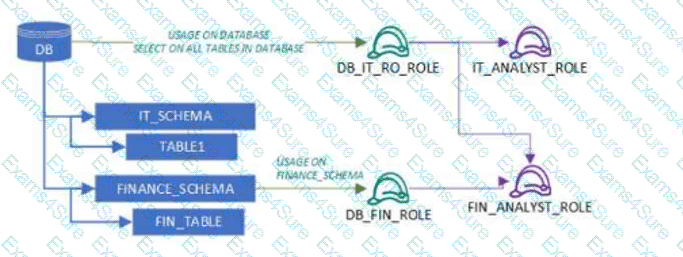
Question # 7

A database (DB) grants USAGE and SELECT on all tables to DB_IT_RO_ROLE

DB_IT_RO_ROLE is granted to IT_ANALYST_ROLE

IT_SCHEMA contains TABLE1

FINANCE_SCHEMA grants USAGE and SELECT to DB_FIN_ROLE

DB_FIN_ROLE is granted to FIN_ANALYST_ROLE

FINANCE_SCHEMA contains FIN_TABLE

Which tables can each user read?

Options:

A.  

User1 will be the only user able to read tables from both schemas, since the DB_IT_RO_ROLE has SELECT privileges on all database tables.

B.  

User1 will be able to read tables from both schemas, while User2 will be able to read only the FINANCE_SCHEMA tables.

C.  

User2 will be able to read tables from the FINANCE_SCHEMA, while User1 will be unable to read any table.

D.  

User2 will be able to read tables from both schemas, while User1 will be able to read tables only in IT_SCHEM

A.  

Discussion 0
Question # 8

A large manufacturing company runs a dozen individual Snowflake accounts across its business divisions. The company wants to increase the level of data sharing to support supply chain optimizations and increase its purchasing leverage with multiple vendors.

The company’s Snowflake Architects need to design a solution that would allow the business divisions to decide what to share, while minimizing the level of effort spent on configuration and management. Most of the company divisions use Snowflake accounts in the same cloud deployments with a few exceptions for European-based divisions.

According to Snowflake recommended best practice, how should these requirements be met?

Options:

A.  

Migrate the European accounts in the global region and manage shares in a connected graph architecture. Deploy a Data Exchange.

B.  

Deploy a Private Data Exchange in combination with data shares for the European accounts.

C.  

Deploy to the Snowflake Marketplace making sure that invoker_share() is used in all secure views.

D.  

Deploy a Private Data Exchange and use replication to allow European data shares in the Exchange.

Discussion 0
Question # 9

A company has an inbound share set up with eight tables and five secure views. The company plans to make the share part of its production data pipelines.

Which actions can the company take with the inbound share? (Choose two.)

Options:

A.  

Clone a table from a share.

B.  

Grant modify permissions on the share.

C.  

Create a table from the shared database.

D.  

Create additional views inside the shared database.

E.  

Create a table stream on the shared table.

Discussion 0
Question # 10

Company A has recently acquired company

B.  

The Snowflake deployment for company B is located in the Azure West Europe region.

As part of the integration process, an Architect has been asked to consolidate company B's sales data into company A's Snowflake account which is located in the AWS us-east-1 region.

How can this requirement be met?

Options:

A.  

Replicate the sales data from company B's Snowflake account into company A's Snowflake account using cross-region data replication within Snowflake. Configure a direct share from company B's account to company A's account.

B.  

Export the sales data from company B's Snowflake account as CSV files, and transfer the files to company A's Snowflake account. Import the data using Snowflake's data loading capabilities.

C.  

Migrate company B's Snowflake deployment to the same region as company A's Snowflake deployment, ensuring data locality. Then perform a direct database-to-database merge of the sales data.

D.  

Build a custom data pipeline using Azure Data Factory or a similar tool to extract the sales data from company B's Snowflake account. Transform the data, then load it into company A's Snowflake account.

Discussion 0
Get ARA-C01 dumps and pass your exam in 24 hours!

Free Exams Sample Questions