New Year Sale Limited Time 65% Discount Offer - Ends in 0d 00h 00m 00s - Coupon code: 65pass65

FCSS_LED_AR-7.6 Fortinet NSE 6 - LAN Edge 7.6 Architect is now Stable and With Pass Result | Test Your Knowledge for Free

FCSS_LED_AR-7.6 Practice Questions

Fortinet NSE 6 - LAN Edge 7.6 Architect

Last Update 3 days ago
Total Questions : 40

Dive into our fully updated and stable FCSS_LED_AR-7.6 practice test platform, featuring all the latest Fortinet Certified Solution Specialist exam questions added this week. Our preparation tool is more than just a Fortinet study aid; it's a strategic advantage.

Our Fortinet Certified Solution Specialist practice questions crafted to reflect the domains and difficulty of the actual exam. The detailed rationales explain the 'why' behind each answer, reinforcing key concepts about FCSS_LED_AR-7.6. Use this test to pinpoint which areas you need to focus your study on.

FCSS_LED_AR-7.6 PDF

FCSS_LED_AR-7.6 PDF (Printable)
$43.75
$124.99

FCSS_LED_AR-7.6 Testing Engine

FCSS_LED_AR-7.6 PDF (Printable)
$50.75
$144.99

FCSS_LED_AR-7.6 PDF + Testing Engine

FCSS_LED_AR-7.6 PDF (Printable)
$63.7
$181.99
Question # 1

Refer to the exhibits.

Question # 1

Question # 1

Examine the FortiGate RSSO configuration shown in the exhibit.

FortiGate is set up to use RSSO for user authentication. It is currently receiving RADIUS accounting messages through port3. The incoming RADIUS accounting messages contain the username in the User-Name attribute and group membership in the Class attribute. You must ensure that the users are authenticated through these RADIUS accounting messages and accurately mapped to their respective RSSO user groups.

Which three critical configurations must you implement on the FortiGate device? (Choose three.)

Options:

A.  

The RADIUS Attribute Value setting configured for an RSSO user group should match the class RADIUS attribute value in the RADIUS accounting message.

B.  

RSSO user groups should be assigned to all firewall policies.

C.  

Device detection and Security Fabric Connection should be enabled on port3

D.  

The sso-attribute CLI setting in the RSSO agent configuration should be set to Class.

E.  

The rsso-endpoint-attribute CLI setting in the RSSO agent configuration should be set to User-Name.

Discussion 0
Question # 2

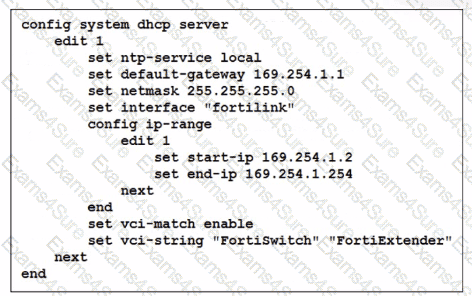
A FortiSwitch is not appearing in the FortiGate management interface after being connected via FortiLink. What could be a first troubleshooting step?

Options:

A.  

Ensure that the FortiGate security policies allow traffic from the FortiSwitch.

B.  

Manually assign a static IP to the FortiSwitch.

C.  

Verify that FortiGate device DHCP server is assigning an IP to the FortiSwitch.

D.  

Ensure the FortiSwitch has internet access.

Discussion 0
Question # 3

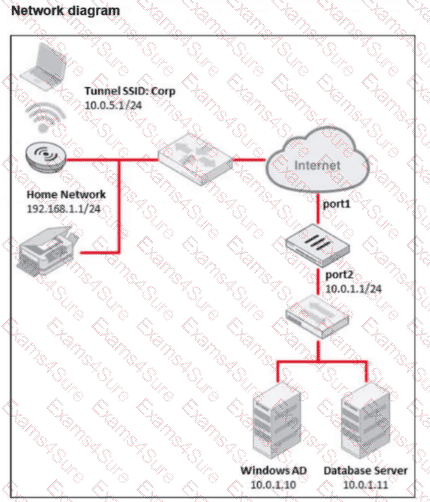
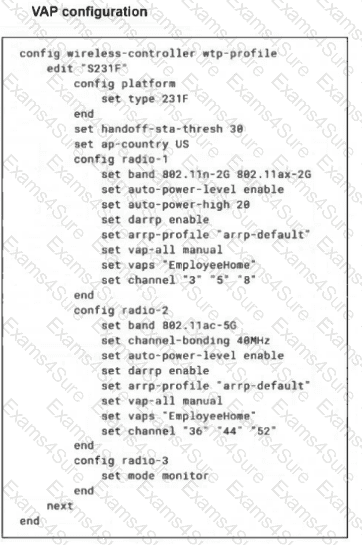
Refer to the exhibits.

Question # 3

Question # 3

Examine the FortiManager configuration and FortiGate CLI output shown in the exhibit.

The NAC feature is being tested with a device connected to port2 on managed FortiSwitch S224SPTF19005867. The NAC policy has been applied to port2, and traffic was generated from the test device. However, the traffic from the test device does not match the NAC policy and remains in the onboarding VLAN.

What are two possible reasons why the test device is not being correctly classified by the NAC policy? (Choose two.)

Options:

A.  

Device detection is not enabled on VLAN 4089.

B.  

The device operating system detected by FortiGate is not Linux.

C.  

Management communication between FortiGate and FortiSwitch is down.

D.  

The MAC address configured on the NAC policy is incorrect.

Discussion 0
Question # 4

In addition to requiring a FortiAnalyzer device to configure the Security Fabric, which license must be added to FortiAnalyzer to use Indicators of Compromise (IOC) rules?

Options:

A.  

loT Security Add-on license

B.  

IOC Subscription license

C.  

IOC detection is included on FAZ-Basic license

D.  

Threat Detection Service license

Discussion 0
Question # 5

Refer to the exhibit.

Question # 5

Question # 5

Question # 5

A RADIUS server has been successfully configured on FortiGate, which sends RADIUS authentication requests to FortiAuthenticator. FortiAuthenticator, in turn, relays the authentication using LDAP to a Windows Active Directory server.

It was reported that wireless users are unable to authenticate successfully.

The FortiGate configuration confirms that it can connect to the RADIUS server without issues.

While testing authentication on FortiGate using the command diagnose test authserver radius, it was observed that authentication succeeds with PAP but fails with MSCHAPv2.

Additionally, the Remote LDAP Server configuration on FortiAuthenticator was reviewed.

Which configuration change might resolve this issue?

Options:

A.  

Change the RADIUS authentication protocol to CHAP

B.  

Enable Windows Active Directory Domain Authentication.

C.  

Manually add user credentials to the FortiAuthenticator local database

D.  

Use RADIUS attributes under the FortiGate configuration.

Discussion 0
Question # 6

Refer to the exhibits.

Question # 6

Question # 6

Examine the FortiGate configuration, FortiAnalyzer logs, and FortiGate widget shown in the exhibits.

Security Fabhc quarantine automation has been configured to isolate compromised devices automatically. FortiAnalyzer has been added to the Security Fabric, and an automation stitch has been configured to quarantine compromised devices.

To test the setup, a device with the IP address 10.0.2.1 that is connected through a managed FortiSwitch attempts to access a malicious website. The logs on FortiAnalyzer confirm that the event was recorded, but the device does not appear in the FortiGate quarantine widget.

Which two reasons could explain why FortiGate is not quarantining the device? (Choose two.)

Options:

A.  

The IOC action should include only the FortiSwitch in the quarantine.

B.  

The SSL inspection should be set to deep-Inspection

C.  

The malicious website is not recognized as an indicator of compromise (IOC) by FortiAnalyzer.

D.  

The threat detection services license is missing or invalid under FortiAnalyzer.

Discussion 0
Question # 7

Connectivity tests are being performed on a newly configured VLAN. The VLAN is configured on a FortiSwitch device that is managed by FortiGate. During testing, it is observed that devices

within the VLAN can successfully ping FortiGate. and FortiGate can also ping these devices.

Inter-VLAN communication is working as expected. However, devices within the same VLAN are unable to communicate with each other.

What could be causing this issue?

Options:

A.  

Access VLAN is enabled on the VLAN.

B.  

The FortiSwitch MAC address table is missing entries.

C.  

The FortiGate ARP table is missing entries.

D.  

The native VLAN configured on the ports is incorrect.

Discussion 0
Question # 8

You are troubleshooting a Syslog-based single sign-on (SSO) issue on FortiAuthenticator, where user authentication is not being correctly mapped from the syslog messages. You need a tool to diagnose the issue and understand the logs to resolve it quickly.

Which tool in FortiAuthenticator can you use to troubleshoot and diagnose a Syslog SSO issue?

Options:

A.  

Debug logs > Remote Servers > Syslog Viewer

B.  

Parsing Test Tool

C.  

Debug logs > SSO Sessions page

D.  

Debug logs > Single Sign-On > Syslog SSO

Discussion 0
Question # 9

Which statement about generating a certificate signing request (CSR) for a CER certificate is true?

Options:

A.  

Inaccurate or missing fields in the CSR will prevent the CA from validating the request, leading to the rejection of the certificate and possible delays in the deployment process.

B.  

If key fields like the common name (CN) and organization (O) are incorrect, the certification authority (CA) will still issue the certificate, but it may not be trusted by certain applications or systems that rely on accurate field information for validation.

C.  

CSR fields are primarily used for internal recordkeeping by the requesting organization, and only the public key in the CSR must be accurate for successful certificate signing.

D.  

The fields in the CSR are primarily for documentation purposes; any missing or incorrect information will be automatically corrected by the CA during the signing process.

Discussion 0
Question # 10

In each user certificate, you can define the subject field, expiration date. User Principal Name (UPN), URL for CRL download, and the OCSP URL. How does the detailed configuration of these attributes impact the certificate?

Options:

A.  

It makes the certificate easier to revoke manually because it reduces the need for automatic checks.

B.  

It limits the validity of the certificate to specific devices and applications, reducing its general usability.

C.  

It enables precise identification of the user and ensures timely certificate revocation checks.

D.  

It makes the certificate compatible with a wide range of applications and services by ensuring universal validity

Discussion 0
Get FCSS_LED_AR-7.6 dumps and pass your exam in 24 hours!

Free Exams Sample Questions