Summer Sale Limited Time 65% Discount Offer - Ends in 0d 00h 00m 00s - Coupon code: 65pass65

FCSS_NST_SE-7.6 Fortinet NSE 6 - Network Security 7.6 Support Engineer is now Stable and With Pass Result | Test Your Knowledge for Free

Exams4sure Dumps

FCSS_NST_SE-7.6 Practice Questions

Fortinet NSE 6 - Network Security 7.6 Support Engineer

Last Update 3 days ago
Total Questions : 134

Dive into our fully updated and stable FCSS_NST_SE-7.6 practice test platform, featuring all the latest Fortinet Certified Solution Specialist exam questions added this week. Our preparation tool is more than just a Fortinet study aid; it's a strategic advantage.

Our free Fortinet Certified Solution Specialist practice questions crafted to reflect the domains and difficulty of the actual exam. The detailed rationales explain the 'why' behind each answer, reinforcing key concepts about FCSS_NST_SE-7.6. Use this test to pinpoint which areas you need to focus your study on.

FCSS_NST_SE-7.6 PDF

FCSS_NST_SE-7.6 PDF (Printable)
$54.25
$154.99

FCSS_NST_SE-7.6 Testing Engine

FCSS_NST_SE-7.6 PDF (Printable)
$59.5
$169.99

FCSS_NST_SE-7.6 PDF + Testing Engine

FCSS_NST_SE-7.6 PDF (Printable)
$74.55
$212.99
Question # 11

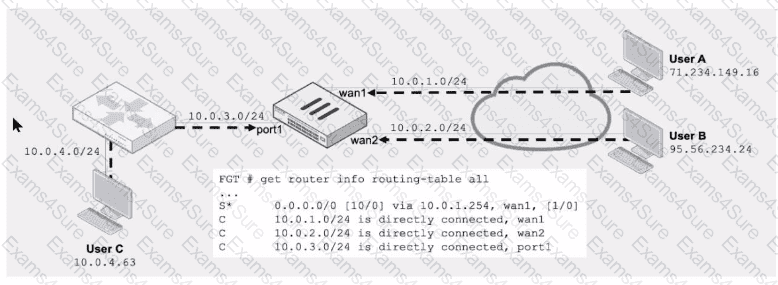
Refer to the exhibit.
Question # 11

Assuming a default configuration, which three statements are true? (Choose three.)

Options:

A.  

Strict RPF is enabled by default.

B.  

User B: Fail. There is no route to 95.56.234.24 .

C.  

User A: Pass. The default static route through wan1 passes the RPF check regardless of the source IP address.

D.  

User B: Pass. FortiGate will use asymmetric routing using wan1 to reply to traffic for 95.56.234.24.

E.  

User C: Fail. There is no route to 10.0.4.63 using port1 in the touting table.

Discussion 0
Question # 12

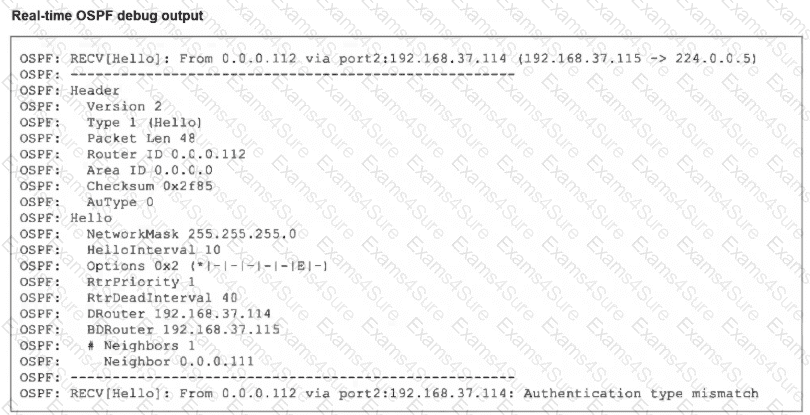
Refer to the exhibit, which shows the partial output of a real-time OSPF debug.
Question # 12

Why are the two FortiGate devices unable to form an adjacency?

Options:

A.  

The Hello packet is being sent from an OSPF router with ID 0.0.0.112.

B.  

The two FortiGate devices attempting adjacency are in area 0.0.0.0.

C.  

One FortiGate device is configured to require authentication, while the other is not.

D.  

The passwords on the FortiGate devices do not match.

Discussion 0
Question # 13

What are two functions of automation stitches? (Choose two.)

Options:

A.  

You can configure automation stitches to run diagnostic commands and attach the results to an email message when CPU or memory usage exceeds specified thresholds.

B.  

You can configure automation stitches to modify packet headers and payloads if specific traffic triggers an anomaly IPS event.

C.  

You can configure automation stitches to insert a delay between actions if the automation stitches are set to execute actions in parallel.

D.  

You can configure automation stitches to take parameters from previous actions as input for the next action if the automation stitches are set to execute actions in sequence.

Discussion 0
Question # 14

Which statement about IKEv2 is true?

Options:

A.  

Both IKEv1 and IKEv2 share the feature of asymmetric authentication.

B.  

IKEv1 and IKEv2 have enough of the header format in common that both versions can run over the same UDP port.

C.  

IKEv1 and IKEv2 use the same TCP port but run on different UDP ports.

D.  

IKEv1 and IKEv2 share the concept of phase1 and phase2.

Discussion 0
Question # 15

Refer to the exhibit.

Question # 15

The port1 interface configuration on FortiGate and partial session information for ICMP traffic are shown.

Which two things happen to the session information if a routing change occurs that affects this session? (Choose two answers)

Options:

A.  

This session will be unaffected by routing changes. The routing changes will apply only to new sessions.

B.  

The session will be flagged as dirty but no route lookups will be performed.

C.  

The session information will not change unless the current route has been removed from the routing table.

D.  

The session information will not change even when the active route has been removed from the routing table.

Discussion 0
Question # 16

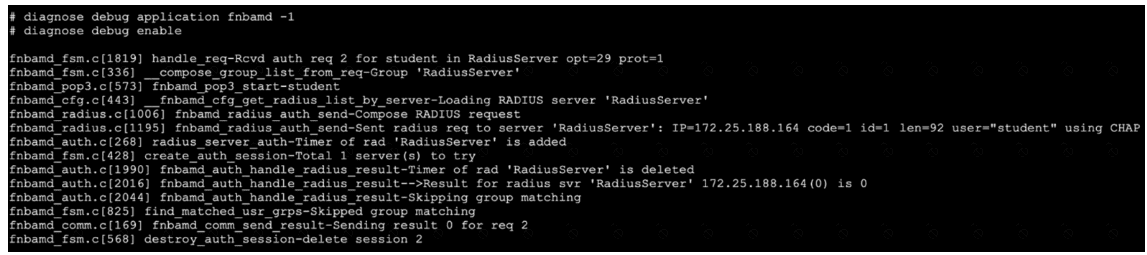
Refer to the exhibit, which shows a truncated output of a real-time RADIUS debug.
Question # 16

Which two statements are true? (Choose two answers)

Options:

A.  

The RADIUS server queried for authentication is located at IP address 172.25.188.164.

B.  

Authentication was unsuccessful.

C.  

The authentication scheme used was pop3.

D.  

Authentication was successful.

E.  

Two-factor authentication was required.

Discussion 0
Question # 17

Exhibit.

Question # 17

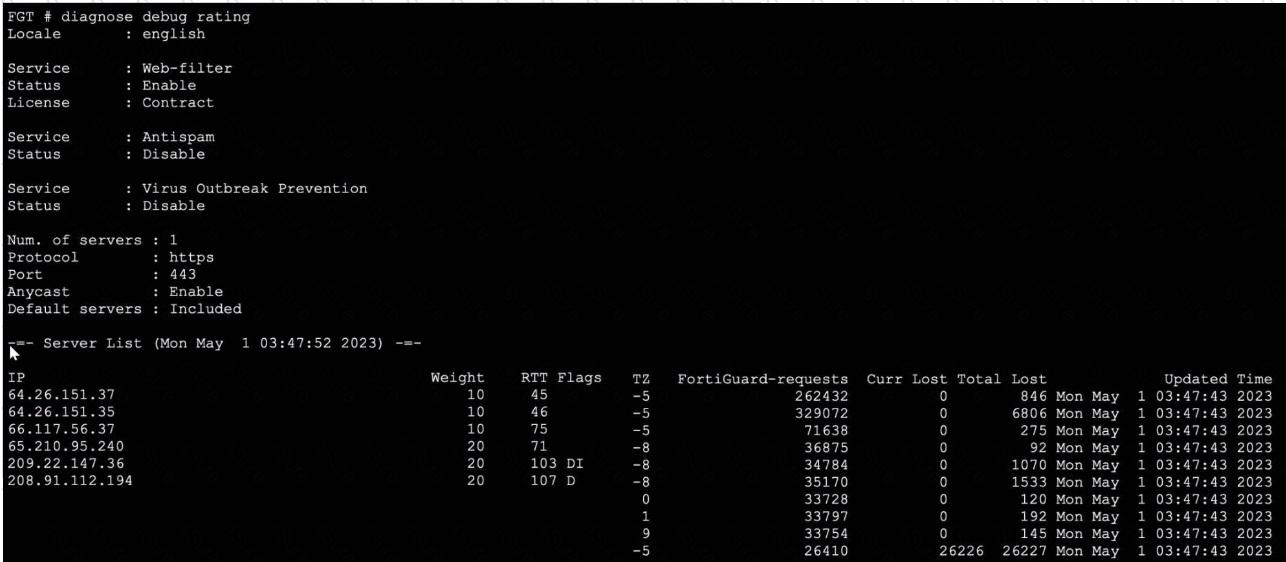
Refer to the exhibit, which shows the output of a diagnose command.

What can you conclude about the debug output in this scenario?

Options:

A.  

The first server provided to FortiGate when it performed a DNS query looking for a list of rating servers, was 121.111.236.179.

B.  

There is a natural correlation between the value in the FortiGuard-requests field and the value in the Weight field.

C.  

FortiGate used 64.26.151.37 as the initial server to validate its contract.

D.  

Servers with a negative TZ value are less preferred for rating requests.

Discussion 0
Question # 18

Refer to the exhibit.

Question # 18

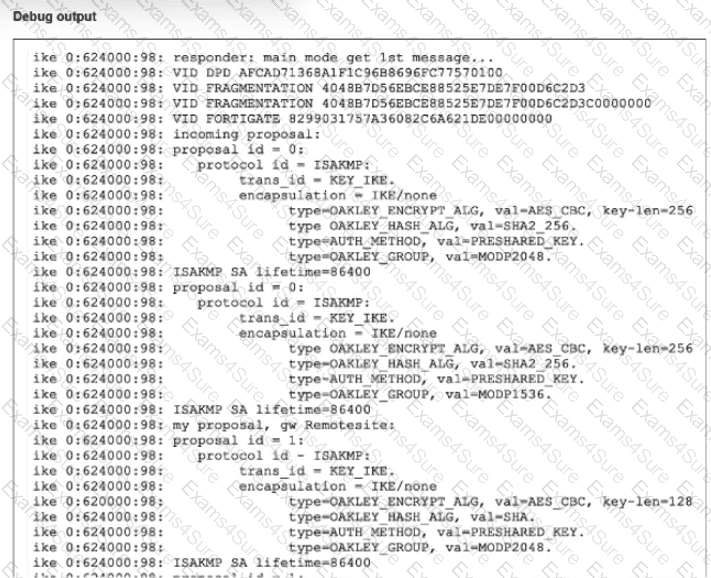
A partial output from an IKE real-time debug is shown

The administrator does not have access to (he remote gateway

Based on the debug output, which two conclusions can you draw? (Choose two.)

Options:

A.  

The remote peer is the initiating peer.

B.  

This is a phase1 negotiation.

C.  

There is a Diffie-Hellman group mismatch.

D.  

This is a phase2 negotiation

Discussion 0
Question # 19

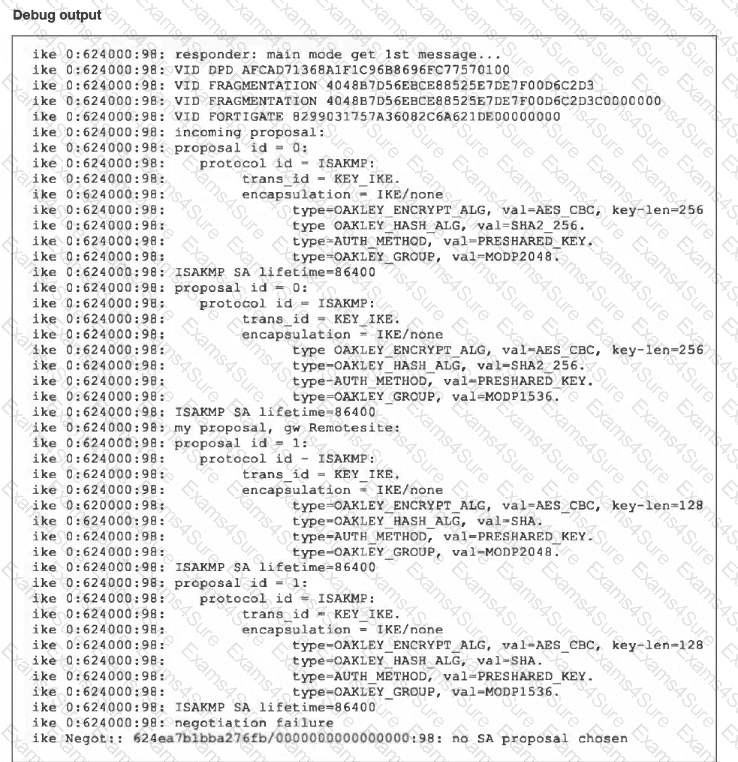
Refer to the exhibit, which contains partial output from an IKE real-time debug.
Question # 19

The administrator does not have access to the remote gateway.

Based on the debug output, which configuration change the administrator make to the local gateway to resolve the phase 1 negotiation error?

Options:

A.  

In the phase 1 proposal configuration, add AES256-SHA256 to the list of encryption algorithms.

B.  

In the phase 1 proposal configuration, add AESCBC-SHA2 to the list of encryption algorithms.

C.  

In the phase 1 network configuration, set the IKE version to 2.

D.  

In the phase 1 proposal configuration, add AES128-SHA128 to the list of encryption algorithms.

Discussion 0
Question # 20

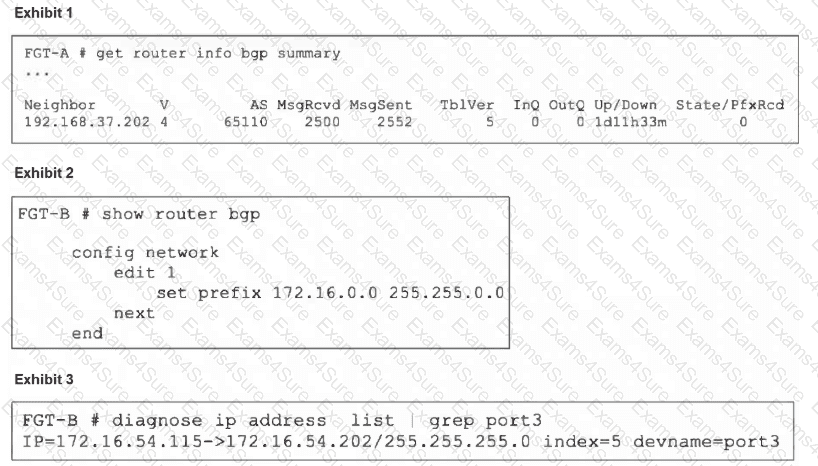
Refer to the exhibits.

Question # 20

An administrator is attempting to advertise the network configured on port3. However, FGT-A is not receiving the prefix.

Which two actions can the administrator take to fix this problem? (Choose two.)

Options:

A.  

Modify the prefix using the network command from 172.16.0.0/16 to 172.16.54.0/24.

B.  

Manually add the BGP route on FGT-

A.  

C.  

Restart BGP using a soft reset to force both peers to exchange their complete BGP routing tables.

D.  

Use the set network-import-check disable command.

Discussion 0
Get FCSS_NST_SE-7.6 dumps and pass your exam in 24 hours!

Free Exams Sample Questions