

Exam style questions across every H12-821_V1.0 domain
Last Update 12 hours ago
Total Questions : 394
Start with our free H12-821_V1.0 practice questions, carefully crafted to mirror the domains, phrasing, and difficulty of the real HCIP-Datacom exam. Each H12-821_V1.0 exam question comes with a detailed rationale that explains not just which answer is correct but why the others fall short. That's how concepts stick. Use the free set to benchmark yourself: identify your Huawei weak domains, see where you're losing marks, and build a focused study plan in minutes.

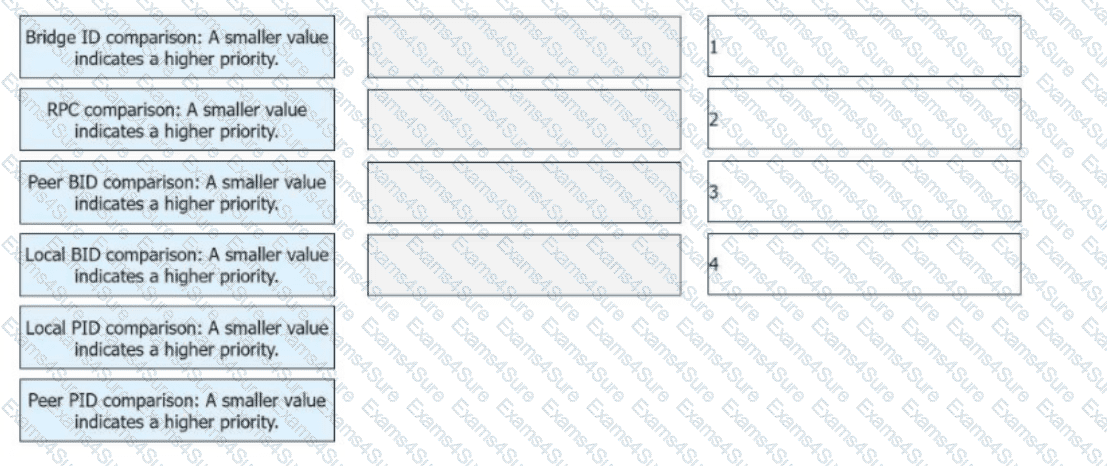
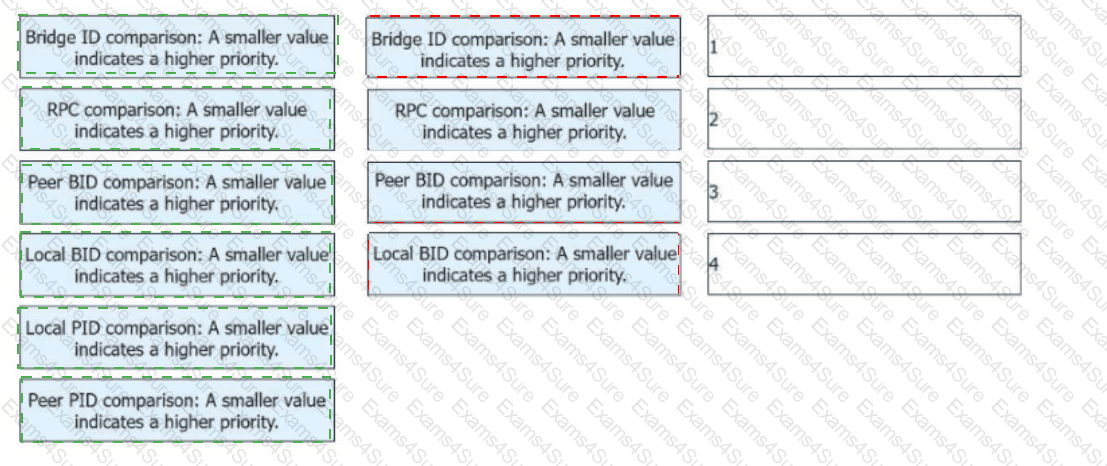
On an STP network, the root bridge, root port, and designated port are elected in sequence. The election rules of these ports are different. List the steps for electing the root port in sequence.
OSPF networks are classified into four types of networks by link layer protocol. Which of the following types of networks do not require DR/BDR election?
The Internet Assigned Numbers Authority (IANA) allocates Class D addresses to IPv4 multicast. An IPv4 address is 32 bits long, and the four most significant bits of a Class D address are 1110.
On an IS-IS network, all routers generate LSPs. Which of the following types of information is not contained in the LSPs generated by pseudonodes?
By default, if no router ID is configured but multiple loopback interface addresses are configured, BGP selects the largest loopback interface address as the router I
D.
Depending on the type of algorithms used, routing protocols are classified into distance-vector protocols and link-state protocols. Which of the following routing protocols are link-state protocols?
See the network shown in the following figure.
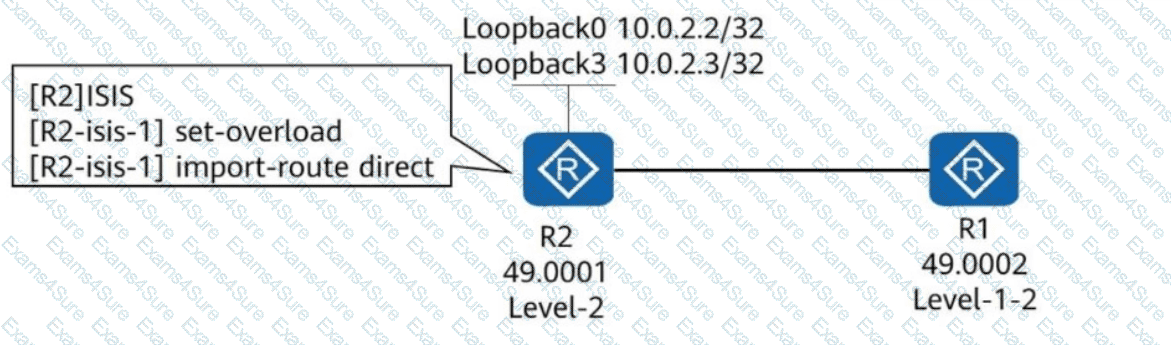
R1 and R2 run IS-IS and establish an adjacency. IS-IS is enabled on Loopback0 of R2 but disabled on Loopback3 of R2. The configurations shown in the figure are performed in the IS-IS process of R2. Which of the following statements are true?
Bidirectional route re-advertisement enables a border router to import routes between two routing domains. However, this may cause sub-optimal routes and routing loops.
Which of the following statements regarding OSPF route summarization is false?