

JN0-351 Practice Questions
Enterprise Routing and Switching Specialist (JNCIS-ENT)
Last Update 4 days ago
Total Questions : 107
Dive into our fully updated and stable JN0-351 practice test platform, featuring all the latest JNCIS-ENT exam questions added this week. Our preparation tool is more than just a Juniper study aid; it's a strategic advantage.
Our free JNCIS-ENT practice questions crafted to reflect the domains and difficulty of the actual exam. The detailed rationales explain the 'why' behind each answer, reinforcing key concepts about JN0-351. Use this test to pinpoint which areas you need to focus your study on.

Which two statements about BGP facilitate the prevention of routing loops between two autonomous systems? (Choose two.)
You implemented the MAC address limit feature with the shutdown action on all interfaces on your switch.
In this scenario, which statement is correct when a violation occurs?
Exhibit.
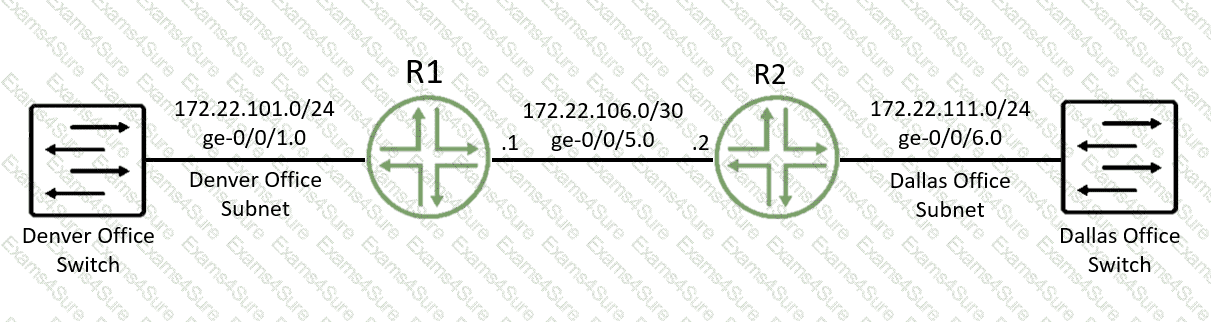
You are using OSPF to advertise the subnets that are used by the Denver and Dallas offices. The routers that are directly connected to the Dallas and Denver subnets are not advertising the connected subnets.
Referring to the exhibit, which two statements are correct? (Choose two.)
You are deploying a trunk port with multiple VLANs.
In this scenario, which statement is true about the native VLAN?
You are a network operator who wants to add a second ISP connection and remove the default route to the existing ISP You decide to deploy the BGP protocol in the network.
What two statements are correct in this scenario? (Choose two.)
Which two events cause a router to advertise a connected network to OSPF neighbors? (Choose two.)
Exhibit.
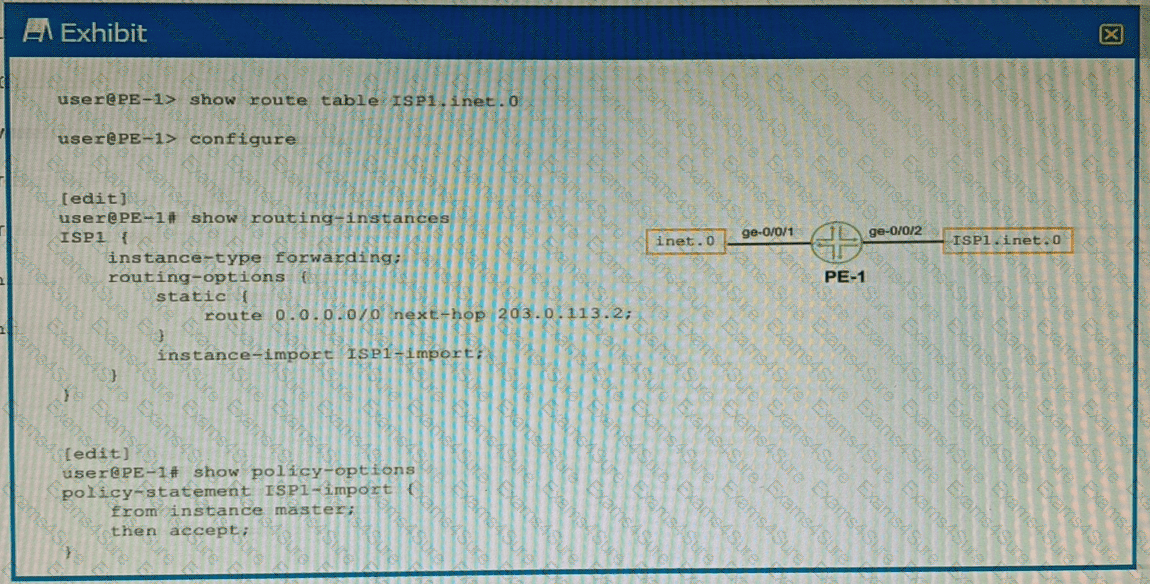
The ispi _ inet. 0 route table has currently no routes in it.
What will happen when you commit the configuration shown on the exhibit?
You are asked to create a default route that will be advertised to your internal OSPF neighbors. You have three upstream connections to the Internet and you must ensure that when available, all traffic uses ISP1 as your primary connection and only uses ISP2 and ISP3 when ISP1 is not available.
Which solution should you implement in this scenario?
Exhibit

You have configured a GRE tunnel. To reduce the risk of dropping traffic, you have configured a keepalive OAM probe to monitor the state of the tunnel; however, traffic drops are still occurring.
Referring to the exhibit, what is the problem?