

JN0-351 Practice Questions
Enterprise Routing and Switching Specialist (JNCIS-ENT)
Last Update 4 days ago
Total Questions : 107
Dive into our fully updated and stable JN0-351 practice test platform, featuring all the latest JNCIS-ENT exam questions added this week. Our preparation tool is more than just a Juniper study aid; it's a strategic advantage.
Our free JNCIS-ENT practice questions crafted to reflect the domains and difficulty of the actual exam. The detailed rationales explain the 'why' behind each answer, reinforcing key concepts about JN0-351. Use this test to pinpoint which areas you need to focus your study on.

Which two types of tunnels are able to be created on all Junos devices? (Choose two.)
You are asked to connect an IP phone and a user computer using the same interface on an EX Series switch. The traffic from the computer does not use a VLAN tag, whereas the traffic from the IP phone uses a VLAN tag.
Which feature enables the interface to receive both types of traffic?
Which two mechanisms are part of building and maintaining a Layer 2 bridge table? (Choose two.)
What is the maximum allowable MTU size for a default GRE tunnel without IPv4 traffic fragmentation?
Which two multicast IP addresses are used for link-state update packets? (Choose two.)
After receiving a BGP route, which two conditions are verified by the receiving router to ensure that the received route is valid? (Choose two)
Which two BGP attributes must be supported by all BGP implementations and must be included in every update? (Choose two.)
Exhibit
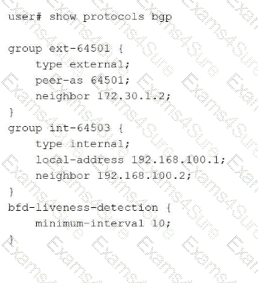
Your BGP neighbors, one in the USA and one in France, are not establishing a connection with each other.
Referring to the exhibit, which statement is correct?
Exhibit.
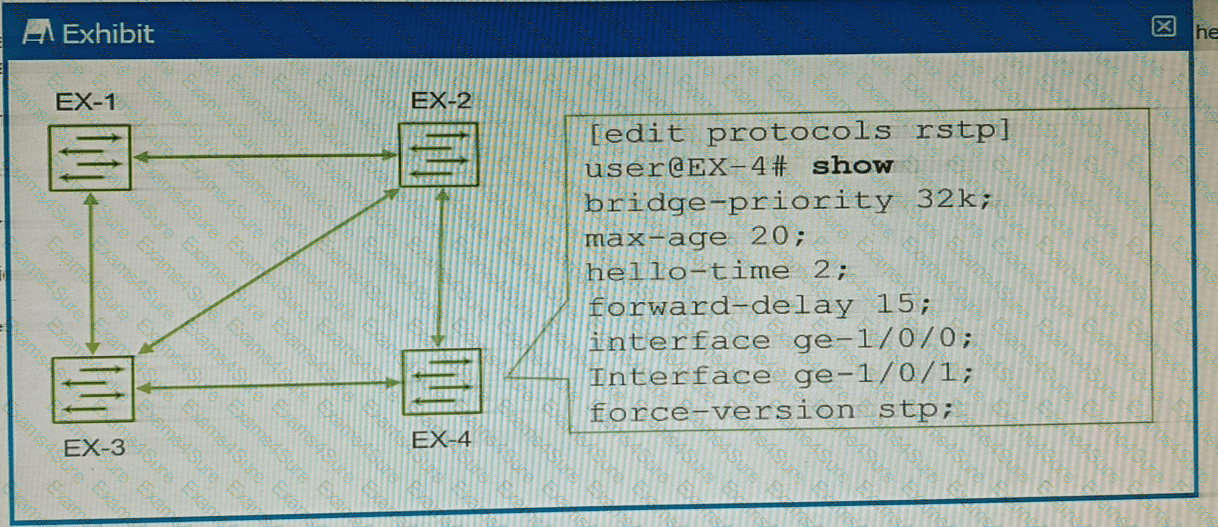
You have configured the four EX Series switches with RSTP, as shown in the exhibit. You discover that whenever a link between switches goes up or down, the switches take longer than expected for RSTP to converge, using the default settings.
In this scenario, which action would solve the delay in RSTP convergence?