Weekend Sale Limited Time 70% Discount Offer - Ends in 0d 00h 00m 00s - Coupon code: merry71

Free Fortinet NSE 7 - Secure Networking 7.6 Architect Practice Questions

Question # 11

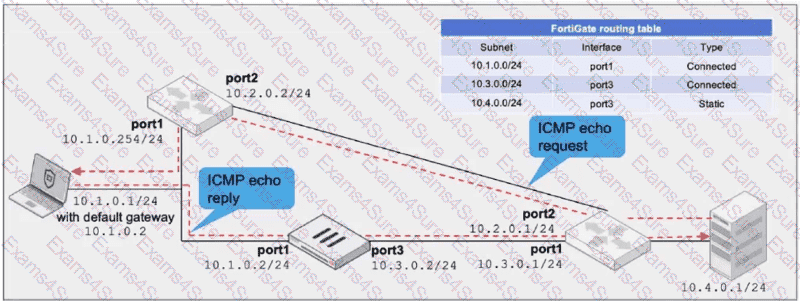
Refer to the exhibit, which a network topology and a partial routing table.
Question # 11

FortiGate has already been configured with a firewall policy that allows all ICMP traffic to flow from port1 to port3.

Which changes must the administrator perform to ensure the server at 10.4.0.1/24 receives the echo reply from the laptop at 10.1.0.1/24?

Options:

A.  

Enable asymmetric routing under config system settings.

B.  

Change the configuration from strict RPF check mode to feasible RPF check mode.

C.  

A firewall policy that allows all ICMP traffic from port3 to port1.

D.  

Modify the default gateway on the laptop from 10.1.0.2 to 10.2.0.2.

Discussion 0
Question # 12

In a Security Fabric environment which three actions must you take to ensure successful communication among the nodes? (Choose three.)

Options:

A.  

You must ensure that TCP port 8013 is not blocked along the way.

B.  

You must ensure that the port for Neighbor Discovery has been changed.

C.  

You must configure FortiGate in transparent mode.

D.  

You must authorize the downstream FortiGate on the root FortiGate.

E.  

You must enable FortiTelemetry on the receiving interlace of the upstream FortiGate.

Discussion 0
Question # 13

Refer to the exhibit.

Question # 13

An administrator has configured a firewall policy to use proxy-based inspection mode. What could explain the messages observed in the debug flow output?

Options:

A.  

At least one protocol port under Protocol Options has been mapped to Any.

B.  

SSL deep inspection is not configured.

C.  

The FTP protocol has not yet been mapped to port 211 under Protocol Options.

D.  

FortiGate does not have enough free memory to perform proxy-based inspections.

Discussion 0
Question # 14

Refer to the exhibit, which shows a truncated output of a real-time LDAP debug.

Question # 14

What two conclusions can you draw from the output? (Choose two.)

Options:

A.  

The name of the configured LDAP server is Lab.

B.  

The user is authenticating using CN=John Smith.

C.  

FortiOS is able to locate the user in step 3 (Bind Request) of the LDAP authentication process.

D.  

FortiOS is performing the second step (Search Request) in the LDAP authentication process.

Discussion 0
Question # 15

As an IT manager, you want to delegate the installation and management of your SD-WAN deployment to a managed security service provider (MSSP).

Each site must maintain direct internet access and be secure. You expect significant traffic flow between the sites and want to delegate as much of the network administration and management as possible to the MSSP.

Which two MSSP deployment blueprints address your requirements? (Choose two.)

Options:

A.  

Use a shared hub on the MSSP premises with a dedicated VDOM for the customer, and install the spokes on the customer premises.

B.  

Install the hub and spokes on the customer premises, and enable the MSSP to manage the SD-WAN deployment using FortiManager with a dedicated ADOM.

C.  

Install a dedicated hub on the MSSP premises for the customer, and install the spokes on the customer premises.

D.  

Use a shared hub on the MSSP premises and a dedicated hub on the customer premises, and install the spokes on the customer premises.

Discussion 0
Question # 16

What are two functions of automation stitches? (Choose two.)

Options:

A.  

You can configure automation stitches to run diagnostic commands and attach the results to an email message when CPU or memory usage exceeds specified thresholds.

B.  

You can configure automation stitches to modify packet headers and payloads if specific traffic triggers an anomaly IPS event.

C.  

You can configure automation stitches to insert a delay between actions if the automation stitches are set to execute actions in parallel.

D.  

You can configure automation stitches to take parameters from previous actions as input for the next action if the automation stitches are set to execute actions in sequence.

Discussion 0
Question # 17

Refer to the exhibit, which shows the port1 interface configuration on FortiGate and partial session information for ICMP traffic.

Question # 17

What happens to the session information if a routing change occurs that affects this session?

Options:

A.  

Only the interface and gateway information for dev=7 will be removed.

B.  

The session information will not change unless the current route has been removed from the routing table.

C.  

The session will be flagged as dirty but no route lookups will be performed.

D.  

Sessions involving port7 or port19 will not have their routing information flushed.

Discussion 0
Question # 18

What are three characteristics of the provisioning templates available on FortiManager? (Choose three.)

Options:

A.  

Each template group can contain up to three IPsec tunnel templates.

B.  

A CLI template can be of type CLI script or Perl script.

C.  

A CLI template group can contain CLI templates of different types.

D.  

CLI templates are applied in order, from top to bottom.

E.  

A template group can include a system template and an SD-WAN template.

Discussion 0
Question # 19

Refer to the exhibit.

Question # 19

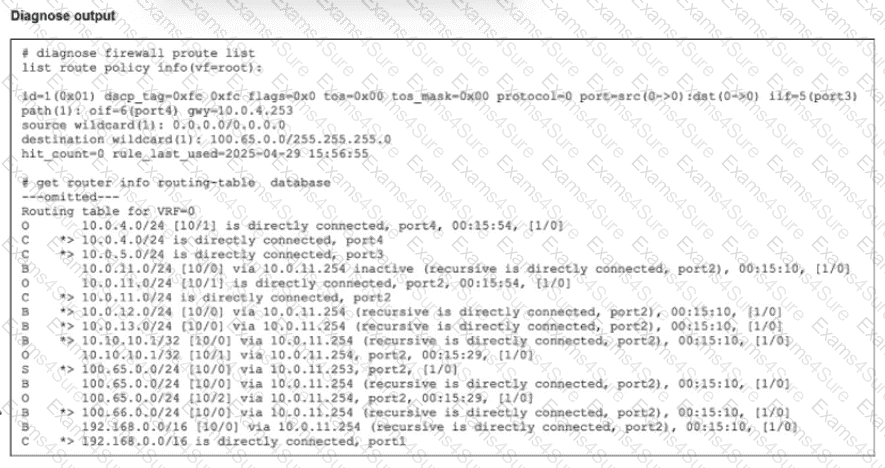
Which route will traffic take to get to the 100.65.0.0/24 network considering the routes are all configured with the same distance?

Options:

A.  

The BGP route

B.  

The policy route

C.  

The static route

D.  

The OS PF route

Discussion 0
Question # 20

Refer to the exhibits.

Question # 20

Question # 20

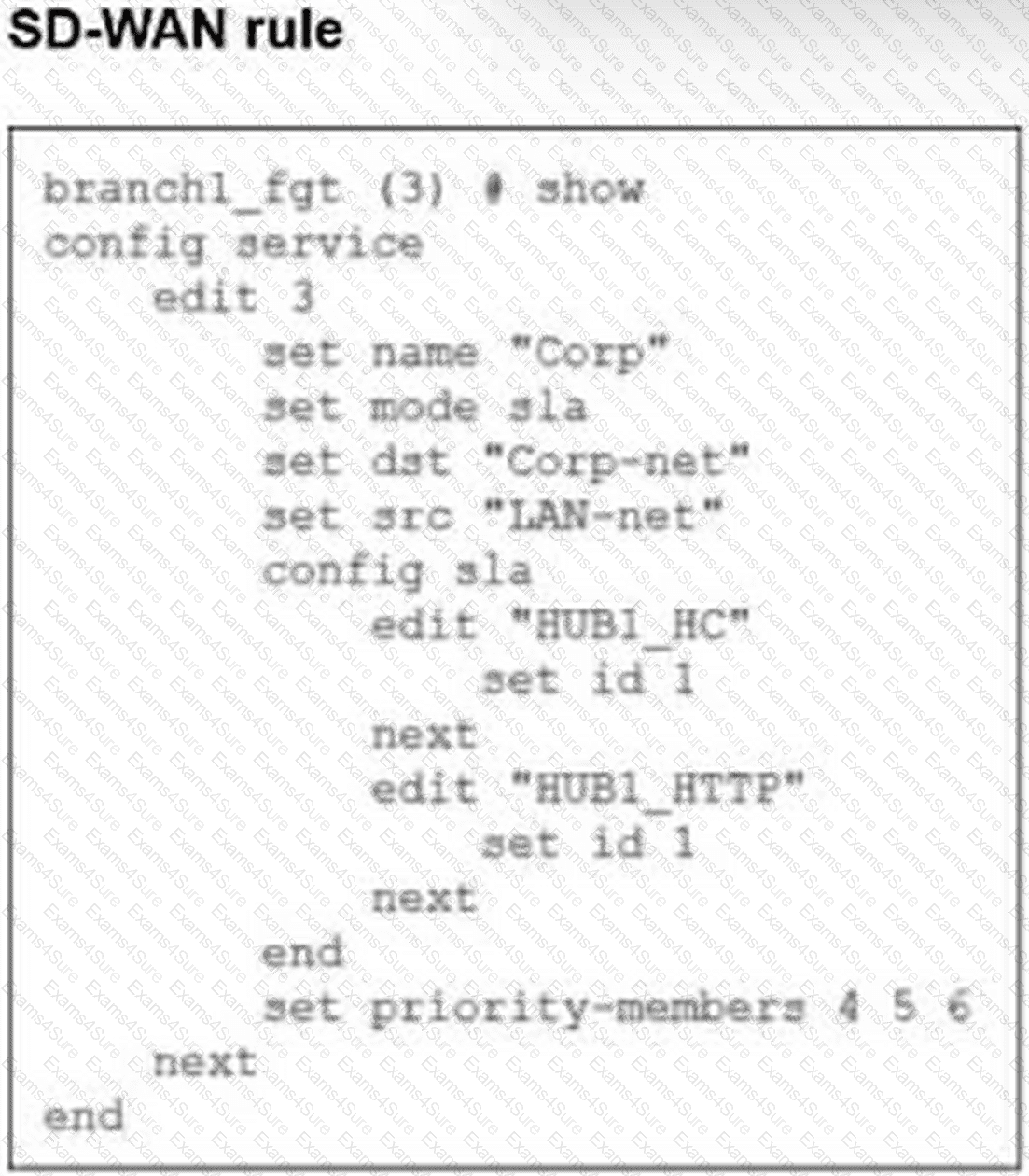
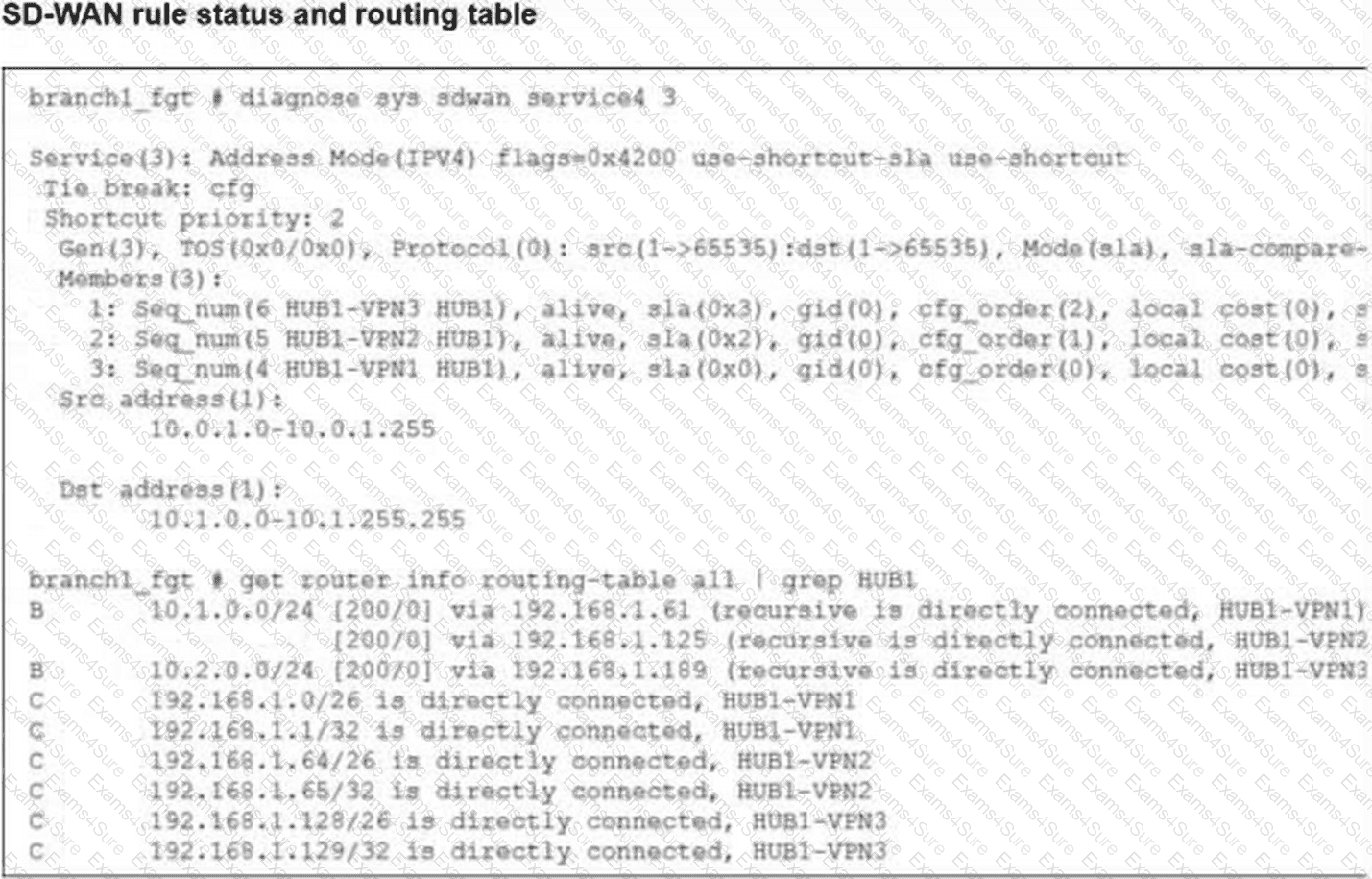
The configuration of an SD-WAN rule and the corresponding rule status and routing table are shown.

You want to understand the expected behavior for traffic that matches the SD-WAN rule, at the time the output was collected.

Based on the exhibits, which behavior can you expect for traffic that matches the SD-WAN rule?

Options:

A.  

The traffic will be load balanced across all three overlays.

B.  

The traffic will be routed over HUB1-VPN2.

C.  

The traffic will be routed over HUB1-VPN1.

D.  

The traffic will be routed over HUB1-VPN3.

Discussion 0

NSE7_FSN_AR-7.6 PDF

NSE7_FSN_AR-7.6 PDF (Printable)
$46.5
$154.99

NSE7_FSN_AR-7.6 Testing Engine

NSE7_FSN_AR-7.6 PDF (Printable)
$51
$169.99

NSE7_FSN_AR-7.6 PDF + Testing Engine

NSE7_FSN_AR-7.6 PDF (Printable)
$63.9
$212.99

Free Exams Sample Questions