Summer Sale Limited Time 65% Discount Offer - Ends in 0d 00h 00m 00s - Coupon code: 65pass65

NSE7_FSN_AR-7.6 Fortinet NSE 7 - Secure Networking 7.6 Architect is now Stable and With Pass Result | Test Your Knowledge for Free

Exams4sure Dumps

NSE7_FSN_AR-7.6 Practice Questions

Fortinet NSE 7 - Secure Networking 7.6 Architect

Last Update 2 days ago
Total Questions : 172

Dive into our fully updated and stable NSE7_FSN_AR-7.6 practice test platform, featuring all the latest NSE 7 Network Security Architect exam questions added this week. Our preparation tool is more than just a Fortinet study aid; it's a strategic advantage.

Our free NSE 7 Network Security Architect practice questions crafted to reflect the domains and difficulty of the actual exam. The detailed rationales explain the 'why' behind each answer, reinforcing key concepts about NSE7_FSN_AR-7.6. Use this test to pinpoint which areas you need to focus your study on.

NSE7_FSN_AR-7.6 PDF

NSE7_FSN_AR-7.6 PDF (Printable)
$54.25
$154.99

NSE7_FSN_AR-7.6 Testing Engine

NSE7_FSN_AR-7.6 PDF (Printable)
$59.5
$169.99

NSE7_FSN_AR-7.6 PDF + Testing Engine

NSE7_FSN_AR-7.6 PDF (Printable)
$74.55
$212.99
Question # 31

Which authentication option can you not configure under config user radius on FortiOS?

Options:

A.  

mschap

B.  

pap

C.  

mschap2

D.  

eap

Discussion 0
Question # 32

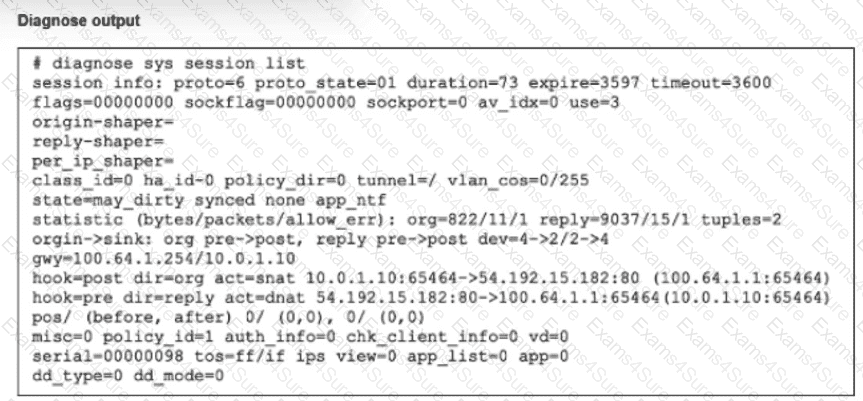
Refer to the exhibit.

Question # 32

The output of diagnose sys session list command is shown.

If the HA ID for the primary device is 9, what happens if the primary fails and the secondary becomes the primary?

Options:

A.  

The session is synchronized with the secondary device, however, because application control is applied. the session is marked dirty and has to be reevaluated after failover.

B.  

The session will be removed from the session table of the secondary device because the TCP session is not yet fully established.

C.  

The session continues to permit traffic on the new primary device after failover. without requiring the client to restart the session with the server.

D.  

The session state is preserved but the kernel will re-evaluate the session because the routing information will be flushed

Discussion 0
Question # 33

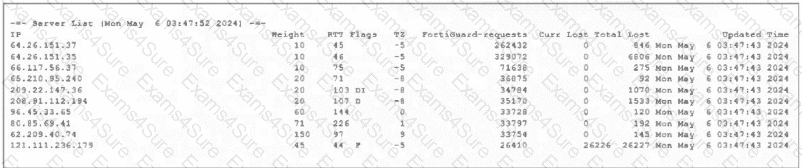
Refer to the exhibit, which shows the partial output of command diagnose debug rating.
Question # 33

In this exhibit, which FDS server will the FortiGate algorithm choose?

Options:

A.  

66.117.56.37

B.  

208.91.112.194

C.  

209.22.147.36

D.  

64.26.151.37

Discussion 0
Question # 34

When FortiGate enters conserve mode because of memory pressure, which action can FortiGate perform to preserve memory?

Options:

A.  

FortiGate automatically reboots to clear memory and restore full operation.

B.  

FortiGate switches to a less memory-intensive inspection mode, such as flow-based inspection.

C.  

FortiGate reduces or stops non-essential processes like logging and antivirus scanning.

D.  

FortiGate begins dropping all new sessions to protect resources.

Discussion 0
Question # 35

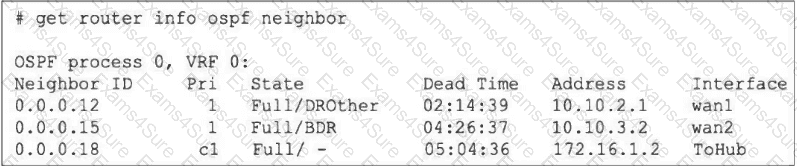
Refer to the exhibit, which shows the output of the command get router info ospf neighbor.
Question # 35

To what extent does FortiGate operate when looking at its OSPF neighbors? (Choose two.)

Options:

A.  

The local FortiGate has at least one interface that participates in a broadcast network.

B.  

The local FortiGate has at least one interface that participates in a point-to-point network.

C.  

The local FortiGate is the DR.

D.  

Neighbor 0.0.0.18 is the designated router (DR).

Discussion 0
Question # 36

In IKEv2, which exchange establishes the first CHILD_SA?

Options:

A.  

IKE_SA_INIT

B.  

INFORMATIONAL

C.  

CREATE_CHILD_SA

D.  

IKE_AUTH

Discussion 0
Question # 37

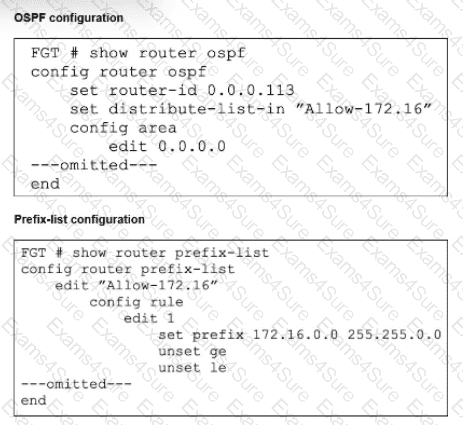
Refer to the exhibits.

Question # 37

An OSPF peer is advertising route 172.16.52.0/24. The local FortiGate is configured with an inbound distribution list that allows the 172.16.0.0/16 network to be injected into its routing table. However, the 1 ' 2.16.52.0/24 subnet cannot be seen in the FI

B.  

Which two stops can the administrator of the local FortiGate take to ensure that the advertised 172.16. 52.0/24 subnet will be injected into the routing table? (Choose two.)

Options:

A.  

Add another entry to the prefix list to specifically allow the 172.16.52.0/24 network.

B.  

Change the ge value to 17.

C.  

Change the R- value lo 16.

D.  

Modify the default prefix-list behavior from implicit deny to implicit allow.

Discussion 0
Question # 38

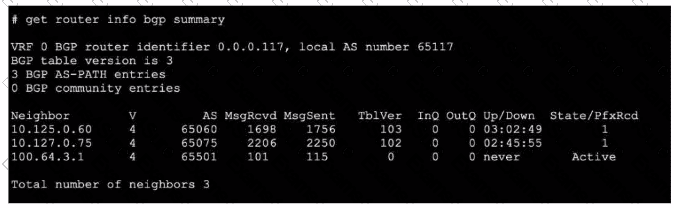
Refer to the exhibit, which shows the output of a BGP debug command.
Question # 38

What can you conclude about the router in this scenario?

Options:

A.  

The router 100.64.3.1 needs to update the local AS number in its BGP configuration in order to bring up the 8GP session with the local router.

B.  

An inbound route-map on local router is blocking the prefixes from neighbor 100.64.3.1.

C.  

All of the neighbors displayed are part of a single BGP configuration on the local router with the neighbor-range set to a value of 4.

D.  

The BGP session with peer 10.127.0.75 is up.

Discussion 0
Question # 39

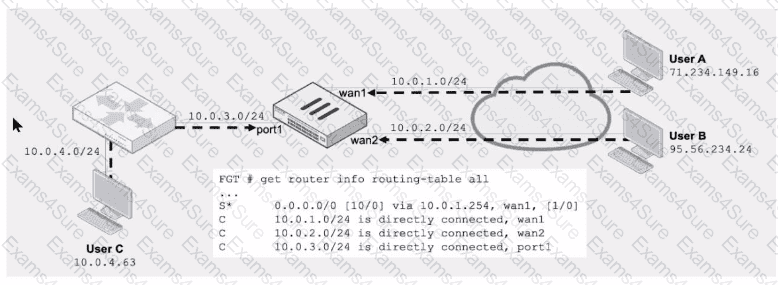
Refer to the exhibit.

Question # 39

Assuming a default configuration, which three statements are true? (Choose three.)

Options:

A.  

Strict RPF is enabled by default.

B.  

User B: Fail. There is no route to 95.56.234.24 .

C.  

User A: Pass. The default static route through wan1 passes the RPF check regardless of the source IP address.

D.  

User B: Pass. FortiGate will use asymmetric routing using wan1 to reply to traffic for 95.56.234.24.

E.  

User C: Fail. There is no route to 10.0.4.63 using port1 in the touting table.

Discussion 0
Question # 40

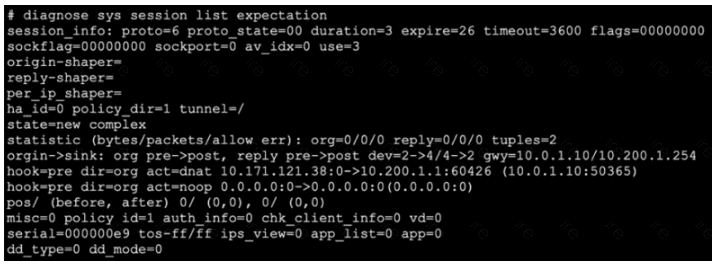
Refer to the exhibit, which shows the output of a diagnose command.
Question # 40

What two conclusions can you draw from the output shown in the exhibit? (Choose two answers)

Options:

A.  

This is an expected session created by the IPS engine.

B.  

Traffic in the original direction (coming from the IP address 10.171.121.38) will be routed to the next-hop IP address 10.0.1.10.

C.  

Traffic in the original direction (coming from the IP address 10.171.121.38) will be routed to the next-hop IP address 10.200.1.1.

D.  

This is a pinhole session created to allow traffic for a protocol that requires additional sessions to operate through FortiGate.

Discussion 0
Get NSE7_FSN_AR-7.6 dumps and pass your exam in 24 hours!

Free Exams Sample Questions