Weekend Sale Limited Time 70% Discount Offer - Ends in 0d 00h 00m 00s - Coupon code: merry71

Free Fortinet NSE 7 - Secure Networking 7.6 Architect Practice Questions

Question # 1

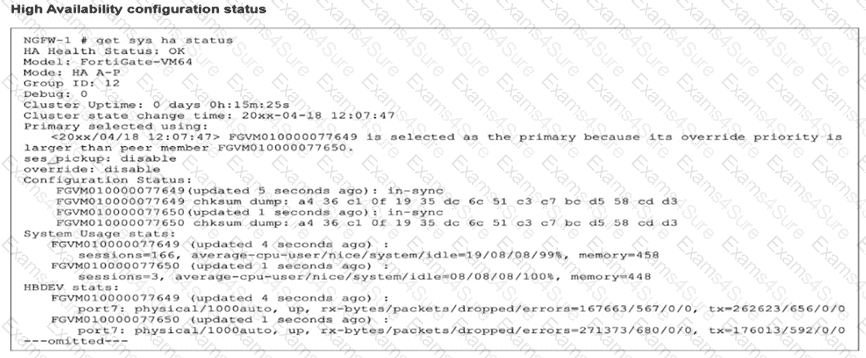
Refer to the exhibit.
Question # 1

Which two statements about the output are true, considering NGFW-1 and NGFW-2 have been up for a week? (Choose two.)

Options:

A.  

If FGVM...649 is rebooted, FGVM...650 will become the primary FortiGate and retain that role, even after FGVM...649 rejoins the cluster.

B.  

If port7 becomes disconnected on the secondary FortiGate, both FortiGate devices will elect themselves as primary.

C.  

If a configuration change is made to the secondary FortiGate, the Configuration Status will not change.

D.  

If a configuration change is made to the primary FortiGate at this time, the secondary will initiate a synchronization reset.

Discussion 0
Question # 2

Refer to the exhibit, which shows a partial output of the fssod daemon real-time debug command.

Question # 2

What two conclusions can you draw from the output? (Choose two.)

Options:

A.  

The workstation with IP 10.124.2.90 will be polled frequently using TCP port 445 to see if the user is still logged on.

B.  

The logon event can be seen on the collector agent installed on Windows.

C.  

FSSO is using DC agent mode to detect logon events.

D.  

FSSO is using agentless polling mode to detect logon events.

Discussion 0
Question # 3

What are two reasons you might see iprope_in check () check failed, drop when using the debug How? (Choose two.)

Options:

A.  

The packet was dropped because it is not allowed by any firewall policy.

B.  

The packet was dropped because there is no route to the source.

C.  

The packet was dropped because the trusted host list is misconfigured

D.  

The packet was dropped because the requested service is not enabled on FortiGate

Discussion 0
Question # 4

Which authentication option can you not configure under config user radius on FortiOS?

Options:

A.  

mschap

B.  

pap

C.  

mschap2

D.  

eap

Discussion 0
Question # 5

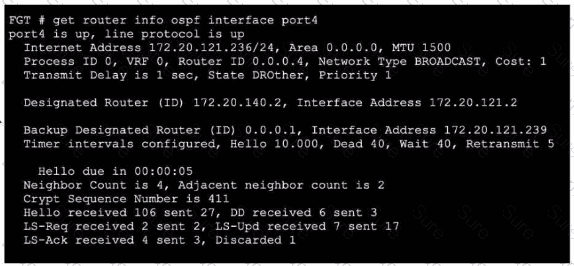
Refer to the exhibit, which shows the output of a debug command.
Question # 5

Which two statements about the output are true? (Choose two.)

Options:

A.  

The interlace is part of the OSPF backbone area.

B.  

There are a total of five OSPF routers attached to the vorz4 network segment

C.  

One of the neighbors has a router ID of 0.0.0.4.

D.  

In the network connected to port4, two OSPF routers are down.

Discussion 0
Question # 6

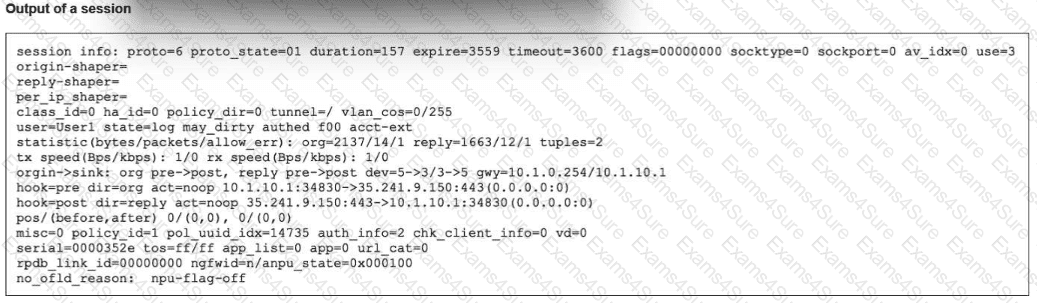
Refer to the exhibit.

Question # 6

The exhibit shows the output of a session. Which two statements are correct? (Choose two.)

Options:

A.  

The session did not match a firewall policy.

B.  

The gateway to the destination is 10.1.10.1.

C.  

The session was initiated from an authenticated user.

D.  

The TCP session has been successfully established.

Discussion 0
Question # 7

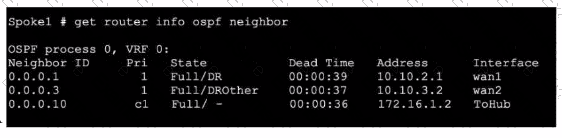
Refer to the exhibit, which shows the output of get router info ospf neighbor.
Question # 7

What can you conclude from the command output?

Options:

A.  

The network type connecting the local Fortigate and OSPF neighbor 0.0.0.10 is point-to-point.

B.  

All neighbors are in area 0.0.0.0.

C.  

The local FortiGate is the BDR.

D.  

The local FortiGate is not a DROther.

Discussion 0
Question # 8

An administrator wants to capture encrypted phase 2 traffic between two FotiGate devices using the built-in sniffer.

If the administrator knows that there Is no NAT device located between both FortiGate devices, which command should the administrator run?

Options:

A.  

diagnose sniffer packet any ' udp port 500 '

B.  

diagnose sniffer packet any ' lp proto 50 '

C.  

diagnose sniffer packet any ' udp port 4500 '

D.  

diagnose sniffer packet any ' ah '

Discussion 0
Question # 9

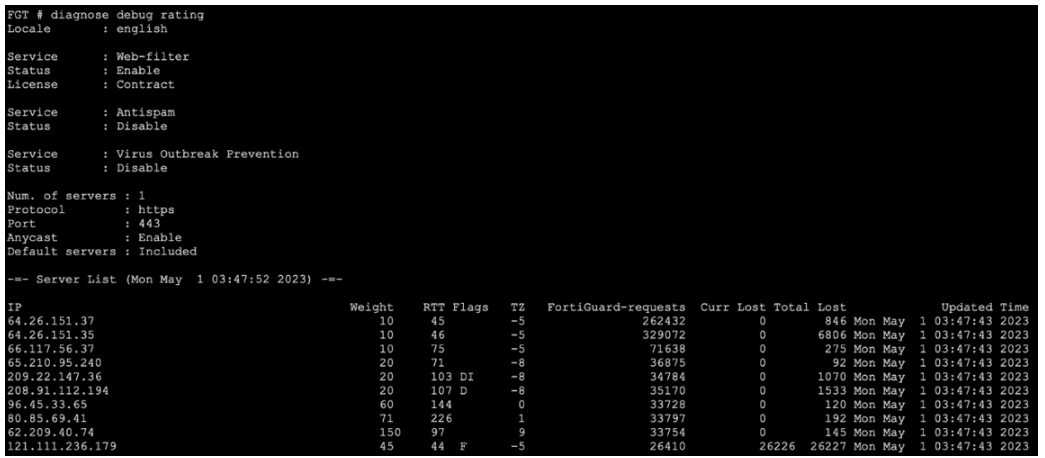
Refer to the exhibit, which shows the output of a diagnose command. What can you conclude from the RTT value?
Question # 9

Options:

A.  

Its value represents the time it takes to receive a response after a rating request is sent to a particular server.

B.  

Its value is incremented with each packet lost.

C.  

It determines which FortiGuard server is used for license validation.

D.  

Its initial value is statically set to 10.

Discussion 0
Question # 10

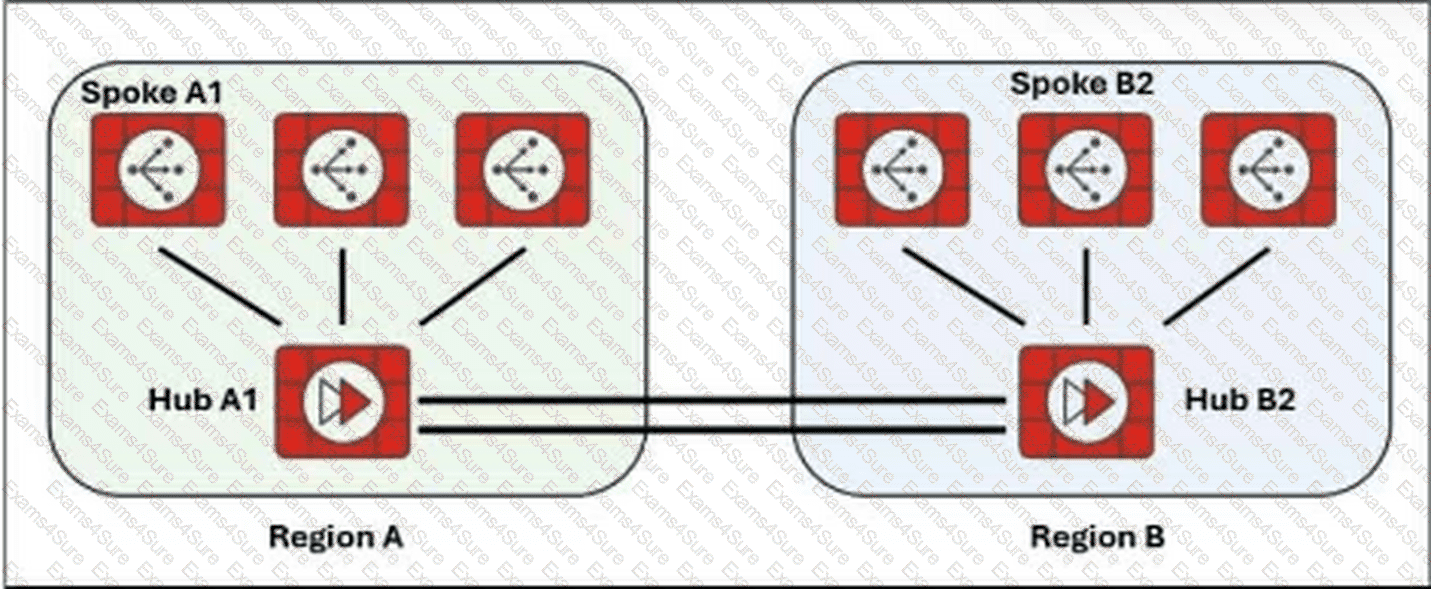
Refer to the exhibit.

Question # 10

Two hub-and-spoke groups are connected through redundant site-to-site IPsec VPNs between Hub 1 and Hub 2.

Which two configuration settings are required for Spoke A1 to establish an auto-discovery VPN (ADVPN) shortcut with Spoke B2? (Choose two.)

Options:

A.  

On the spokes, auto-discovery-receiver must be enabled on the IPsec VPNs to the hubs.

B.  

On the hubs, auto-discovery-forwarder must be enabled on the IPsec VPNs between the hubs.

C.  

On the spokes, auto-discovery-sender must be enabled on the IPsec VPNs to the hubs.

D.  

On the hubs, auto-discovery-receiver must be enabled on the IPsec VPNs to the spokes.

Discussion 0

NSE7_FSN_AR-7.6 PDF

NSE7_FSN_AR-7.6 PDF (Printable)
$46.5
$154.99

NSE7_FSN_AR-7.6 Testing Engine

NSE7_FSN_AR-7.6 PDF (Printable)
$51
$169.99

NSE7_FSN_AR-7.6 PDF + Testing Engine

NSE7_FSN_AR-7.6 PDF (Printable)
$63.9
$212.99
Exams4sure Dumps

Exam style questions across every NSE7_FSN_AR-7.6 domain

Last Update 1 day ago
Total Questions : 177

Start with our free NSE7_FSN_AR-7.6 practice questions, carefully crafted to mirror the domains, phrasing, and difficulty of the real NSE 7 Network Security Architect exam. Each NSE7_FSN_AR-7.6 exam question comes with a detailed rationale that explains not just which answer is correct but why the others fall short. That's how concepts stick. Use the free set to benchmark yourself: identify your Fortinet weak domains, see where you're losing marks, and build a focused study plan in minutes.


Free Exams Sample Questions