
Exam style questions across every NSE7_SOC_AR-7.6 domain
Last Update 1 day ago
Total Questions : 91
Start with our free NSE7_SOC_AR-7.6 practice questions, carefully crafted to mirror the domains, phrasing, and difficulty of the real Fortinet Certified Professional Security Operations exam. Each NSE7_SOC_AR-7.6 exam question comes with a detailed rationale that explains not just which answer is correct but why the others fall short. That's how concepts stick. Use the free set to benchmark yourself: identify your Fortinet weak domains, see where you're losing marks, and build a focused study plan in minutes.

Refer to the exhibits.
The FortiMail Sender Blocklist playbook is configured to take manual input and add those entries to the FortiMail abc. com domain-level block list. The playbook is configured to use a FortiMail connector and the ADD_SENDER_TO_BLOCKLIST action.
Why is the FortiMail Sender Blocklist playbook execution failing7
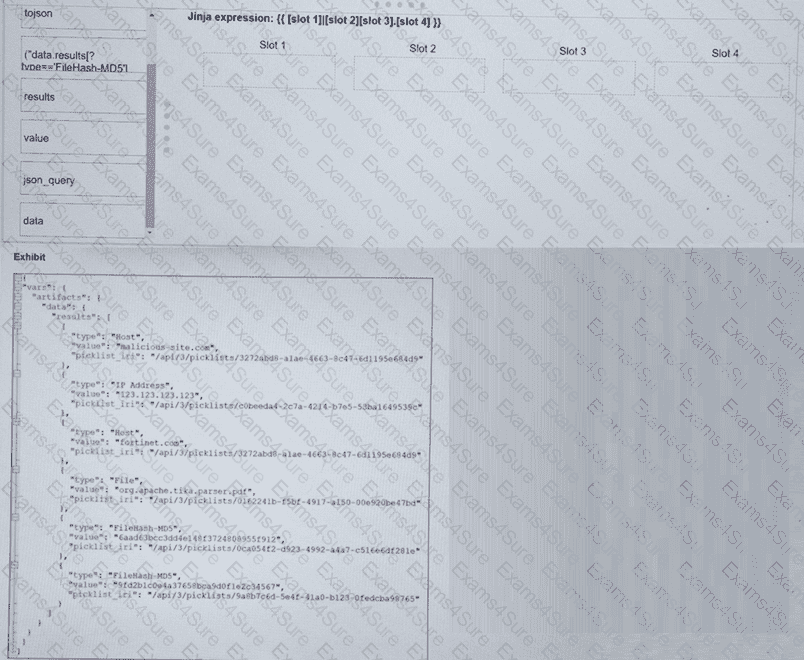
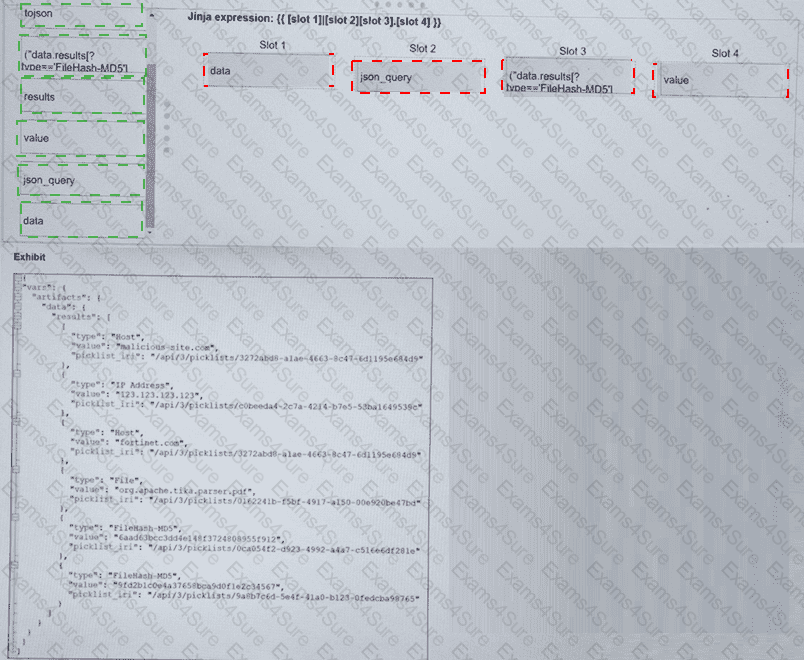
Refer to the exhibit. What is the correct Jinja expression to filter the results to show only the MD5 hash values?
{{ [slot 1] | [slot 2] [slot 3].[slot 4] }}
Select the Jinja expression in the left column, hold and drag it to a blank position on the right. Place the four correct steps in order, placing the first step in the first slot.
Refer to the exhibit.
Which two options describe how the Update Asset and Identity Database playbook is configured? (Choose two.)
You are trying to create a playbook that creates a manual task showing a list of public IPv6 addresses. You were successful in extracting all IP addresses from a previous action into a variable called ip_list , which contains both private and public IPv4 and IPv6 addresses. You must now filter the results to display only public IPv6 addresses. Which two Jinja expressions can accomplish this task? (Choose two answers)
A partner organization recently suffered a distributed denial-of-service (DDoS) attack, but the adversary’s identity and TTPs remain unknown. Your SOC has not received any relevant threat intelligence from the partner organization, but you are asked to determine whether similar activity could be happening in your environment. Which threat hunting action should you perform first? Choose one answer.
Refer to the exhibits.
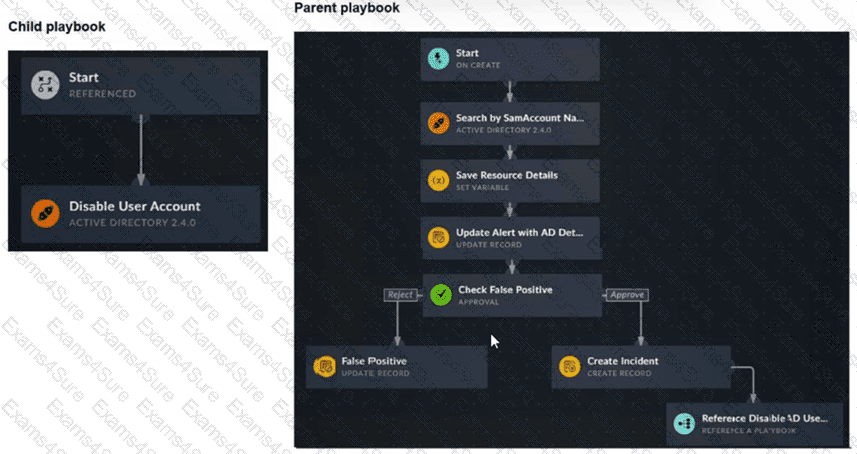
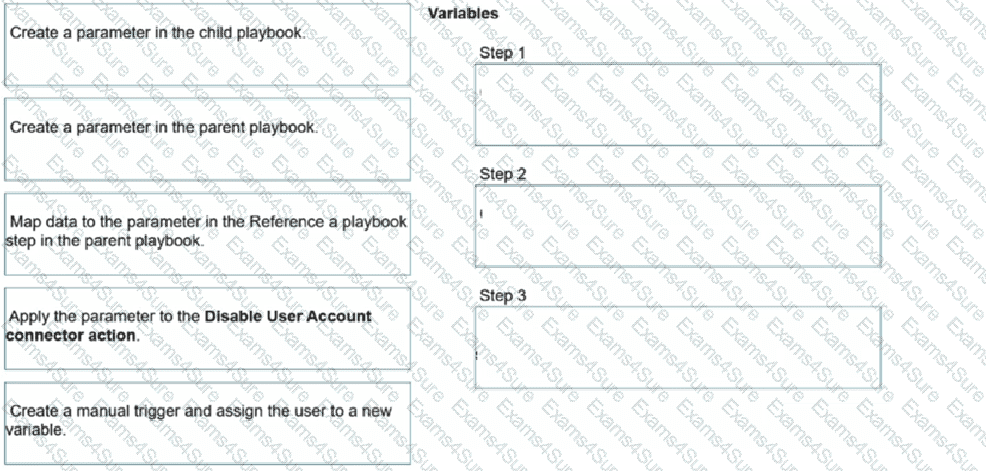
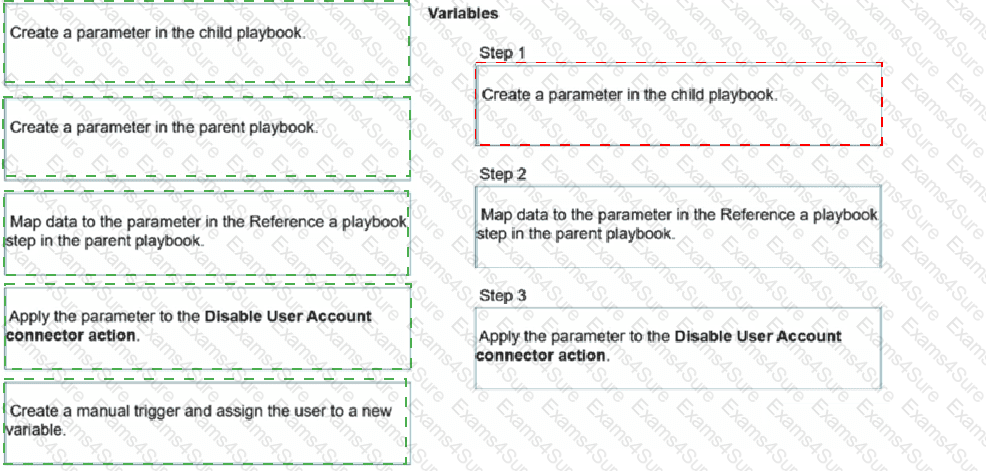
You have a playbook that, depending on whether an analyst deems the alert to be a true positive, could reference a child playbook. You need to pass variables from the parent playbook to the child playbook.
Place the steps needed to accomplish this in the correct order.
Refer to Exhibit:
You are tasked with reviewing a new FortiAnalyzer deployment in a network with multiple registered logging devices. There is only one FortiAnalyzer in the topology.
Which potential problem do you observe?
Which two types of variables can you use in playbook tasks? (Choose two.)



