
Exam style questions across every P1 domain
Last Update 3 days ago
Total Questions : 260
Start with our free P1 practice questions, carefully crafted to mirror the domains, phrasing, and difficulty of the real CIMA Operational exam. Each P1 exam question comes with a detailed rationale that explains not just which answer is correct but why the others fall short. That's how concepts stick. Use the free set to benchmark yourself: identify your CIMA weak domains, see where you're losing marks, and build a focused study plan in minutes.

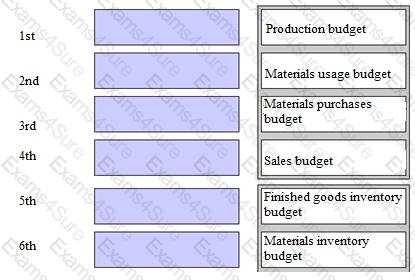
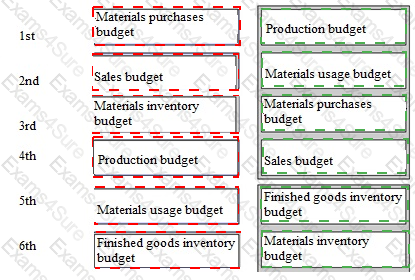
For a company that does not have any production resource limitations, what would be the correct sequence for budget preparation?
FG Enterprises manufactures and sells three products. There are 4,400 kg of Material X available in the next period. Material X is used in the manufacture of all three products. The following data is available for the next period.
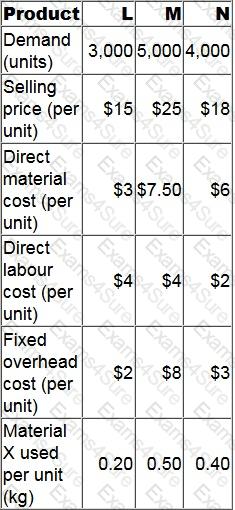
What is the optimal production plan for the next period in order to maximise profit?
A company currently uses a rate of $32 per machine hour to absorb its total production overheads of $960,000.
Using this system the production overhead cost per unit of product X is $160.
An activity based costing exercise has revealed that only $345,000 of the production overhead is driven by machine hours. The remainder is driven by the number of machine set ups, at a rate of $9.60 per set up.
Product X requires 3 set ups per unit.
Calculate the total production overhead cost per unit of product X using an activity based costing system.
Give your answer to two decimal places.
A company is forecasting sales volume using time series analysis. The following equation has been derived from past data and is considered to be a reliable predictor of future sales volume:
y = 20,000+80x
Where y is the total sales units each quarter and x is the time period (the first quarter of year 1 is time period 1).
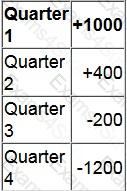
The following set of seasonal variations for each quarter has been calculated using the additive model.
What is the forecast sales units for the second quarter of year 3?
RT produces two products from different quantities of the same resources using a just-in-time (JIT) production system. The selling price and resource requirements of each of the products are shown below:
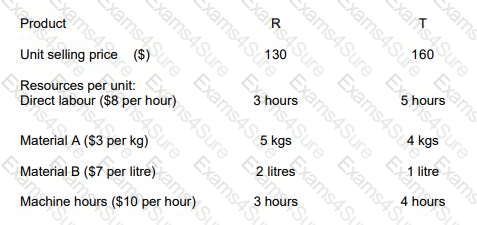
Market research shows that the maximum demand for products R and T during June 2010 is 500 units and 800 units respectively. This does not include an order that RT has agreed with a commercial customer for the supply of 250 units of R and 350 units of T at selling prices of $100 and $135 per unit respectively. Although the customer will accept part of the order, failure by RT to deliver the order in full by the end of June will cause RT to incur a $10,000 financial penalty. At a recent meeting of the purchasing and production managers to discuss the production plans of RT for June, the following resource restrictions for June were identified:
Direct labour hours 7,500 hours
Material A 8,500 kgs
Material B 3,000 litres
Machine hours 7,500 hours
Assuming that RT completes the order with the commercial customer, prepare calculations to show, from a financial perspective, the optimum production plan for June 2010 and the contribution that would result from adopting this plan.
The optimum production plan will be:
An entity manufactures two products.
The sales revenues of the products are in the constant mix of 3:1. Forecast data for next period are as follows:
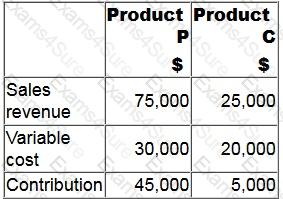
The margin of safety for next period is $30,000 of sales revenue. Fixed costs are constant at all levels of output.
What is the forecast profit for next period?
Give your answer to the nearest whole number.
The labour requirement for a special contract is 250 skilled labour hours paid at $10 per hour and 750 semi-skilled labour hours paid at $8 per hour.
At present, skilled labour is fully utilised on other contracts which generate a $12 contribution per hour, after charging labour costs. Additional skilled labour is unavailable in the short term.
There is a surplus of 1,200 semi-skilled hours over the period of the contract but the firm has a policy of no redundancies.
The relevant cost of labour for the special contract is:
XY can choose from four mutually exclusive projects. The projects will each last for one year and their net cash inflows will be determined by market conditions. The forecast net cash inflows for each of the possible outcomes are shown below.
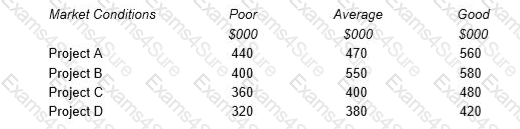
If the company applies the maximin criterion the project chosen would be:
Which of the following are examples of feedforward control?
Select ALL that apply.
A company's markets are affected by fluctuating exchange rates. It is difficult to forecast more than two or three months ahead.
Which of the following budgeting systems would be most useful in this company's circumstances?



