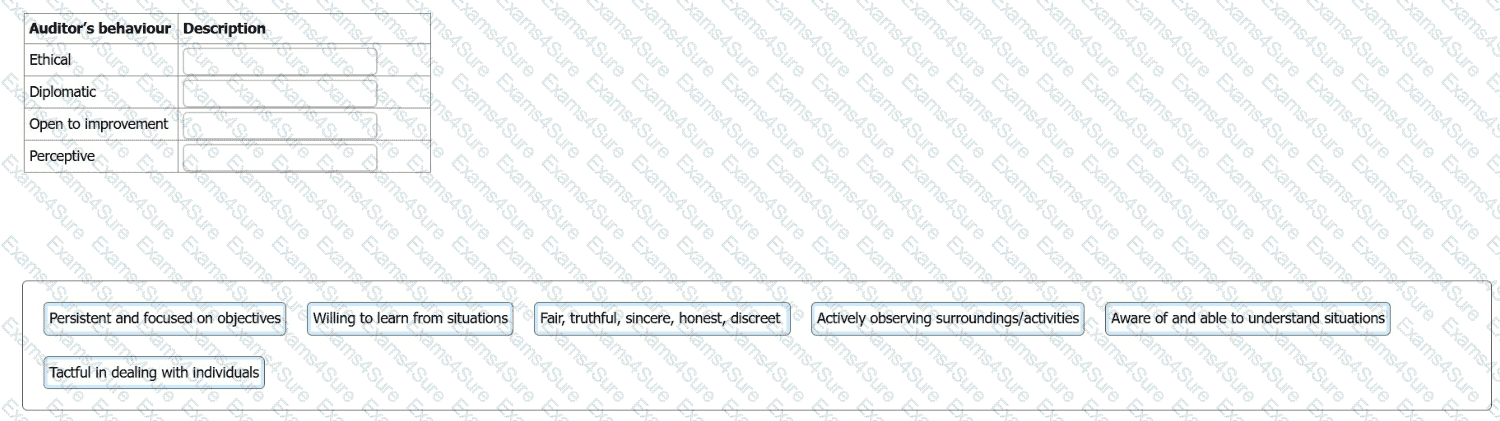
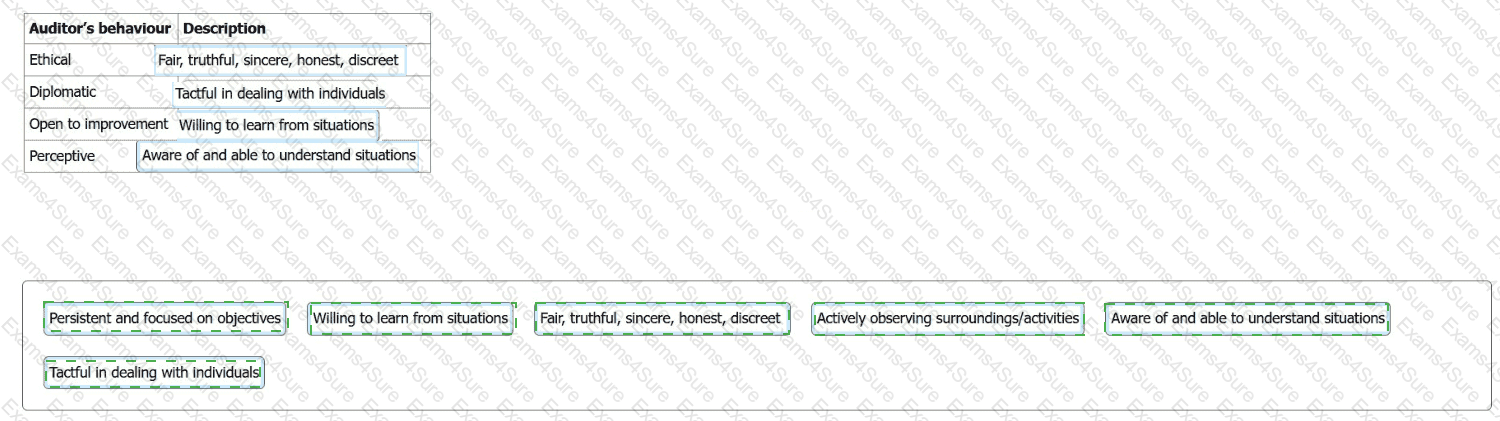
An auditor ' s personal behaviour during an audit is key to ensuring that the audit objectives are achieved. Match each of the descriptions to the correct type of behaviour.
To complete the table click on the blank section you want to complete so it is highlighted in red and then click on the applicable text from the options below. Alternatively, drag and drop each of the following descriptions.
An audit team leader who has been contracted to perform a full Occupational Health and Safety management system audit is conducting a documented information review in preparation for the audit.
Which four options are a benefit of completing this task?
Whistlekleen is a national dry cleaning and laundry organization with 50 shops. You are conducting an OHSMS surveillance audit of the head office and are sampling health and safety performance monitoring. You find that 80 per cent of incident originate from five shops in the same region. Most of these relate to staff and customer feeling unwell due to breathing in the pungent atmosphere. Some required to be hospitalized. The OHS Manager tells you that these are the oldest shops in the organization. The cleaning equipment emits Volatile Organic Compounds (VOCs) and needs replacing but the organisation cannot afford it at the moment.
You are an audit team leader conducting an ISO 45001 Stage 2 audit of a nautical college that provides courses for those working in the maritime sector. The College Principal is absent, and the Deputy Principal represents top management.
At the closing meeting attended solely by the Deputy Principal, you inform him that you have found numerous gaps in the OHSMS processes which constitute poor planning and control of the OHSMS. Your team raises a large number of findings including major nonconformities, minor nonconformities, and opportunities for improvement.
Select three of the options which would represent major nonconformities from the evidence described.
Which two of the following are ' criteria ' in relation to a first-party audit?
In the initial communication by the audit team leader for a certification audit, the OHSMS Manager asks that the audit includes detailed coverage of the OHSMS legislation of the local authority, which has been specified in a recent customer contract.
Which two of the following responses should the audit team leader make?
At a wall before sweeping up the reside into baskets. They have asked to see the criteria (in this case work instructions) relating to this process and find that workers are following the instructions given. The auditor in training, however, considers the process to be dangerous and wants to raise a nonconformity against clause 8.1.1.
How would you react? Select four.
Which three of the following findings could be used to support a nonconformity against ISO 45001:2018 clause 7.2 Competence?
A multi-level shopping centre is open every day to the public from 09:00–21:00. During an external audit of the centre to ISO 45001, you establish that there are 120 retail outlets. There are eight escalators to all levels and four sets of elevators. When asked about safety performance improvement objectives, the Centre Manager says that there are plans to reduce the number of reported incidents and complaints.
You: I note from the incident log that reported incidents have increased in the past year. Why is this?
Centre Manager: The number of shoppers coming into the centre has increased by about 10 per cent in the last year. More people around means that more things will happen.
You: What actions have been taken to deal with this increase?
Centre Manager: We conducted awareness training for staff. For example, making sure that any hazardous areas are well signed.
You: I see that the escalators account for a number of accidents. Have you taken any actions to try and reduce this?
Centre Manager: Most of these accidents are caused by people failing to take care at the ends. So, the answer is no, it is difficult to do anything about that.
You: How do you monitor safety in the centre?
Centre Manager: We train our staff to be alert to potential safety problems when walking around the centre. We empower them to take whatever action is necessary.
Which four actions should you take to investigate the situation further?
You are auditing clause 4.1 (Context of the organisation) with a member of the organisation ' s top management. You ask them for examples of external issues the OHSMS is currently facing.
Which three of their responses would you accept as valid examples of such issues?