
Exam style questions across every CTAL-TM domain
Last Update 3 months ago
Total Questions : 228
Start with our free CTAL-TM practice questions, carefully crafted to mirror the domains, phrasing, and difficulty of the real Test Manager Advanced exam. Each CTAL-TM exam question comes with a detailed rationale that explains not just which answer is correct but why the others fall short. That's how concepts stick. Use the free set to benchmark yourself: identify your ISTQB weak domains, see where you're losing marks, and build a focused study plan in minutes.

You are a Test Manager on a new project. The software that is being created will be used to control the projectors in movie theaters. This is a time critical project because the software must be released before the Christmas holiday season which has the highest movie attendance of the year.
You have decided to implement a review process for the work products that are a part of this release to save both time and money. In order to expedite the training, you brought in a consultant to
train the participants and moderators in proper review processes. Your team is enthusiastic about participating in the reviews.
Your manager is questioning the money you have spent on this training effort. He wants to know how you intend to justify the expense when you present your numbers at the annual budget
meeting in February.
What would be a reasonable way for you to justify the cost of the training and the reviews when you present your information at the budget meeting? [3]
You are the Test Manager on a new project. The schedule is aggressive and will require the team to work at peak efficiency. The requirements are not well defined yet, but it is clear that the
project will be using new technologies. To help the developers meet the development schedule, an offshore group will be added to the development team.
At this time there is not enough budget to add more testing resources. The project stakeholders are very concerned about the quality of delivered product and will be watching the project closely,
particularly during the testing cycles. The exit criteria from the system test level require no open high priority/severity defects, 100% pass rate for all test cases covering risks that are classified as
"high" or "very high", 90% pass rate for all "medium" risks and 50% pass rate for all "low" and "very low" risks.
Given this information, which lifecycle model should you recommend? [3]
Refer to SCENARIO 3
You are the Test Manager for a software house called "MakeMyApp" that specialise in mobile phone applications, agile techniques are used for all software development projects.
A new project is underway to develop enhancements to a 'photo sharing' application, known as 'PictureFriend'. There are two types of user account available -Premium Users and Guest Users. Guest users only have limited functionality available. The enhanced features to PictureFriend are:
• Feature 1: Guest Users can share photos with other Guest Users and Premium Users;
• Feature 2: Premium Users can edit pictures before posting to their account;
• Feature 3: Premium Users can create '3D-effect' photographs
The requirements for each feature will be broken down into a number of User Stories with acceptance criteria created for each of them. User Stories are planned and delivered in 2-week 'Sprints'. The project will have 3 sprints.
Which of the following are test planning activities that would be MOST appropriate for Sprint 1?
a) Analyse the risk for each of the user stories in sprint 1
b) Publish lest progress reports throughout the sprint
c) Arrange informal reviews of the user stories by the test team
d) Plan an automated system test suite for the user stories.
e) Specify system test conditions at a detailed level for all user stories Chose one of the following options:
SELECT ONE OPTION
Your Project Manager has challenged you to come up with a process improvement strategy using the IDEAL model.
Which step within the process defines the success criteria? [2]
You are the Test Manager on a project to replace an old sales and merchandising system with one that will be based on modern platforms It will be developed using an Agile lifecycle.
The main requirements for the system are:
Loading sales data, sent electronically from the stores each evening, into a central database.
Producing sales reports for the merchandisers, whose job is to manage stock levels in stores.
Producing forecast reports, used to predict demand for each product, based on a combination of sales history and forecasting parameters. The parameters will be entered by the merchandisers into a browser based front end and the reports will be produced overnight.Requirements 1 and 2 are satisfied by the existing system and will be rewritten with no significant changes. Requirement 3 is new.The Data Centre Manager is concerned about the performance of overnight batch processing and the Sales and Merchandising Manager is concerned about usability. Both managers have indicated that they are keen to allocate resources to acceptance testing.You have already determined that component and component integration testing will be done by developers before any other testing.
Which option contains TWO items that would complete your test approach in respect of test levels?
Assume that you are part of a team conducting test design for a new university system that will allow students to update their own personal information. The Test
Strategy states that positive and negative testing should be carried out. along with performance, security and interoperability testing against all new requirements.
The following requirements have been identified by stakeholders:
1. Students must be able to make changes to the following information:
a Name (due to marital status)
b Marital status
c. Home address
d. Home telephone number
e. Email address
f. Mobile telephone number
g. Contact details in case of emergency
2 Only Reception staff must have access to the information held.
3 The system must support 2000 concurrent users and details updated on the system within 20 seconds.
4. Interoperability of the new system with the other systems maintained by the University for student Registrations.
Test analysis for functional and non-functional testing has iust bequn and the following test conditions have been identified:
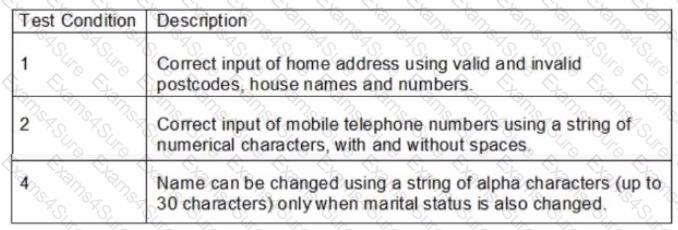
Which one of the following is a valid test condition that is missing from the table of test conditions and has clear traceability back to the test strategy and requirements?
SELECT ONE OPTION



