
Exam style questions across every MuleSoft-Platform-Architect-I domain
Last Update 1 day ago
Total Questions : 152
Start with our free MuleSoft-Platform-Architect-I practice questions, carefully crafted to mirror the domains, phrasing, and difficulty of the real Salesforce MuleSoft exam. Each MuleSoft-Platform-Architect-I exam question comes with a detailed rationale that explains not just which answer is correct but why the others fall short. That's how concepts stick. Use the free set to benchmark yourself: identify your Salesforce weak domains, see where you're losing marks, and build a focused study plan in minutes.

Refer to the exhibit.
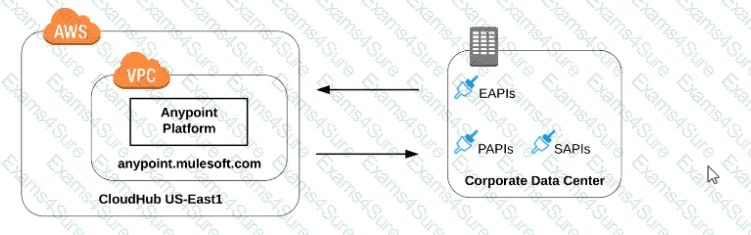
what is true when using customer-hosted Mule runtimes with the MuleSoft-hosted Anypoint Platform control plane (hybrid deployment)?
What best describes the Fully Qualified Domain Names (FQDNs), also known as DNS entries, created when a Mule application is deployed to the CloudHub Shared Worker Cloud?
A Mule application implements an API. The Mule application has an HTTP Listener whose connector configuration sets the HTTPS protocol and hard-codes the port
value. The Mule application is deployed to an Anypoint VPC and uses the CloudHub 1.0 Shared Load Balancer (SLB) for all incoming traffic.
Which port number must be assigned to the HTTP Listener's connector configuration so that the Mule application properly receives HTTPS API invocations routed through the
SLB?
A company is building an application network using MuleSoft's recommendations for various API layers.
What is the main (default) role of a process API in an application network?
An online store's marketing team has noticed an increase in customers leaving online baskets without checking out. They suspect a technology issue is at the root cause of the baskets being left behind. They approach the Center for Enablement to ask for help identifying the issue. Multiple APIs from across all the layers of their application network are involved in the shopping application.
Which feature of the Anypoint Platform can be used to view metrics from all involved APIs at the same time?
A Rate Limiting policy is applied to an API implementation to protect the back-end system. Recently, there have been surges in demand that cause some API client
POST requests to the API implementation to be rejected with policy-related errors, causing delays and complications to the API clients.
How should the API policies that are applied to the API implementation be changed to reduce the frequency of errors returned to API clients, while still protecting the back-end
system?
An organization requires several APIs to be secured with OAuth 2.0, and PingFederate has been identified as the identity provider for API client authorization, The
PingFederate Client Provider is configured in access management, and the PingFederate OAuth 2.0 Token Enforcement policy is configured for the API instances required by the
organization. The API instances reside in two business groups (Group A and Group B) within the Master Organization (Master Org).
What should be done to allow API consumers to access the API instances?
A company has started to create an application network and is now planning to implement a Center for Enablement (C4E) organizational model. What key factor would lead the company to decide upon a federated rather than a centralized C4E?
An organization wants to create a Center for Enablement (C4E). The IT director schedules a series of meetings with IT senior managers.
What should be on the agenda of the first meeting?



