
Exam style questions across every MuleSoft-Platform-Architect-I domain
Last Update 19 hours ago
Total Questions : 152
Start with our free MuleSoft-Platform-Architect-I practice questions, carefully crafted to mirror the domains, phrasing, and difficulty of the real Salesforce MuleSoft exam. Each MuleSoft-Platform-Architect-I exam question comes with a detailed rationale that explains not just which answer is correct but why the others fall short. That's how concepts stick. Use the free set to benchmark yourself: identify your Salesforce weak domains, see where you're losing marks, and build a focused study plan in minutes.

What CANNOT be effectively enforced using an API policy in Anypoint Platform?
A large organization with an experienced central IT department is getting started using MuleSoft. There is a project to connect a siloed back-end system to a new
Customer Relationship Management (CRM) system. The Center for Enablement is coaching them to use API-led connectivity.
What action would support the creation of an application network using API-led connectivity?
A retail company with thousands of stores has an API to receive data about purchases and insert it into a single database. Each individual store sends a batch of purchase data to the API about every 30 minutes. The API implementation uses a database bulk insert command to submit all the purchase data to a database using a custom JDBC driver provided by a data analytics solution provider. The API implementation is deployed to a single CloudHub worker. The JDBC driver processes the data into a set of several temporary disk files on the CloudHub worker, and then the data is sent to an analytics engine using a proprietary protocol. This process usually takes less than a few minutes. Sometimes a request fails. In this case, the logs show a message from the JDBC driver indicating an out-of-file-space message. When the request is resubmitted, it is successful. What is the best way to try to resolve this throughput issue?
A circuit breaker strategy is planned in order to meet the goal of improved response time and demand on a downstream API.
* Circuit Open: More than 10 errors per minute for three minutes
* Circuit Half-Open: One error per minute
* Circuit Closed: Less than one error per minute for five minutes
Out of several proposals from the engineering team, which option will meet this goal?
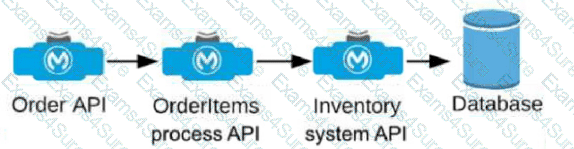
An Order API triggers a sequence of other API calls to look up details of an order's items in a back-end inventory database. The Order API calls the OrderItems process API, which calls the Inventory system API. The Inventory system API performs database operations in the back-end inventory database.
The network connection between the Inventory system API and the database is known to be unreliable and hang at unpredictable times.
Where should a two-second timeout be configured in the API processing sequence so that the Order API never waits more than two seconds for a response from the Orderltems process API?
An organization has built an application network following the API-led connectivity approach recommended by MuleSoft. To protect the application network against
attacks from malicious external API clients, the organization plans to apply JSON Threat Protection policies.
To which API-led connectivity layer should the JSON Threat Protection policies most commonly be applied?
An established communications company is beginning its API-led connectivity journey, The company has been using a successful Enterprise Data Model for many years. The company has identified a self-service account management app as the first effort for API-led, and it has identified the following APIs.
Experience layer: Mobile Account Management EAPI, Browser Account Management EAPI
Process layer: Customer Lookup PAPI, Service Lookup PAPI, Account Lookup PAPI
System layer: Customer SAPI, Account SAPI, Product SAPI, Service SAPI
According to MuleSoft's API-led connectivity approach, which API would not be served by the Enterprise Data Model?
How can the application of a rate limiting API policy be accurately reflected in the RAML definition of an API?



