Pre-Summer Sale Limited Time 65% Discount Offer - Ends in 0d 00h 00m 00s - Coupon code: 65pass65

OG0-093 TOGAF 9.2 Combined Part 1 and Part 2 is now Stable and With Pass Result | Test Your Knowledge for Free

Exams4sure Dumps

OG0-093 Practice Questions

TOGAF 9.2 Combined Part 1 and Part 2

Last Update 3 days ago
Total Questions : 420

Dive into our fully updated and stable OG0-093 practice test platform, featuring all the latest TOGAF 9 Certified exam questions added this week. Our preparation tool is more than just a The Open Group study aid; it's a strategic advantage.

Our free TOGAF 9 Certified practice questions crafted to reflect the domains and difficulty of the actual exam. The detailed rationales explain the 'why' behind each answer, reinforcing key concepts about OG0-093. Use this test to pinpoint which areas you need to focus your study on.

OG0-093 PDF

OG0-093 PDF (Printable)
$43.75
$124.99

OG0-093 Testing Engine

OG0-093 PDF (Printable)
$50.75
$144.99

OG0-093 PDF + Testing Engine

OG0-093 PDF (Printable)
$63.7
$181.99
Question # 21

Which of the following describes a key objective of the Technology Architecture Phase?

Options:

A.  

To define the solution architecture needed to support the Application Architecture

B.  

To define technology components into a set of technology platforms

C.  

To define the Transition Architectures needed to achieve the Target Architecture

D.  

To develop a migration plan to deliver incremental capabilities

E.  

To select a set of technology products that will form the basis of a solution architecture

Discussion 0
Question # 22

Which one of the following is an objective of the Preliminary Phase of the ADM?

Options:

A.  

To define, scope and prioritize architecture tasks

B.  

To define the architecture principles

C.  

To develop a Target Business Architecture

D.  

To obtain management commitment for this cycle of the ADM ActualTests.com

E.  

To prioritize work packages

Discussion 0
Question # 23

Scenario

Please read this scenario prior to answering the Question

You are serving as the Lead Architect for a chain of convenience stores. The stores operate 24 hours a day and 7 days a week and use cloud-based point-of-sale (POS) technology to manage their sales and inventory. Cloud-based POS systems store all user data, including sales and inventory in a remote server.

The cloud-based systems collect real-time data to support ordering and product selection decisions including the tailoring of product assortment based on sales history, customer demographics as well as the next day's weather forecast. In many cases, several stores are located in neighboring areas. This strategy makes distribution to each store cheaper, as well as making multiple deliveries per day possible. The stores also act as self-service delivery locations for a large online retailer which further increases the number of potential customers entering the stores.

An Enterprise Architecture practice exists within the company, with the CEO and CIO as joint sponsors. They have decided to adopt TOGAF standard within the practice and the first project is to restructure the Enterprise Architecture so that it can better support the existing environment and accommodate future changes of strategy within the company.

The CIO has stated that the following issues need to be addressed in the restructuring:

    They need to address problems with data quality and inconsistent data in order to support better decision making and analysis.

    The architecture should focus on the needs of the business, not technology

    To remain competitive, new products and promotions must undergo market trials and if these are successful, deployed across the retail chain. Information systems must be able to manage changes and updates without undue delays.

Refer to the Scenario

[Note: You should assume that the company has adopted the example set of principles that are listed and defined in TOGAF, Section 23.6. You may need to refer to Chapter 23 of the reference text in order to answer this question.]

You have been asked to identify the most relevant architecture principles for the current situation.

Based on TOGAF, which of the following is the best answer? [Note: The ordering of the principles listed in each answer is not significant.]

Options:

A.  

Interoperability, Data is Accessible, Data is Shared, Requirements Based Change, Control Technical Diversity

B.  

Requirements Based Change, Business Continuity, Common Vocabulary and Data Definitions, Data Trustee, Responsive Change Management

C.  

IT Responsibility, Data Security, Ease of Use, Service Orientation, Common Use Applications

D.  

Interoperability, Maximize Benefit to the Enterprise, Data Trustee, Data is an Asset, Responsive Change Management

Discussion 0
Question # 24

Which of the following types of architecture defines technology standards for building blocks and reflects general computing requirements?

Options:

A.  

Industry Architecture

B.  

Transition Architecture

C.  

Foundation Architecture

D.  

Organization-Specific Architecture

E.  

Common Systems Architecture

Discussion 0
Question # 25

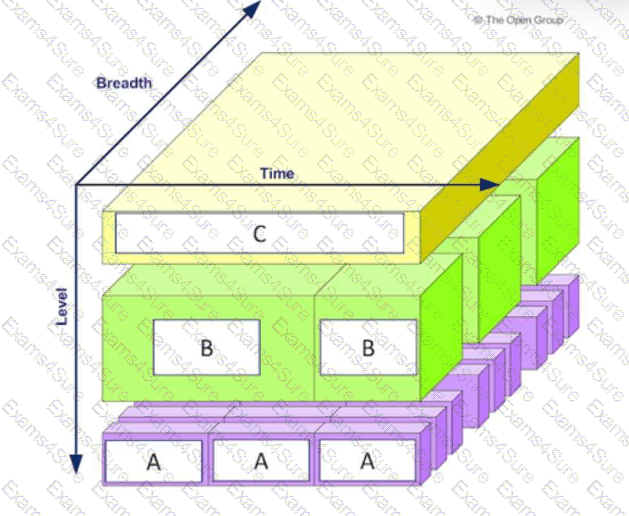
Complete the sentence. The Architecture Landscape is divided into levels, Strategic Architectures, _____________

Options:

A.  

Segment Architectures, and Capability Architectures

B.  

Solution Architectures, and Corporate Architectures

C.  

Gap Architectures, and Target Architectures

D.  

Transitional Architectures, and Incremental Architectures

E.  

Baseline Architectures, and To Be Architectures

Discussion 0
Question # 26

Scenario

Please read this scenario prior to answering the Question

You are serving as the Lead Architect for the enterprise architecture team at a multinational company. The company has grown rapidly by acquisition and has inherited numerous supply chain processes and related IT systems. Several supply chain processes have had problems related to the timing of purchases, which has led to excess inventory. The Vice President in charge of Supply Chain Management has made the decision to consolidate and reduce redundant processes and systems. The company will move to a "Just-in-time" supply chain management system so as to keep inventory costs low.

The TOGAF standard is used for internal Enterprise Architecture activities. This project is using an iterative approach for executing the Architecture Development Method (ADM).

At present, there are no particularly useful architectural assets in the Architecture Repository related to this initiative. All assets will need to be acquired, customized, or created.The company prefers to implement commercial off the shelf package applications with little customization. The CIO, who is the project sponsor, has stated that she is not concerned about preserving the existing supply chain management processes or systems.

The architecture development project has completed Phase A and has started a number of iteration cycles to develop the Architecture. As a packaged application is being considered, the next iteration will include both the Business, Application and Data Architectures. Key stakeholder concerns that should be addressed by these architectures include:

1. What groups of people should be involved in supply chain management-related business processes?

2. What non-supply chain management applications will need to be integrated with the new supply chain management applications?

3. What data will need to be shared?

Refer to the Scenario

[Note: You may need to refer to Chapter 35 of the reference text in order to answer this question.] You have been asked to identify the most appropriate catalogs, matrices, and diagrams to support the next iteration of Architecture development.

Based on TOGAF, which of the following is the best answer?

Options:

A.  

In the next iteration of Architecture development, you would describe the Baseline Business Architecture with a Value Chain diagram and a Baseline Business Process catalog. You would describe the Baseline Data Architecture with a Data diagram. You would describe the Baseline Application Architecture with an Environment and Location diagram.

B.  

In the next iteration of Architecture development, you would describe the Target Business Architecture with an Organization/Actor catalog, a Business Service/Function catalog and Data Lifecycle diagrams. You would describe the Target Application Architecture with an Application Interaction matrix and Application Communications diagrams.

C.  

You would describe the Baseline Business Architecture with a Business Service/Function catalog, an Organization/Actor catalog and a Data Entity/Business Function matrix. You would describe the Baseline Data Architecture using a Data Entity/Data Component catalog. You would describe the Baseline Application Architecture with an Application/Function matrix.

D.  

You would describe the Target Business Architecture with a Business Service/Function catalog, and a Business Interaction matrix. You would describe the Target Data Architecture with a Data Entity/Business Function matrix and an Application/Data matrix. You would describe the Target Application Architecture with Application Communication diagrams and an Application Interaction matrix.

Discussion 0
Question # 27

Complete the sentence. Two of the four architecture domains that are subsets of an overall Enterprise Architecture are Business and Technology, the other two are Application and _________

Options:

A.  

Vision

B.  

Transition

C.  

Segment

D.  

Capability

E.  

Data

Discussion 0
Question # 28

Complete the sentence. Actions arising from the Business Transformation Readiness Assessment technique should be incorporated in the ___________

Options:

A.  

Architecture Requirements Specification

B.  

Implementation Governance Model

C.  

Architecture Roadmap

D.  

Implementation and Migration Plan

E.  

Communications Plan

Discussion 0
Question # 29

According to the TOGAF standard, what term describes an individual with an interest in a system?

Options:

A.  

Sponsor

B.  

Consumer

C.  

Lead architect

D.  

Stakeholder

Discussion 0
Question # 30

Which of the following best describes the TOGAF Architecture Development Method?

Options:

A.  

A method for controlling change at an enterprise-wide level

B.  

A method for developing an organization-specific architecture

C.  

A method for managing architecture requirements

D.  

A method for classifying architectures and solutions

E.  

A method for creating an Architecture Repository

Discussion 0
Get OG0-093 dumps and pass your exam in 24 hours!

Free Exams Sample Questions