
Spring Sale Limited Time 65% Discount Offer - Ends in 0d 00h 00m 00s - Coupon code: 65pass65

Professional-Cloud-DevOps-Engineer Google Cloud Certified - Professional Cloud DevOps Engineer Exam is now Stable and With Pass Result | Test Your Knowledge for Free

Exams4sure Dumps

Professional-Cloud-DevOps-Engineer Practice Questions

Google Cloud Certified - Professional Cloud DevOps Engineer Exam

Last Update 2 days ago
Total Questions : 201

Dive into our fully updated and stable Professional-Cloud-DevOps-Engineer practice test platform, featuring all the latest Cloud DevOps Engineer exam questions added this week. Our preparation tool is more than just a Google study aid; it's a strategic advantage.

Our free Cloud DevOps Engineer practice questions crafted to reflect the domains and difficulty of the actual exam. The detailed rationales explain the 'why' behind each answer, reinforcing key concepts about Professional-Cloud-DevOps-Engineer. Use this test to pinpoint which areas you need to focus your study on.

Professional-Cloud-DevOps-Engineer PDF

Professional-Cloud-DevOps-Engineer PDF (Printable)
$43.75
$124.99

Professional-Cloud-DevOps-Engineer Testing Engine

Professional-Cloud-DevOps-Engineer PDF (Printable)
$50.75
$144.99

Professional-Cloud-DevOps-Engineer PDF + Testing Engine

Professional-Cloud-DevOps-Engineer PDF (Printable)
$63.7
$181.99
Question # 31

You are troubleshooting a failed deployment in your CI/CD pipeline. The deployment logs indicate that the application container failed to start due to a missing environment variable. You need to identify the root cause and implement a solution within your CI/CD workflow to prevent this issue from recurring. What should you do?

Options:

A.  

Run integration tests in the CI pipeline.

B.  

Implement static code analysis in the CI pipeline.

C.  

Use a canary deployment strategy.

D.  

Enable Cloud Audit Logs for the deployment.

Discussion 0
Question # 32

You are managing an MLOps platform on a Google Kubernetes Engine (GKE) cluster that serves two teams:

    The Research team runs hundreds of small, daily experiments that can run as capacity allows and are highly cost-sensitive.

    The Production team must retrain the company's main language model every Friday at 10:00 PM. This job is business-critical, cannot be interrupted, and must start on time.

You need to configure the modes for Dynamic Workload Scheduler to meet each team's requirements. What should you do?

Options:

A.  

Use Flex Start mode for both the Research and Production teams.

B.  

Use Flex Start mode for the Research team and Calendar mode for the Production team.

C.  

Use Calendar mode for both the Research and Production teams.

D.  

Use Calendar mode for the Research team and Flex Start mode for the Production team.

Discussion 0
Question # 33

You are responsible for the reliability of a custom-built, distributed file storage service that your company uses internally. This service handles thousands of file uploads and downloads daily. You need to define a service level indicator (SLI) to measure the reliability of your service usage and configure alerts to be notified of potential issues. Which SLI should you use to measure the reliability of the service?

Options:

A.  

Average request latency of API calls (e.g. get, put, list)

B.  

Average size of objects stored in your service

C.  

Ratio of successful API calls to the total number of attempted API calls

D.  

Number of successful file uploads and downloads per minute

Discussion 0
Question # 34

You created a Stackdriver chart for CPU utilization in a dashboard within your workspace project. You want to share the chart with your Site Reliability Engineering (SRE) team only. You want to ensure you follow the principle of least privilege. What should you do?

Options:

A.  

Share the workspace Project ID with the SRE team. Assign the SRE team the Monitoring Viewer IAM role in the workspace project.

B.  

Share the workspace Project ID with the SRE team. Assign the SRE team the Dashboard Viewer IAM role in the workspace project.

C.  

Click "Share chart by URL" and provide the URL to the SRE team. Assign the SRE team the Monitoring Viewer IAM role in the workspace project.

D.  

Click "Share chart by URL" and provide the URL to the SRE team. Assign the SRE team the Dashboard Viewer IAM role in the workspace project.

Discussion 0
Question # 35

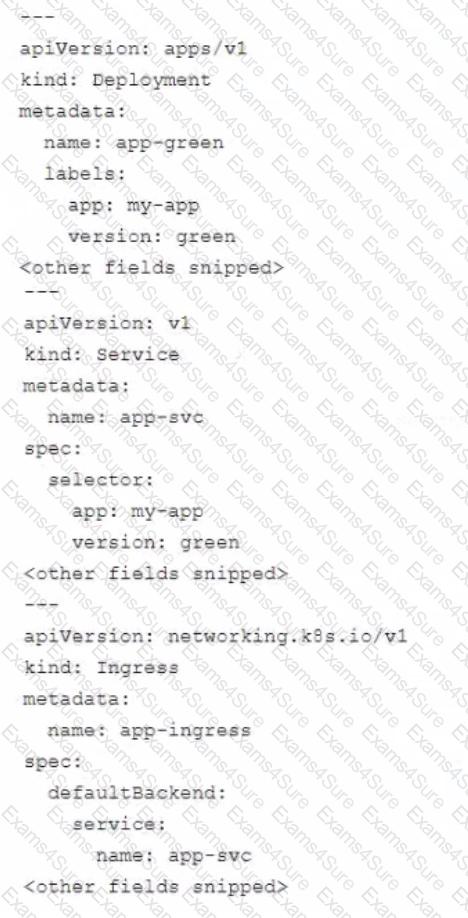
You manage an application that runs in Google Kubernetes Engine (GKE) and uses the blue/green deployment methodology Extracts of the Kubernetes manifests are shown below:
Question # 35

The Deployment app-green was updated to use the new version of the application During post-deployment monitoring you notice that the majority of user requests are failing You did not observe this behavior in the testing environment You need to mitigate the incident impact on users and enable the developers to troubleshoot the issue What should you do?

Options:

A.  

Update the Deployment app-blue to use the new version of the application

B.  

Update the Deployment ape-green to use the previous version of the application

C.  

Change the selector on the Service app-2vc to app: my-app.

D.  

Change the selector on the Service app-svc to app: my-app, version: blue

Discussion 0
Question # 36

Your company runs services on Google Cloud. Each team runs their applications in a dedicated project. New teams and projects are created regularly. Your security team requires that all logs are processed by a security information and event management (SIEM) system. The SIEM ingests logs by using Pub/Sub. You must ensure that all existing and future logs are scanned by the SIEM. What should you do?

Options:

A.  

Create an organization-level aggregated sink with a SIEM Pub/Sub topic as the destination. Set an inclusion filter to include all logs.

B.  

Create a project-level logging sink with a SIEM Pub/Sub topic as the destination. Set an inclusion filter to include all logs. Repeat for each project.

C.  

Create an organization-level aggregated sink with a SIEM log bucket as the destination. Set an inclusion filter to include all logs.

D.  

Create a folder-level aggregated sink with a SIEM Pub/Sub topic as the destination. Set an inclusion filter to include all logs. Repeat for each folder.

Discussion 0
Question # 37

You are designing a deployment technique for your applications on Google Cloud. As part Of your deployment planning, you want to use live traffic to gather performance metrics for new versions Ofyour applications. You need to test against the full production load before your applications are launched. What should you do?

Options:

A.  

Use A/B testing with blue/green deployment.

B.  

Use shadow testing with continuous deployment.

C.  

Use canary testing with continuous deployment.

D.  

Use canary testing with rolling updates deployment,

Discussion 0
Question # 38

You need to introduce postmortems into your organization during the holiday shopping season. You are expecting your web application to receive a large volume of traffic in a short period. You need to prepare your application for potential failures during the event What should you do?

Choose 2 answers

Options:

A.  

Monitor latency of your services for average percentile latency.

B.  

Review your increased capacity requirements and plan for the required quota management.

C.  

Create alerts in Cloud Monitoring for all common failures that your application experiences.

D.  

Ensure that relevant system metrics are being captured with Cloud Monitoring and create alerts at levels of interest.

E.  

Configure Anthos Service Mesh on the application to identify issues on the topology map.

Discussion 0
Question # 39

You deploy a new release of an internal application during a weekend maintenance window when there is minimal user traffic. After the window ends, you learn that one of the new features isn't working as expected in the production environment. After an extended outage, you roll back the new release and deploy a fix. You want to modify your release process to reduce the mean time to recovery so you can avoid extended outages in the future. What should you do?

Choose 2 answers

Options:

A.  

Before merging new code, require 2 different peers to review the code changes.

B.  

Adopt the blue/green deployment strategy when releasing new code via a CD server.

C.  

Integrate a code linting tool to validate coding standards before any code is accepted into the repository.

D.  

Require developers to run automated integration tests on their local development environments before release.

E.  

Configure a CI server.Add a suite of unit tests to your code and have your CI server run them on commit and verify any changes.

Discussion 0
Question # 40

You need to enforce several constraint templates across your Google Kubernetes Engine (GKE) clusters. The constraints include policy parameters, such as restricting the Kubernetes API. You must ensure that the policy parameters are stored in a GitHub repository and automatically applied when changes occur. What should you do?  

Options:

A.  

Set up a GitHub action to trigger Cloud Build when there is a parameter change. In Cloud Build, run a gcloud CLI command to apply the change.

B.  

When there is a change in GitHub, use a webhook to send a request to Cloud Service Mesh, and apply the change.

C.  

Configure Config Sync with the GitHub repository. When there is a change in the repository, use Config Sync to apply the change.

D.  

Configure Config Connector with the GitHub repository. When there is a change in the repository, use Config Connector to apply the change.

Discussion 0
Get Professional-Cloud-DevOps-Engineer dumps and pass your exam in 24 hours!

Free Exams Sample Questions