
Spring Sale Limited Time 65% Discount Offer - Ends in 0d 00h 00m 00s - Coupon code: 65pass65

Professional-Machine-Learning-Engineer Google Professional Machine Learning Engineer is now Stable and With Pass Result | Test Your Knowledge for Free

Exams4sure Dumps

Professional-Machine-Learning-Engineer Practice Questions

Google Professional Machine Learning Engineer

Last Update 3 days ago
Total Questions : 296

Dive into our fully updated and stable Professional-Machine-Learning-Engineer practice test platform, featuring all the latest Machine Learning Engineer exam questions added this week. Our preparation tool is more than just a Google study aid; it's a strategic advantage.

Our free Machine Learning Engineer practice questions crafted to reflect the domains and difficulty of the actual exam. The detailed rationales explain the 'why' behind each answer, reinforcing key concepts about Professional-Machine-Learning-Engineer. Use this test to pinpoint which areas you need to focus your study on.

Professional-Machine-Learning-Engineer PDF

Professional-Machine-Learning-Engineer PDF (Printable)
$43.75
$124.99

Professional-Machine-Learning-Engineer Testing Engine

Professional-Machine-Learning-Engineer PDF (Printable)
$50.75
$144.99

Professional-Machine-Learning-Engineer PDF + Testing Engine

Professional-Machine-Learning-Engineer PDF (Printable)
$63.7
$181.99
Question # 21

You are collaborating on a model prototype with your team. You need to create a Vertex Al Workbench environment for the members of your team and also limit access to other employees in your project. What should you do?

Options:

A.  

1. Create a new service account and grant it the Notebook Viewer role.

2 Grant the Service Account User role to each team member on the service account.

3 Grant the Vertex Al User role to each team member.

4. Provision a Vertex Al Workbench user-managed notebook instance that uses the new service account.

B.  

1. Grant the Vertex Al User role to the default Compute Engine service account.

2. Grant the Service Account User role to each team member on the default Compute Engine service account.

3. Provision a Vertex Al Workbench user-managed notebook instance that uses the default Compute Engine service account.

C.  

1 Create a new service account and grant it the Vertex Al User role.

2 Grant the Service Account User role to each team member on the service account.

3. Grant the Notebook Viewer role to each team member.

4 Provision a Vertex Al Workbench user-managed notebook instance that uses the new service account.

D.  

1 Grant the Vertex Al User role to the primary team member.

2. Grant the Notebook Viewer role to the other team members.

3. Provision a Vertex Al Workbench user-managed notebook instance that uses the primary user’s account.

Discussion 0
Question # 22

Your team trained and tested a DNN regression model with good results. Six months after deployment, the model is performing poorly due to a change in the distribution of the input data. How should you address the input differences in production?

Options:

A.  

Create alerts to monitor for skew, and retrain the model.

B.  

Perform feature selection on the model, and retrain the model with fewer features

C.  

Retrain the model, and select an L2 regularization parameter with a hyperparameter tuning service

D.  

Perform feature selection on the model, and retrain the model on a monthly basis with fewer features

Discussion 0
Question # 23

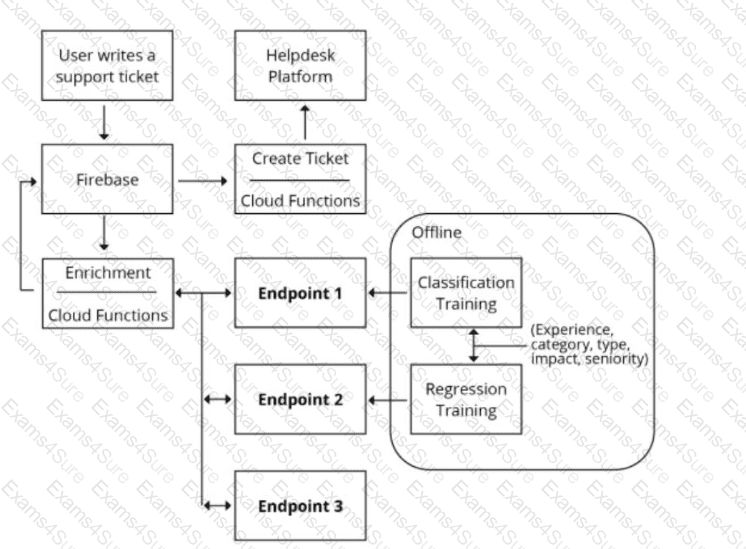
You are designing an architecture with a serverless ML system to enrich customer support tickets with informative metadata before they are routed to a support agent. You need a set of models to predict ticket priority, predict ticket resolution time, and perform sentiment analysis to help agents make strategic decisions when they process support requests. Tickets are not expected to have any domain-specific terms or jargon.

The proposed architecture has the following flow:
Question # 23

Which endpoints should the Enrichment Cloud Functions call?

Options:

A.  

1 = Vertex Al. 2 = Vertex Al. 3 = AutoML Natural Language

B.  

1 = Vertex Al. 2 = Vertex Al. 3 = Cloud Natural Language API

C.  

1 = Vertex Al. 2 = Vertex Al. 3 = AutoML Vision

D.  

1 = Cloud Natural Language API. 2 = Vertex Al, 3 = Cloud Vision API

Discussion 0
Question # 24

You work at a bank. You need to develop a credit risk model to support loan application decisions You decide to implement the model by using a neural network in TensorFlow Due to regulatory requirements, you need to be able to explain the models predictions based on its features When the model is deployed, you also want to monitor the model ' s performance overtime You decided to use Vertex Al for both model development and deployment What should you do?

Options:

A.  

Use Vertex Explainable Al with the sampled Shapley method, and enable Vertex Al Model Monitoring to

check for feature distribution drift.

B.  

Use Vertex Explainable Al with the sampled Shapley method, and enable Vertex Al Model Monitoring to

check for feature distribution skew.

C.  

Use Vertex Explainable Al with the XRAI method, and enable Vertex Al Model Monitoring to check for feature distribution drift.

D.  

Use Vertex Explainable Al with the XRAI method and enable Vertex Al Model Monitoring to check for feature distribution skew.

Discussion 0
Question # 25

You work for an online publisher that delivers news articles to over 50 million readers. You have built an AI model that recommends content for the company’s weekly newsletter. A recommendation is considered successful if the article is opened within two days of the newsletter’s published date and the user remains on the page for at least one minute.

All the information needed to compute the success metric is available in BigQuery and is updated hourly. The model is trained on eight weeks of data, on average its performance degrades below the acceptable baseline after five weeks, and training time is 12 hours. You want to ensure that the model’s performance is above the acceptable baseline while minimizing cost. How should you monitor the model to determine when retraining is necessary?

Options:

A.  

Use Vertex AI Model Monitoring to detect skew of the input features with a sample rate of 100% and a monitoring frequency of two days.

B.  

Schedule a cron job in Cloud Tasks to retrain the model every week before the newsletter is created.

C.  

Schedule a weekly query in BigQuery to compute the success metric.

D.  

Schedule a daily Dataflow job in Cloud Composer to compute the success metric.

Discussion 0
Question # 26

You built a custom Vertex AI pipeline job that preprocesses images and trains an object detection model. The pipeline currently uses 1 n1-standard-8 machine with 1 NVIDIA Tesla V100 GPU. You want to reduce the model training time without compromising model accuracy. What should you do?

Options:

A.  

Reduce the number of layers in your object detection model.

B.  

Train the same model on a stratified subset of your dataset.

C.  

Update the WorkerPoolSpec to use a machine with 24 vCPUs and 1 NVIDIA Tesla V100 GPU.

D.  

Update the WorkerPoolSpec to use a machine with 24 vCPUs and 3 NVIDIA Tesla V100 GPUs.

Discussion 0
Question # 27

Your company stores a large number of audio files of phone calls made to your customer call center in an on-premises database. Each audio file is in wav format and is approximately 5 minutes long. You need to analyze these audio files for customer sentiment. You plan to use the Speech-to-Text API. You want to use the most efficient approach. What should you do?

Options:

A.  

1 Upload the audio files to Cloud Storage

2. Call the speech: Iongrunningrecognize API endpoint to generate transcriptions

3. Call the predict method of an AutoML sentiment analysis model to analyze the transcriptions

B.  

1 Upload the audio files to Cloud Storage

2 Call the speech: Iongrunningrecognize API endpoint to generate transcriptions.

3 Create a Cloud Function that calls the Natural Language API by using the analyzesentiment method

C.  

1 Iterate over your local Tiles in Python

2. Use the Speech-to-Text Python library to create a speech.RecognitionAudio object and set the content to the audio file data

3. Call the speech: recognize API endpoint to generate transcriptions

4. Call the predict method of an AutoML sentiment analysis model to analyze the transcriptions

D.  

1 Iterate over your local files in Python

2 Use the Speech-to-Text Python Library to create a speech.RecognitionAudio object, and set the content to the audio file data

3. Call the speech: lengrunningrecognize API endpoint to generate transcriptions

4 Call the Natural Language API by using the analyzesenriment method

Discussion 0
Question # 28

You have trained a deep neural network model on Google Cloud. The model has low loss on the training data, but is performing worse on the validation data. You want the model to be resilient to overfitting. Which strategy should you use when retraining the model?

Options:

A.  

Apply a dropout parameter of 0 2, and decrease the learning rate by a factor of 10

B.  

Apply a L2 regularization parameter of 0.4, and decrease the learning rate by a factor of 10.

C.  

Run a hyperparameter tuning job on Al Platform to optimize for the L2 regularization and dropout parameters

D.  

Run a hyperparameter tuning job on Al Platform to optimize for the learning rate, and increase the number of neurons by a factor of 2.

Discussion 0
Question # 29

You are investigating the root cause of a misclassification error made by one of your models. You used Vertex Al Pipelines to tram and deploy the model. The pipeline reads data from BigQuery. creates a copy of the data in Cloud Storage in TFRecord format trains the model in Vertex Al Training on that copy, and deploys the model to a Vertex Al endpoint. You have identified the specific version of that model that misclassified: and you need to recover the data this model was trained on. How should you find that copy of the data ' ?

Options:

A.  

Use Vertex Al Feature Store Modify the pipeline to use the feature store; and ensure that all training data is stored in it Search the feature store for the data used for the training.

B.  

Use the lineage feature of Vertex Al Metadata to find the model artifact Determine the version of the model and identify the step that creates the data copy, and search in the metadata for its location.

C.  

Use the logging features in the Vertex Al endpoint to determine the timestamp of the models deployment Find the pipeline run at that timestamp Identify the step that creates the data copy; and search in the logs for its location.

D.  

Find the job ID in Vertex Al Training corresponding to the training for the model Search in the logs of that job for the data used for the training.

Discussion 0
Question # 30

You have a functioning end-to-end ML pipeline that involves tuning the hyperparameters of your ML model using Al Platform, and then using the best-tuned parameters for training. Hypertuning is taking longer than expected and is delaying the downstream processes. You want to speed up the tuning job without significantly compromising its effectiveness. Which actions should you take?

Choose 2 answers

Options:

A.  

Decrease the number of parallel trials

B.  

Decrease the range of floating-point values

C.  

Set the early stopping parameter to TRUE

D.  

Change the search algorithm from Bayesian search to random search.

E.  

Decrease the maximum number of trials during subsequent training phases.

Discussion 0
Get Professional-Machine-Learning-Engineer dumps and pass your exam in 24 hours!

Free Exams Sample Questions


