Pre-Summer Sale Limited Time 65% Discount Offer - Ends in 0d 00h 00m 00s - Coupon code: 65pass65

300-215 Conducting Forensic Analysis and Incident Response Using Cisco CyberOps Technologies (CBRFIR) is now Stable and With Pass Result | Test Your Knowledge for Free

Exams4sure Dumps

300-215 Practice Questions

Conducting Forensic Analysis and Incident Response Using Cisco CyberOps Technologies (CBRFIR)

Last Update 4 hours ago
Total Questions : 131

Dive into our fully updated and stable 300-215 practice test platform, featuring all the latest CyberOps Professional exam questions added this week. Our preparation tool is more than just a Cisco study aid; it's a strategic advantage.

Our free CyberOps Professional practice questions crafted to reflect the domains and difficulty of the actual exam. The detailed rationales explain the 'why' behind each answer, reinforcing key concepts about 300-215. Use this test to pinpoint which areas you need to focus your study on.

300-215 PDF

300-215 PDF (Printable)
$48.3
$137.99

300-215 Testing Engine

300-215 PDF (Printable)
$52.5
$149.99

300-215 PDF + Testing Engine

300-215 PDF (Printable)
$65.45
$186.99
Question # 11

An engineer received a report of a suspicious email from an employee. The employee had already opened the attachment, which was an empty Word document. The engineer cannot identify any clear signs of compromise but while reviewing running processes, observes that PowerShell.exe was spawned by cmd.exe with a grandparent winword.exe process. What is the recommended action the engineer should take?

Options:

A.  

Upload the file signature to threat intelligence tools to determine if the file is malicious.

B.  

Monitor processes as this is standard behavior of Word macro embedded documents.

C.  

Contain the threat for further analysis as this is an indication of suspicious activity.

D.  

Investigate the sender of the email and communicate with the employee to determine the motives.

Discussion 0
Question # 12

An engineer is investigating a ticket from the accounting department in which a user discovered an unexpected application on their workstation. Several alerts are seen from the intrusion detection system of unknown outgoing internet traffic from this workstation. The engineer also notices a degraded processing capability, which complicates the analysis process. Which two actions should the engineer take? (Choose two.)

Options:

A.  

Restore to a system recovery point.

B.  

Replace the faulty CPU.

C.  

Disconnect from the network.

D.  

Format the workstation drives.

E.  

Take an image of the workstation.

Discussion 0
Question # 13

Refer to the exhibit.

Question # 13

What is occurring within the exhibit?

Options:

A.  

Source 10.1.21.101 sends HTTP requests with the size of 302 kb.

B.  

Host 209.141.51.196 redirects the client request from /Lk9tdZ to /files/1.bin.

C.  

Host 209.141.51.196 redirects the client request to port 49723.

D.  

Source 10.1.21.101 is communicating with 209.141.51.196 over an encrypted channel.

Discussion 0
Question # 14

Which tool is used for reverse engineering malware?

Options:

A.  

Ghidra

B.  

SNORT

C.  

Wireshark

D.  

NMAP

Discussion 0
Question # 15

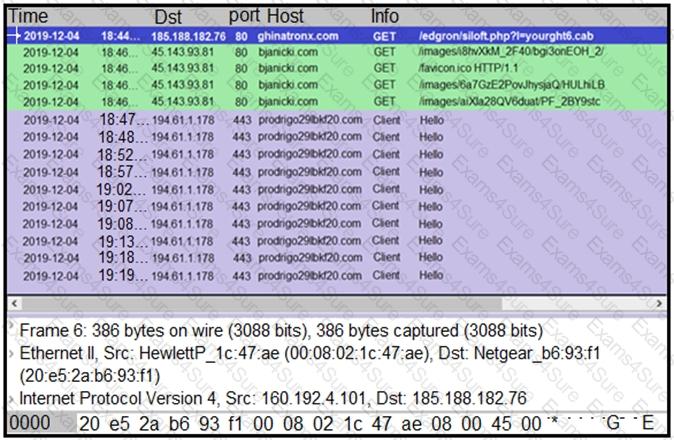
Refer to the exhibit.

Question # 15

A network engineer is analyzing a Wireshark file to determine the HTTP request that caused the initial Ursnif banking Trojan binary to download. Which filter did the engineer apply to sort the Wireshark traffic logs?

Options:

A.  

http.request.un matches

B.  

tls.handshake.type ==1

C.  

tcp.port eq 25

D.  

tcp.window_size ==0

Discussion 0
Question # 16

Which magic byte indicates that an analyzed file is a pdf file?

Options:

A.  

cGRmZmlsZQ

B.  

706466666

C.  

255044462d

D.  

0a0ah4cg

Discussion 0
Question # 17

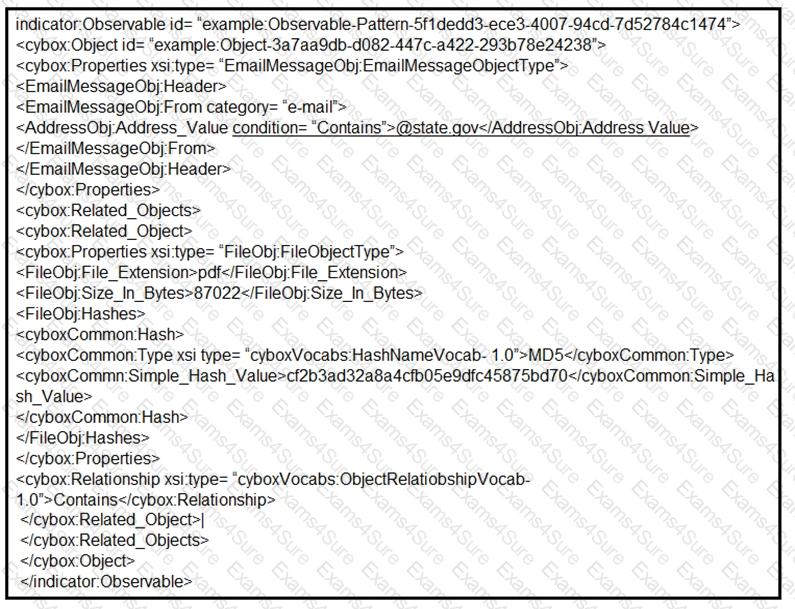
Refer to the exhibit.

Question # 17

Which two actions should be taken as a result of this information? (Choose two.)

Options:

A.  

Update the AV to block any file with hash “cf2b3ad32a8a4cfb05e9dfc45875bd70”.

B.  

Block all emails sent from an @state.gov address.

C.  

Block all emails with pdf attachments.

D.  

Block emails sent from Admin@state.net with an attached pdf file with md5 hash “cf2b3ad32a8a4cfb05e9dfc45875bd70”.

E.  

Block all emails with subject containing “cf2b3ad32a8a4cfb05e9dfc45875bd70”.

Discussion 0
Question # 18

An employee receives an email from a “trusted” person containing a hyperlink that is malvertising. The employee clicks the link and the malware downloads. An information analyst observes an alert at the SIEM and engages the cybersecurity team to conduct an analysis of this incident in accordance with the incident response plan. Which event detail should be included in this root cause analysis?
Options:

A.  

phishing email sent to the victim

B.  

alarm raised by the SIEM

C.  

information from the email header

D.  

alert identified by the cybersecurity team

Discussion 0
Question # 19

What is the transmogrify anti-forensics technique?

Options:

A.  

hiding a section of a malicious file in unused areas of a file

B.  

sending malicious files over a public network by encapsulation

C.  

concealing malicious files in ordinary or unsuspecting places

D.  

changing the file header of a malicious file to another file type

Discussion 0
Question # 20

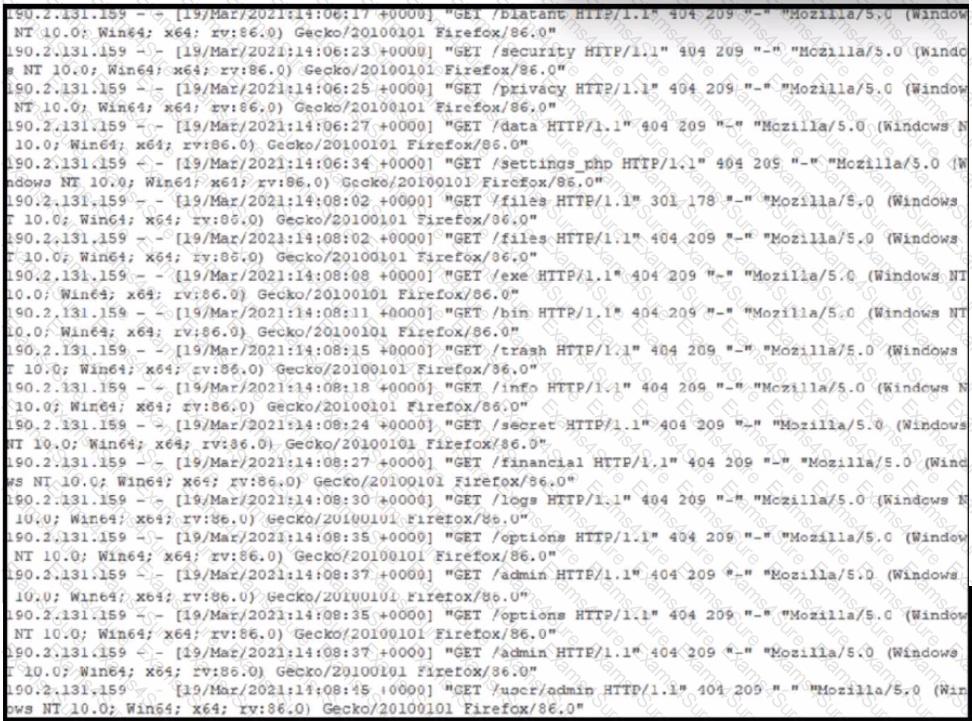
Question # 20

Refer to the exhibit. A security analyst notices that a web application running on NGINX is generating an unusual number of log messages. The application is operational and reachable. What is the cause of this activity?


Options:

A.  

botnet infection

B.  

directory fuzzing

C.  

DDoS attack

D.  

SQL injection

Discussion 0
Get 300-215 dumps and pass your exam in 24 hours!

Free Exams Sample Questions